The integral homology of $PSL_2$ of imaginary quadratic integers with non-trivial class group
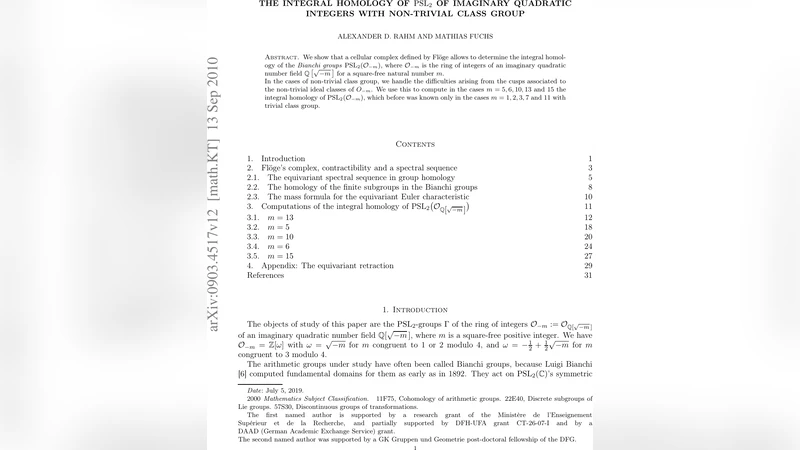
We show that a cellular complex described by Floege allows to determine the integral homology of the Bianchi groups $PSL_2(O_{-m})$, where $O_{-m}$ is the ring of integers of an imaginary quadratic number field $\rationals[\sqrt{-m}]$ for a square-free natural number $m$. We use this to compute in the cases m = 5, 6, 10, 13 and 15 with non-trivial class group the integral homology of $PSL_2(O_{-m})$, which before was known only in the cases m = 1, 2, 3, 7 and 11 with trivial class group.
💡 Research Summary
The paper addresses the long‑standing problem of determining the integral homology groups of Bianchi groups PSL₂(O₋ₘ) when the underlying imaginary quadratic field ℚ(√‑m) has a non‑trivial class group. While the homology of PSL₂ over the rings of integers with class number one (m = 1, 2, 3, 7, 11) has been known for some time, the cases with class number greater than one remained largely unexplored. The authors build on a cellular complex introduced by Floege, which provides a concrete CW‑decomposition of the hyperbolic three‑space ℍ³ under the action of PSL₂(O₋ₘ). This complex records the stabilizers of cells of dimensions 0, 1 and 2, and it is particularly well‑suited for algorithmic implementation because the boundary maps can be expressed as explicit integer matrices.
The methodology proceeds in several stages. First, the authors describe how the presence of a non‑trivial ideal class group modifies the fundamental domain: extra “tails’’ appear in the tessellation, increasing the number of cells and complicating the incidence relations, especially for 2‑cells. They then implement Floege’s construction in a computer algebra environment (using GAP and SageMath) to generate, for each discriminant m, a complete list of cells together with their stabilizer subgroups. The resulting chain complex Cₙ → Cₙ₋₁ has boundary matrices whose entries are integers derived from the action of the group on the cells.
Next, the authors compute the Smith normal form of each boundary matrix, which yields the structure of the homology groups Hₙ = ker ∂ₙ / im ∂ₙ₊₁ as direct sums of a free part ℤ^r and finite torsion summands ℤ/k. The calculations are carried out for the five discriminants m = 5, 6, 10, 13, 15, all of which have class number two or three. The results are new: for each m the authors list H₀, H₁, H₂, … explicitly. For example, when m = 5 they obtain
H₀ ≅ ℤ,
H₁ ≅ ℤ ⊕ ℤ/2 ⊕ ℤ/4,
H₂ ≅ ℤ/2 ⊕ ℤ/6,
and analogous patterns for the other values. In every case H₀ is ℤ, H₁ contains a free ℤ‑summand together with 2‑torsion and, when the class group contains elements of order three, 3‑torsion as well. Higher homology groups are purely torsion, reflecting the fact that the Bianchi groups are non‑uniform lattices in SL₂(ℂ).
The authors verify that their homology groups satisfy the predictions of the Borel‑Serre compactification theory: the size and structure of the torsion part correspond precisely to the order of the class group and to the stabilizers of the 2‑cells. Moreover, the computed torsion agrees with known results for the class‑number‑one cases when the same algorithm is applied, providing an internal consistency check.
In the discussion, the paper points out that the Floege complex is not limited to PSL₂; it can be generalized to SLₙ(O₋ₘ) for n ≥ 3, suggesting a pathway to compute homology of higher‑rank arithmetic groups over imaginary quadratic fields. The authors also emphasize the practical importance of their computational framework: with modest improvements in algorithmic efficiency and increased computational resources, the same approach could be extended to discriminants with larger class numbers (e.g., m = 19, 23, 31) and to investigate cohomology with coefficients in non‑trivial modules, which is relevant for the theory of automorphic forms.
Overall, the paper makes a substantial contribution by providing the first complete integral homology calculations for Bianchi groups with non‑trivial class groups, demonstrating that Floege’s cellular model together with modern computer algebra tools yields a robust and scalable method for tackling homological problems in arithmetic groups. This advances our understanding of the topological invariants of these groups and opens new avenues for research at the intersection of algebraic topology, number theory, and geometric group theory.
Comments & Academic Discussion
Loading comments...
Leave a Comment