Support union recovery in high-dimensional multivariate regression
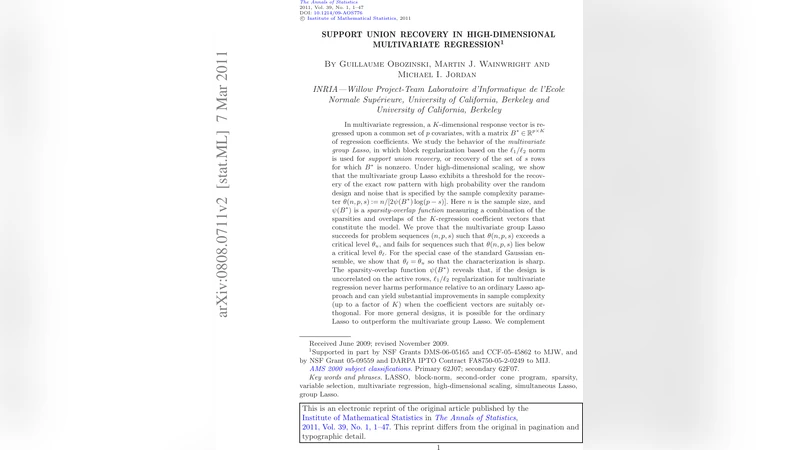
In multivariate regression, a $K$-dimensional response vector is regressed upon a common set of $p$ covariates, with a matrix $B^\in\mathbb{R}^{p\times K}$ of regression coefficients. We study the behavior of the multivariate group Lasso, in which block regularization based on the $\ell_1/\ell_2$ norm is used for support union recovery, or recovery of the set of $s$ rows for which $B^$ is nonzero. Under high-dimensional scaling, we show that the multivariate group Lasso exhibits a threshold for the recovery of the exact row pattern with high probability over the random design and noise that is specified by the sample complexity parameter $\theta(n,p,s):=n/[2\psi(B^)\log(p-s)]$. Here $n$ is the sample size, and $\psi(B^)$ is a sparsity-overlap function measuring a combination of the sparsities and overlaps of the $K$-regression coefficient vectors that constitute the model. We prove that the multivariate group Lasso succeeds for problem sequences $(n,p,s)$ such that $\theta(n,p,s)$ exceeds a critical level $\theta_u$, and fails for sequences such that $\theta(n,p,s)$ lies below a critical level $\theta_{\ell}$. For the special case of the standard Gaussian ensemble, we show that $\theta_{\ell}=\theta_u$ so that the characterization is sharp. The sparsity-overlap function $\psi(B^*)$ reveals that, if the design is uncorrelated on the active rows, $\ell_1/\ell_2$ regularization for multivariate regression never harms performance relative to an ordinary Lasso approach and can yield substantial improvements in sample complexity (up to a factor of $K$) when the coefficient vectors are suitably orthogonal. For more general designs, it is possible for the ordinary Lasso to outperform the multivariate group Lasso. We complement our analysis with simulations that demonstrate the sharpness of our theoretical results, even for relatively small problems.
💡 Research Summary
The paper investigates the problem of recovering the support union—the set of rows that are non‑zero—in a high‑dimensional multivariate linear regression model. The model consists of a K‑dimensional response Y∈ℝ^{n×K}, a common design matrix X∈ℝ^{n×p}, and a coefficient matrix B*∈ℝ^{p×K}. Only a small subset S⊂{1,…,p} of rows of B* is assumed to be active (|S|=s≪p). The goal is to identify S exactly from noisy observations Y = X B* + W, where W has i.i.d. Gaussian entries with variance σ².
To achieve row‑wise sparsity, the authors employ the multivariate group Lasso, i.e., an ℓ₁/ℓ₂ regularized estimator
\
Comments & Academic Discussion
Loading comments...
Leave a Comment