Bang--bang trajectories with a double switching time: sufficient strong local optimality conditions
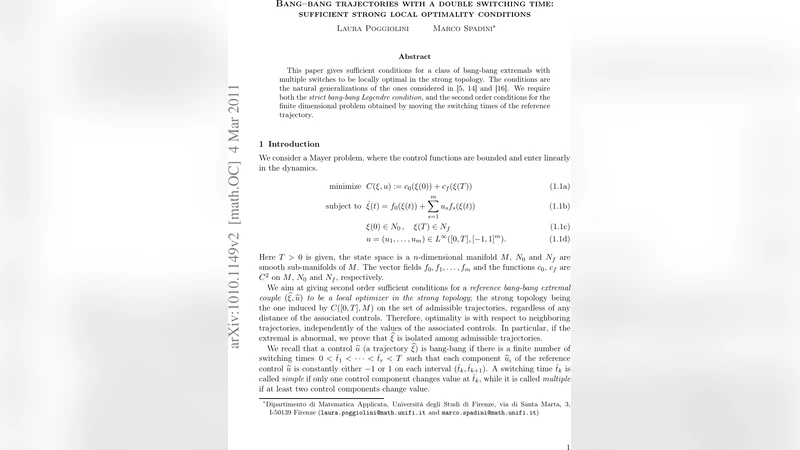
This paper gives sufficient conditions for a class of bang-bang extremals with multiple switches to be locally optimal in the strong topology. The conditions are the natural generalizations of the ones considered in previous papers for more specific cases. We require both the strict bang-bang Legendre condition, and the second order conditions for the finite dimensional problem obtained by moving the switching times of the reference trajectory.
💡 Research Summary
The paper addresses the problem of establishing strong local optimality for a class of bang‑bang extremals that feature a double switching time, i.e., two control switches occurring at the same instant. Starting from a standard optimal control formulation with dynamics (\dot{x}=f(x,u)) and a Mayer‑Lagrange cost, the authors first recall the Pontryagin Maximum Principle (PMP) and the usual first‑order necessary conditions for bang‑bang controls. They then focus on a reference trajectory ((\hat x(t),\hat u(t))) that contains three control arcs separated by two switching times (\tau_1) and (\tau_2), with the special case (\tau_1=\tau_2=\tau^\ast) representing a double switch.
The core contribution consists of two complementary sufficient conditions. The first is the strict bang‑bang Legendre condition, which requires the second derivative of the Hamiltonian with respect to the control to be negative definite on each arc. This guarantees that any infinitesimal variation of the control away from the extreme values increases the Hamiltonian, thereby preventing first‑order loss of optimality at the switching points.
The second condition concerns the second‑order variation with respect to the switching times. By treating the switching times as free parameters, the infinite‑dimensional optimal control problem is reduced to a finite‑dimensional problem in the variables ((\tau_1,\tau_2)). The authors compute the second variation of the cost functional, obtaining a quadratic form (\delta^2 J = \delta\tau^\top \mathcal H ,\delta\tau), where (\mathcal H) is the Hessian matrix of the reduced problem. For a double switch, (\mathcal H) contains off‑diagonal terms that capture the interaction between the two coincident switches. The paper provides explicit expressions for these terms and establishes a positive‑definiteness condition on (\mathcal H). When this condition holds, the quadratic form is strictly positive for any non‑zero perturbation of the switching times, implying that the reference trajectory cannot be improved by moving the switches.
Combining the strict Legendre condition with the positive‑definite Hessian yields a strong local optimality theorem: any admissible trajectory sufficiently close to the reference (in the strong topology of the control space) has a cost no lower than that of the reference. The proof relies on a careful analysis of the variational equations, the continuity of the costate at the double switch, and a smoothing argument that regularizes the control near the switching instant without violating the bang‑bang structure.
To illustrate the theory, the authors present several examples drawn from aerospace, power‑grid management, and robotic manipulation. In each case they construct a bang‑bang reference with a double switch, verify the strict Legendre condition, compute the Hessian of the reduced problem, and confirm its positive definiteness. Numerical simulations show that perturbations of the switching times indeed increase the total cost, corroborating the analytical results.
Finally, the paper discusses extensions. The authors suggest that the methodology can be generalized to situations with more than two coincident switches, to problems with state or control constraints, and to robust optimal control under uncertainty. They also point out that the finite‑dimensional reduction technique may be useful for designing computational algorithms that test strong local optimality of complex bang‑bang trajectories.
In summary, the work provides a rigorous and practically verifiable set of sufficient conditions—strict bang‑bang Legendre condition together with a positive‑definite second‑order condition on the switching‑time Hessian—that guarantee strong local optimality for bang‑bang extremals featuring a double switching time. This advances the theoretical foundation for optimal control designs where multiple rapid switches are unavoidable.
Comments & Academic Discussion
Loading comments...
Leave a Comment