Model Identification of a Network as Compressing Sensing
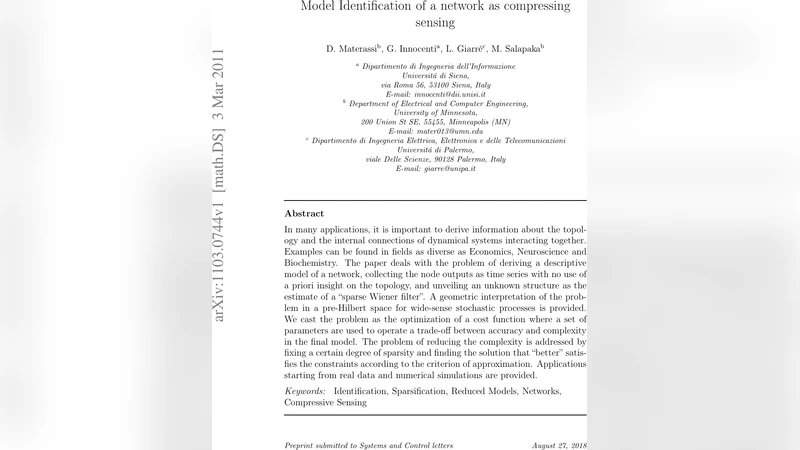
In many applications, it is important to derive information about the topology and the internal connections of dynamical systems interacting together. Examples can be found in fields as diverse as Economics, Neuroscience and Biochemistry. The paper deals with the problem of deriving a descriptive model of a network, collecting the node outputs as time series with no use of a priori insight on the topology, and unveiling an unknown structure as the estimate of a “sparse Wiener filter”. A geometric interpretation of the problem in a pre-Hilbert space for wide-sense stochastic processes is provided. We cast the problem as the optimization of a cost function where a set of parameters are used to operate a trade-off between accuracy and complexity in the final model. The problem of reducing the complexity is addressed by fixing a certain degree of sparsity and finding the solution that “better” satisfies the constraints according to the criterion of approximation. Applications starting from real data and numerical simulations are provided.
💡 Research Summary
The paper tackles the challenging problem of reconstructing the topology of an unknown dynamical network solely from observed time‑series data, without any prior knowledge of the interconnections. The authors introduce a rigorous mathematical framework that treats each node’s output as a wide‑sense stationary stochastic process and embeds these processes into a pre‑Hilbert space defined by an inner product ⟨x, y⟩ = E
Comments & Academic Discussion
Loading comments...
Leave a Comment