Non-equilibrium self-assembly of a filament coupled to ATP/GTP hydrolysis
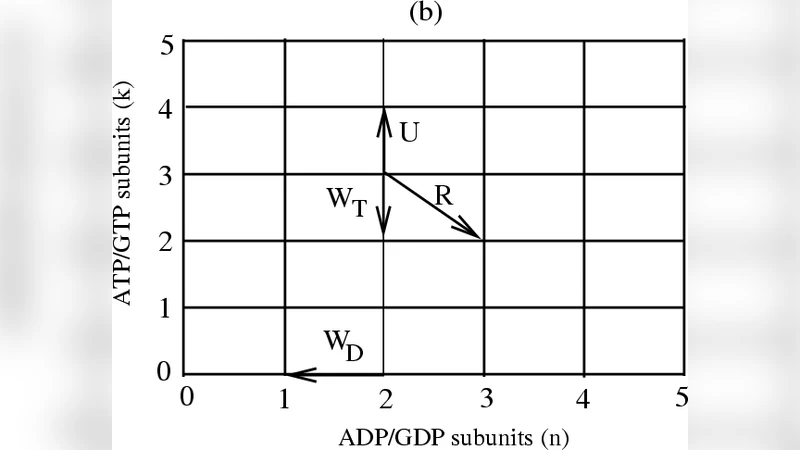
We study the stochastic dynamics of growth and shrinkage of single actin filaments or microtubules taking into account insertion, removal, and ATP/GTP hydrolysis of subunits. The resulting phase diagram contains three different phases: a rapidly growing phase, an intermediate phase and a bound phase. We analyze all these phases, with an emphasis on the bound phase. We also discuss how hydrolysis affects force-velocity curves. The bound phase shows features of dynamic instability, which we characterize in terms of the time needed for the ATP/GTP cap to disappear as well as the time needed for the filament to reach a length of zero, i.e., (to collapse) for the first time. We obtain exact expressions for all these quantities, which we test using Monte Carlo simulations.
💡 Research Summary
The paper presents a comprehensive stochastic model of the growth and shrinkage dynamics of single actin filaments or microtubules, explicitly incorporating three elementary processes: (i) addition of ATP‑ or GTP‑bound subunits at the filament tip, (ii) removal of subunits from the tip, and (iii) hydrolysis of the bound nucleotide within the filament. Each subunit can exist in a T‑state (ATP/GTP bound) or a D‑state (ADP/GDP bound). Polymerization occurs with a rate k_on c that is proportional to the concentration c of free monomers, while depolymerization rates differ for T‑ and D‑state tips (k_off^T and k_off^D respectively). Hydrolysis proceeds randomly along the filament with a constant rate r_h, converting T‑subunits into D‑subunits.
Using a one‑dimensional lattice representation, the authors write down master equations for the joint probability distribution of filament length and cap composition. By introducing generating functions they obtain exact stationary solutions and derive the mean growth velocity
v = k_on c – k_off^T P_T – k_off^D P_D,
where P_T (P_D) is the probability that the tip is in the T (D) state. The sign of v determines three distinct dynamical phases:
-
Rapid‑growth phase (v > 0). The filament length diverges linearly with time. The cap length reaches a finite steady‑state average set by the competition between polymerization and hydrolysis. The cap length distribution is exponential, a result confirmed by Monte‑Carlo simulations.
-
Intermediate phase (v ≈ 0, cap present). The average length is stationary, yet the cap persists most of the time. Small fluctuations occasionally cause brief shrinkage, but the cap quickly reforms, preventing catastrophic collapse. This regime corresponds to the treadmilling‑like behavior observed in actin bundles.
-
Bound (or “static”) phase (v = 0). The filament length is on average constant, but large stochastic excursions occur. The cap can disappear for extended periods, leading to episodes of rapid depolymerization (“catastrophe”) followed by possible rescue when a new T‑subunit is added.
The bound phase is the focus of the paper because it reproduces the hallmark of microtubule dynamic instability. The authors derive exact expressions for two first‑passage times:
- Cap‑loss time τ_cap, the mean time for the ATP/GTP cap to vanish. Analytically,
τ_cap = (k_off^D) /
Comments & Academic Discussion
Loading comments...
Leave a Comment