Managing and Querying Web Services Communities: A Survey
With the advance of Web Services technologies and the emergence of Web Services into the information space, tremendous opportunities for empowering users and organizations appear in various application domains including electronic commerce, travel, intelligence information gathering and analysis, health care, digital government, etc. However, the technology to organize, search, integrate these Web Services has not kept pace with the rapid growth of the available information space. The number of Web Services to be integrated may be large and continuously changing. To ease and improve the process of Web services discovery in an open environment like the Internet, it is suggested to gather similar Web services into groups known as communities. Although Web services are intensively investigated, the community management issues have not been addressed yet In this paper we draw an overview of several Web services Communities’ management approaches based on some currently existing communities platforms and frameworks. We also discuss different approaches for querying and selecting Web services under the umbrella of Web services communities’. We compare the current approaches among each others with respect to some key requirements.
💡 Research Summary
**
The paper “Managing and Querying Web Services Communities: A Survey” provides a comprehensive overview of the concept of Web Services Communities (WSCs) and evaluates existing approaches for their management and querying. The authors begin by motivating the need for a higher‑level abstraction that groups functionally similar Web services into “communities” in order to cope with the rapid growth and dynamic nature of the service ecosystem. By presenting a unified access point for a set of equivalent services, communities aim to simplify discovery, selection, and integration while allowing non‑functional attributes such as QoS, cost, and reliability to be handled at the community level rather than per‑service.
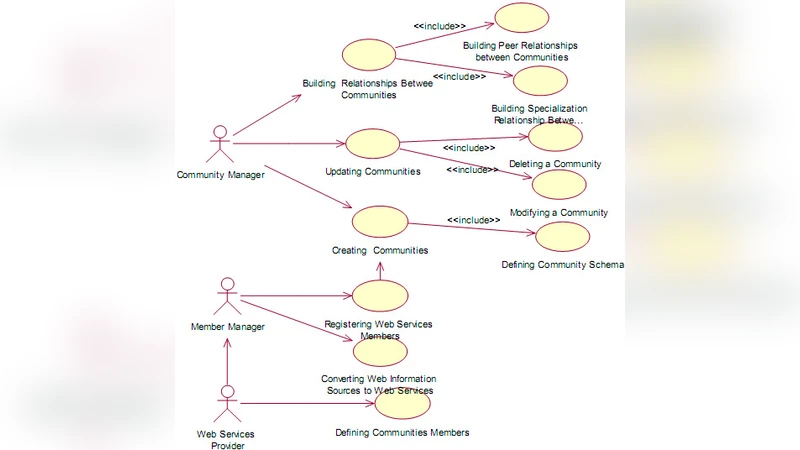
The paper first defines a community in both sociological terms (a group sharing a common space) and technical terms (a collection of Web services offering the same functionality but possibly differing in provider, QoS, or other non‑functional properties). It then derives a set of management requirements, illustrated with a UML use‑case diagram, which include: community creation, updating (addition, modification, deletion), deletion of empty communities, modification of members, establishing peer or specialization relationships between communities, registration of service providers, and conversion of non‑service web information into Web services. These requirements capture the need for dynamism, scalability, and the ability to model hierarchical or peer‑to‑peer relationships among communities.
The core of the survey examines four major frameworks that have been proposed to address these requirements:
-
SELF‑SERV – This framework distinguishes elementary, composite, and community services. Each service is wrapped to expose a uniform interface, and a service manager provides discovery, editing, and deployment capabilities. Composite services are described using state‑charts, and at runtime the community selects a member service based on the current state and QoS criteria. SELF‑SERV excels at clear service layering and dynamic selection but incurs overhead due to wrapper generation and state‑chart maintenance.
-
WS‑CatalogNet – Originating from the e‑catalog domain, WS‑CatalogNet treats catalogs as “communities” of products. It uses high‑level meta‑information and ontologies to describe desired products, supports peer relationships, and routes queries across communities. While its ontology‑driven approach offers strong semantic matching, the model is heavily catalog‑centric, requiring substantial ontology extensions to be applicable to generic Web services.
-
Web Service Community (WSC) – Subject‑Club Model – This approach introduces a hierarchical “subject‑club” ontology that separates common (shared) and private (service‑specific) aspects of services. A “leading service list” ranks members based on performance, enabling fast QoS‑driven selection. The model supports specialization relationships (e.g., Hospital as a sub‑community of Medical Institutions). Its strength lies in fine‑grained semantic distinction, yet the management of the dual ontologies and the ranking algorithm adds considerable complexity.
-
Master‑Slave Architecture with Context‑Based Semantic Mediation – Here a master Web service acts as the community façade, broadcasting a “call for bid” to slave services, collecting proposals, and selecting the best candidate based on QoS, cost, fairness, etc. A mediation module performs context‑aware semantic translation between the master’s request format and each slave’s specific ontology. This design achieves high interoperability across heterogeneous domains, but the mediation layer becomes a performance bottleneck and demands careful ontology alignment.
The authors compare these frameworks against the previously identified management requirements, focusing on dimensions such as dynamism (ability to add/remove services at runtime), scalability (handling large numbers of members), QoS support (explicit selection criteria), ontology dependence (extent of semantic modeling), and implementation complexity. SELF‑SERV and the master‑slave model score highest on dynamism and QoS handling, whereas WS‑CatalogNet and the subject‑club model provide richer semantic capabilities but at the cost of higher overhead.
In the querying section, the paper discusses how a community receives a user request at its single endpoint, forwards it to an appropriate member, and returns the response. Different approaches adopt various selection strategies: state‑chart conditions (SELF‑SERV), ontology‑based matching (WS‑CatalogNet), performance‑driven ranking (subject‑club), and QoS‑weighted bidding (master‑slave). The survey highlights that effective querying hinges on both accurate semantic description of services and robust runtime selection mechanisms.
The conclusion emphasizes that Web Services Communities represent a promising meta‑level abstraction for managing the ever‑expanding service landscape. However, challenges remain in automated ontology generation, dynamic QoS prediction, and trust management. The authors suggest future research directions such as machine‑learning‑driven QoS forecasting, lightweight semantic mediation, and blockchain‑based provenance to enhance reliability and automation.
Overall, the paper offers a valuable taxonomy of community management techniques, clarifies the trade‑offs among existing solutions, and sets a clear agenda for advancing the state of the art in Web Services Community management and querying.
Comments & Academic Discussion
Loading comments...
Leave a Comment