Minimum multicuts and Steiner forests for Okamura-Seymour graphs
We study the problem of finding minimum multicuts for an undirected planar graph, where all the terminal vertices are on the boundary of the outer face. This is known as an Okamura-Seymour instance. We show that for such an instance, the minimum mult…
Authors: Arindam Pal
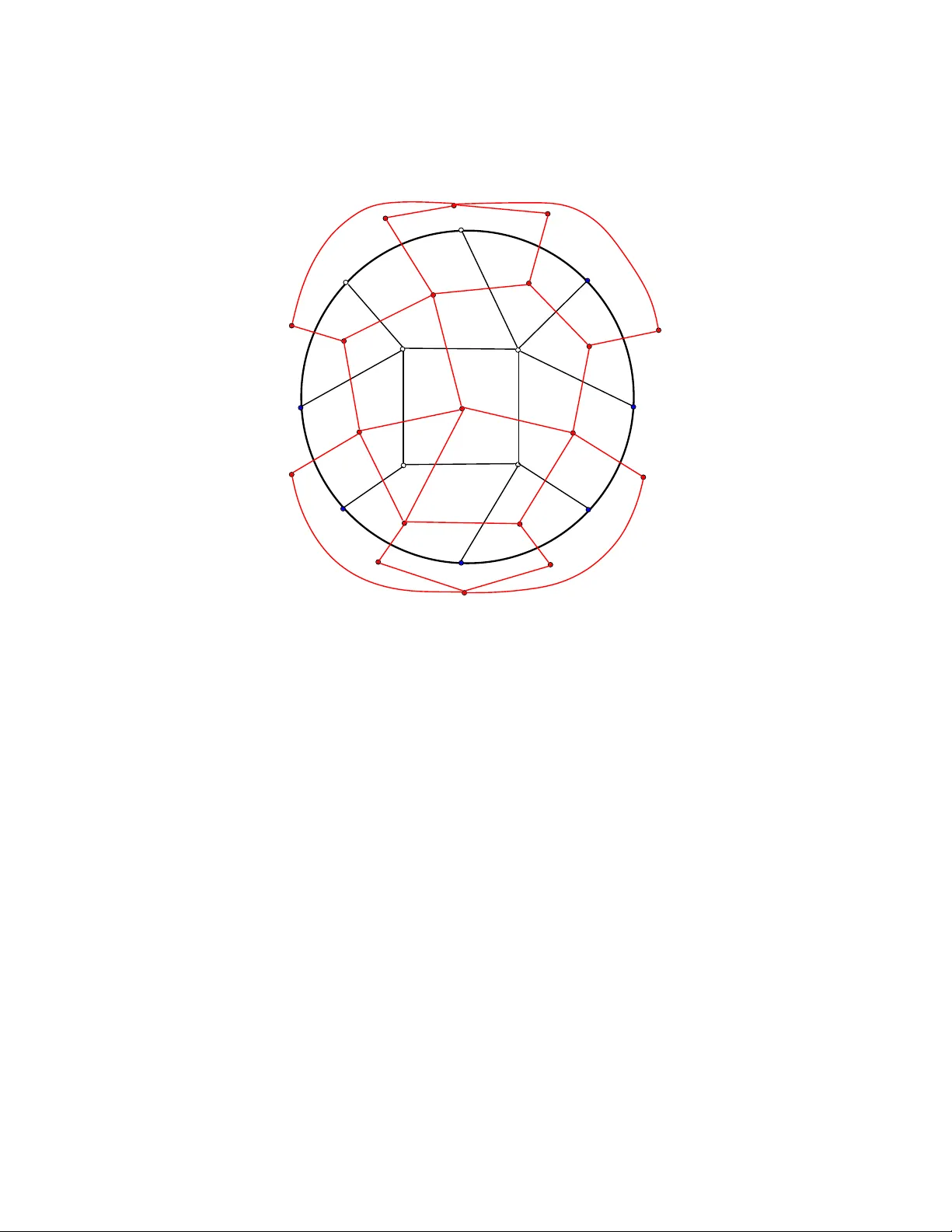
Minimum mul ticuts and Steiner f orests f or Okamura-Seymour graphs Arindam P al Departmen t of Computer Science and Engineering Indian Institute of T echnology , Delhi New Delhi – 110016, India arindamp@cse.iitd.ernet.in F ebruary 27, 2011 Abstract W e study the problem of finding minimum multicuts for an undirected planar gr aph , where all the terminal vertices are on the b oundary of the outer face. This is known as an Okamur a-Seymour instanc e . W e sho w that for suc h an instance, the minimum multicut problem can b e reduced to the minimum-c ost Steiner forest problem on a suitably defined dual gr aph . The minimum-cost Steiner forest problem has a 2-appro ximation algorithm. Hence, the minimum multicut problem has a 2-approximation algorithm for an Ok am ura-Seymour instance. 1 In tro duction Computing the minimum multicut of a graph is an important problem in com- binatorial optimization. The problem is formally defined b elo w. Minimum Mul ticut: Given an undirected graph G = ( V , E ) on n vertices and m edges with edge costs c e and a set T = { ( s 1 , t 1 ) , . . . , ( s k , t k ) } of k termi- nal pairs. Our goal is to find a set of edges F of minim um cost separating all the terminal pairs ( s i , t i ) , 1 ≤ i ≤ k , i.e. , in the subgraph H = ( V , E \ F ), there is no path b et w een s i and t i , for 1 ≤ i ≤ k . The minimum multicut problem is NP-hard and APX-hard , ev en for trees, whic h excludes the p ossibilit y of a PT AS. Garg, V azirani and Y annak akis gav e a 2-approximation algorithm for trees [ Garg et al. , 1997 ] and an O (log k )- appro ximation algorithm for general undirected graphs [ Garg et al. , 1996 ]. When G is planar and all the terminals are on the b oundary of the outer face of G , 1 w e denote suc h an instance of the minimum multicut problem an Okamur a- Seymour instance. The problem of finding edge-disjoint paths on such type of graphs were studied by Ok amura and Seymour [ Ok amura and Seymour , 1981 ]. They show ed the following imp ortan t theorem ( d F ( S ) denotes the num b er of edges in F exactly one of whose endp oin ts is in S ). Theorem 1 ( Okamura-Seymour ) . L et G = ( V , E ) b e an undir e cte d planar gr aph and let R = { ( s i , t i ) : s i , t i ∈ V , 1 ≤ i ≤ k } b e a set of terminal p airs. Supp ose the fol lowing c onditions ar e satisfie d. 1. A l l terminals ar e on the b oundary of the outer fac e of G . 2. The Euler c ondition is satisfie d: ( V , E ∪ R ) is Eulerian. 3. The cut c ondition is satisfie d: d E ( S ) ≥ d R ( S ) , for al l S ⊆ V . Then ther e exist e dge-disjoint p aths b etwe en s i and t i , for 1 ≤ i ≤ k . They also show ed the following corollary ab out the asso ciated multic ommo dity flow problem. Corollary 2 ( Okamura-Seymour ) . L et G = ( V , E ) b e an undir e cte d planar gr aph and let R = { ( s i , t i ) : s i , t i ∈ V , 1 ≤ i ≤ k } b e a set of terminal p airs. Supp ose the fol lowing c onditions ar e satisfie d. 1. A l l terminals ar e on the b oundary of the outer fac e of G . 2. The cut c ondition is satisfie d: d E ( S ) ≥ d R ( S ) , for al l S ⊆ V . Then ther e exists a fe asible multic ommo dity flow b etwe en s i and t i , for 1 ≤ i ≤ k . Mor e over, if c e ∈ N , ∀ e ∈ E and d i ∈ N , ∀ i : 1 ≤ i ≤ k , then ther e exists a half- inte ger multic ommo dity flow. Sc hw arzler prov ed that computing edge-disjoin t paths in such graphs without the Euler c ondition is NP-hard [ Sch w¨ arzler , 2009 ]. W agner and W eihe gav e a linear-time algorithm to compute edge-disjoint paths in suc h graphs [ W agner and W eihe , 1995 ]. The multicommodity flow problem for an Ok am ura-Seymour instance was studied by Matsumoto et al [ Matsumoto et al. , 1985 ]. Their algo- rithm decides whether G has a feasible multicommodity flow, eac h from a source to a sink and of a given demand, and actually finds them if G has one. If G has n v ertices and k source-sink pairs, their algorithm takes O ( kn + n 2 √ log n ) time and O ( kn ) space. How ev er, the dual problem of computing the minimum m ulticut has not been addressed by them. W e tak e a step in that direction. Our main result is the following. Theorem 3. The minimum multicut pr oblem on an Okamur a-Seymour in- stanc e c an b e r e duc e d to the minimum-c ost Steiner for est pr oblem on an ap- pr opriately define d dual gr aph. The minimum-c ost Steiner for est pr oblem has a 2 -appr oximation algorithm. Henc e, the minimum multicut pr oblem has a 2 - appr oximation algorithm for an Okamur a-Seymour instanc e. 2 The minimum-cost Steiner forest problem is formally defined b elo w. Minimum-cost Steiner forest: Given an undirected graph G = ( V , E ) on n v ertices and m edges with edge costs c e and a set T = { ( s 1 , t 1 ) , . . . , ( s k , t k ) } of k terminal pairs. Our goal is to find a set of edges F of minimum cost connecting all the terminal pairs ( s i , t i ) , 1 ≤ i ≤ k , i.e. , in the subgraph H = ( V , F ), there is some path b et w een s i and t i for 1 ≤ i ≤ k . There is a p olynomial-time 2-approximation algorithm for the minimum-cost Steiner forest problem in an y undirected graph, due to Go emans and Williamson [ Go emans and Williamson , 1995 ]. A comprehensiv e surv ey of all these results is given in [ F rank , 1990 ]. F or a more recent survey , see [ Nav es and Seb o , 2009 ]. 2 Reduction of minim um m ulticut to Steiner forest Let OF be the outer face of G and B be the b oundary of O F . W e construct the dual graph G d = ( V d , E d ) of the planar graph G as follows. 1. F or eac h finite face f of G , we asso ciate a dual v ertex v f of G d . 2. F or each edge e = ( u, v ) ∈ E on the boundary of t wo finite faces f and g of G , we asso ciate a dual edge e d = ( v f , v g ) ∈ E d . 3. F or each terminal pair ( s i , t i ), we add t wo dual v ertices u i , v i ∈ V d suc h that u i , v i are on O F in the planar embedding of G . The terminal pair ( s i , t i ) divides B in to t wo parts. Let us denote by [ s i , t i ] the p ortion encoun tered while trav ersing B from s i to t i in the an ti-clo c kwise direction, and b y [ t i , s i ] the other p ortion. W e asso ciate u i with [ s i , t i ] and v i with [ t i , s i ]. 4. F or each edge e ∈ E on B , we add a dual vertex v e on O F and a dual edge e d = ( v e , v f ) ∈ E d , where e is the common boundary of O F and a finite face f . 5. F or each edge e ∈ E on B that we come across during the trav ersal of [ s i , t i ], w e add a dual edge e d = ( u i , v e ) ∈ E d , where e is the common b oundary of O F and a finite face f and v e is a dual vertex on O F added in the last step. Similarly , we add dual edges ( v i , v e ) for the portion [ t i , s i ]. W e assign a cost c e to dual edges of t yp e (2) and (4). F or dual edges of type (5), w e assign a cost N = P e ∈ E c e , i.e. , the sum of all edge costs in G . Note that there is a technical difference b et w een the dual graph defined here and the traditional definition. Here we hav e many dual vertices on the infinite face, whereas traditionally there is only one dual vertex on the infinite face. This is illustrated in Figure 1 . In general, the dual graph G d is not planar. W e say that a set of edges F ⊆ E c orr esp onds to a set of edges F d ⊆ E d , if for every 3 s 1 t 1 s 2 t 2 s 3 t 3 v 1 u 1 Figure 1: A planar graph G and its dual G d . T erminals are in blue, dual vertices and edges are in red. Only u 1 and v 1 are shown for clarity . The other vertices u 2 , v 2 , u 3 , v 3 and the edges inciden t on them can b e drawn similarly . edge f ∈ F , there exists one and only one edge f d ∈ F d suc h that f d is the dual edge of f . Let R = { u 1 , v 1 , . . . , u k , v k } b e the set of dual vertices on O F con taining all the ( u i , v i ) pairs and let S = V d − R b e the set of remaining v ertices of G d . W e call R the set of r e quir e d vertic es and S the set of Steiner vertic es . Our goal is to connect all the pairs ( u i , v i ) ∈ R . Let S F b e a Steiner for est of the dual graph G d connecting all ( u i , v i ) pairs in R using some Steiner vertices in S . W e call a dual edge an internal e dge , if b oth its endp oin ts are inside the outer b oundary B , an external e dge , if b oth its endp oin ts are outside B , and a cr ossing e dge , if one endp oin t is inside and the other is outside B . Note that the external edges ha ve a cost of N and the other edges ha ve a cost of the corresp onding primal edge. F or con venience, we prov e the following technical result. Lemma 4. Supp ose P i is a p ath in G b etwe en the terminals s i and t i . F urther, Q i is a dual p ath in G d b etwe en the dual vertic es u i and v i such that only its first and last e dges ar e external e dges. Then, P i and Q i must cr oss e ach other. Henc e, if ( V ( G ) , E ( G ) \ F ) c ontains no s i - t i -p ath, then the dual e dge set of F plus two external e dges c ontains a u i - v i -p ath. 4 Pr o of. The dual path Q i starts and ends at the outer face O F and passes through the in terior of B . Hence, it separates s i and t i , i.e. s i and t i lie on differen t sides of Q i . So, any path P i b et w een the terminals s i and t i m ust in tersect the dual path Q i . W e claim that the minimum-cost Steiner forest can’t use to o many external edges of cost N . Lemma 5. L et M S F b e a minimum-c ost Steiner for est in G d c onne cting the p airs ( u i , v i ) ∈ R . Then, M S F c an use at most 2 k external e dges, one for e ach r e quir e d vertex w ∈ R . Pr o of. Supp ose this is not the case. If we use more than 2 external edges to connect a pair ( u i , v i ) ∈ R , we need at least 4 suc h edges. This follows from a simple pairing argumen t: if we go outside, w e hav e to come bac k inside using an external edge and if we use only external edges, w e need at least 4 such edges to connect u i and v i . But we need at least 2 external edges to connect any pair, b ecause all the edges incident on any u i , v i are external edges. Hence, cost of M S F is at least (2 k + 2) N , whereas a Steiner forest using 2 k external edges will hav e cost at most 2 k N + P e ∈ E c e < (2 k + 2) N , which is strictly less than the cost of the M S F , contradicting the fact that M S F is a minimum Steiner forest. Next we show the relationship b etw een Steiner forests and m ulticuts. Lemma 6. Every Steiner for est S F in G d c orr esp onds to a multicut M C in G . Pr o of. Consider the dual path Q i in S F b et ween the dual vertices u i and v i . By Lemma 2, an y path P i in G b et ween the terminals s i and t i m ust in tersect Q i . Therefore, primal edges corresp onding to Q i is a s i − t i cut. Since this is true for all terminal pairs, the primal edges corresp onding to S F is a multicut M C in G . W e observe that not every multicut M C in G is a Steiner forest S F in G d . W e say that M C is a minimal multicut if for an y edge e ∈ M C, M C − { e } is not a multicut, i.e. there exists terminals s i and t i suc h that there is a path P i b et w een s i and t i in G − M C ∪ { e } . W e show the relationship b etw een minimal m ulticuts and Steiner forests in the next lemma. Lemma 7. Every minimal multicut M C in G c orr esp onds to a Steiner for est S F in G d . Pr o of. Since M C is a multicut in G , there is no path b etw een s i and t i in G − M C . By Lemma 2, there must b e a dual path betw een u i and v i . Hence all pairs ( u i , v i ) ∈ R are connected. Moreov er, since M C is minimal, there is only one path b etw een u i and v i . Thus, the dual edges corresp onding to M C is a Steiner forest S F in G d . Com bining Lemmas 3, 4 and 5, we arrive at Theorem 3. 5 3 Conclusion and op en problems In this pap er, we studied the minimum multicut problem for an undirected pla- nar graph, where all the terminal vertices are on the boundary of the outer face. W e sho wed its relation to the minimum-cost Steiner forest problem in the dual graph and gav e a 2-appro ximation algorithm. Are there similar relationships b et w een these problems in a general undirected graph? Is there a direct 2- appro ximation algorithm for the minimum multicut problem without reducing it to the Steiner forest problem? References Andras F rank. Pac king paths, circuits, and cuts - a survey . In Bernhard Korte, Laszlo Lov asz, Hans Jurgen Promel, and Alexander Schrijv er, editors, Paths, Flows, and VLSI-L ayout , pages 47–100. Springer-V erlag, 1990. Na veen Garg, Vijay V. V azirani, and Mihalis Y annak akis. Approximate max- flo w min-(multi)cut theorems and their applications. SIAM J. Comput. , 25 (2):235–251, 1996. Na veen Garg, Vijay V. V azirani, and Mihalis Y annak akis. Primal-dual approx- imation algorithms for in tegral flow and m ulticut in trees. Algorithmic a , 18 (1):3–20, 1997. Mic hel X. Go emans and Da vid P . Williamson. A general approximation tech- nique for constrained forest problems. SIAM J. Comput. , 24(2):296–317, 1995. Kazuhik o Matsumoto, T ak ao Nishizeki, and Nobuji Saito. An efficien t algorithm for finding multicommodity flows in planar net works. SIAM J. Comput. , 14 (2):289–302, 1985. Guyslain Nav es and Andras Seb o. Multiflow feasibility: An annotated tableau. In William Co ok, Laszlo Lo v asz, and Jens Vygen, editors, R ese ar ch T r ends in Combinatorial Optimization , pages 261–283. Springer Berlin, 2009. Haruk o Ok amura and P . D. Seymour. Multicommo dit y flows in planar graphs. J. Combin. The ory Ser. B , 31(1):75–81, 1981. W erner Sch w¨ arzler. On the complexit y of the planar edge-disjoin t paths problem with terminals on the outer b oundary . Combinatoric a , 29(1):121–126, 2009. Dorothea W agner and Karsten W eihe. A linear-time algorithm for edge-disjoint paths in planar graphs. Combinatoric a , 15(1):135–150, 1995. 6
Original Paper
Loading high-quality paper...
Comments & Academic Discussion
Loading comments...
Leave a Comment