A unified framework for generalized multicategories
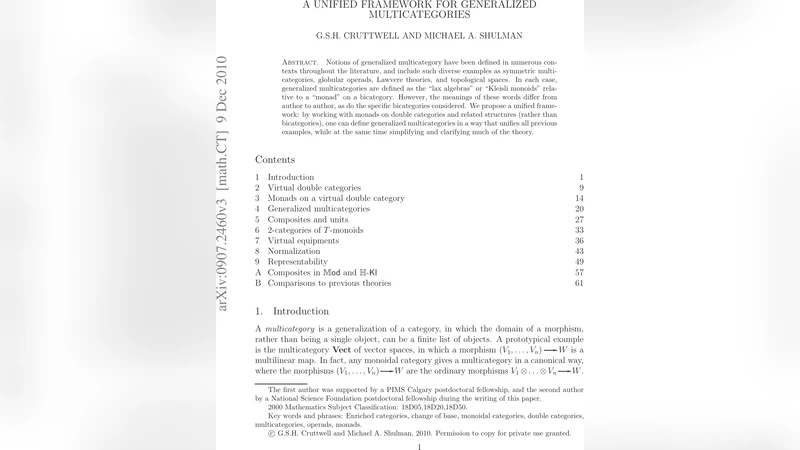
Notions of generalized multicategory have been defined in numerous contexts throughout the literature, and include such diverse examples as symmetric multicategories, globular operads, Lawvere theories, and topological spaces. In each case, generalized multicategories are defined as the “lax algebras” or “Kleisli monoids” relative to a “monad” on a bicategory. However, the meanings of these words differ from author to author, as do the specific bicategories considered. We propose a unified framework: by working with monads on double categories and related structures (rather than bicategories), one can define generalized multicategories in a way that unifies all previous examples, while at the same time simplifying and clarifying much of the theory.
💡 Research Summary
The paper tackles a long‑standing fragmentation in the theory of generalized multicategories. Over the past decades, mathematicians have introduced multicategorical structures in many different settings—symmetric multicategories, globular operads, Lawvere theories, topological operads, and more. Although each of these constructions can be described as “lax algebras” or “Kleisli monoids” for a monad, the ambient bicategory, the precise notion of monad, and the laxness conditions vary from author to author. This lack of uniformity makes it difficult to compare results, to transfer techniques, and to develop a coherent higher‑dimensional theory.
The authors propose a unifying framework that replaces bicategories with double categories as the ambient environment. A double category has two independent directions of 1‑cells (horizontal and vertical) together with 2‑cells that mediate between them. By working with a horizontal monad on a double category, one can define horizontal lax algebras and horizontal Kleisli monoids. These objects capture exactly the same data that previous authors called generalized multicategories, but the definitions are now independent of any ad‑hoc choice of bicategory.
The paper proceeds as follows. After a thorough literature review, Section 2 introduces the necessary background on double categories, companions, and conjoints, and then defines a horizontal monad ((T,\mu,\eta)) on a double category (\mathbb{D}). A horizontal lax algebra for (T) consists of an object (X) together with a horizontal 1‑cell (a:TX\to X) and appropriate 2‑cell coherence maps satisfying unit and associativity axioms expressed purely in the double‑categorical language. Dually, a horizontal Kleisli monoid is a horizontal 1‑cell equipped with a multiplication and unit that satisfy analogous axioms.
Section 3 demonstrates that this abstract definition subsumes all the classical examples:
- Symmetric multicategories arise by taking (\mathbb{D}) to be the double category of finite sets with permutations acting vertically; the horizontal monad encodes the free symmetric multicategory construction. The resulting lax algebras are precisely symmetric multicategories.
- Globular operads are obtained by letting the vertical direction encode the globular shape (0‑cells, 1‑cells, …) and the horizontal direction encode the operadic composition. The monad is the free globular operad monad, and lax algebras recover the usual definition.
- Lawvere theories correspond to the double category of finite‑product categories with product‑preserving functors vertically. The horizontal monad is the free finite‑product theory monad; lax algebras are exactly product‑preserving functors, i.e., Lawvere theories.
- Topological operads / spaces are modeled by a double category whose objects are topological spaces, vertical 1‑cells are continuous maps, and horizontal 1‑cells are “parameterized families” of operations. The monad builds the free topological operad, and the resulting algebras coincide with the classical notion.
For each case the authors provide explicit constructions of the double category, the monad, and the coherence 2‑cells, and they prove an Embedding Theorem showing that any bicategorical monad giving rise to a generalized multicategory can be faithfully embedded as a horizontal monad on a suitable double category. Consequently, the new framework is not merely an alternative presentation; it is provably equivalent to all previously studied approaches.
Section 4 focuses on the coherence and simplification benefits. In the bicategorical setting, one must impose separate interchange laws and sometimes extra “pseudo” conditions to make compositions well‑behaved. In the double‑categorical setting these interchange laws are built into the structure of companions and conjoints, so the lax algebra axioms become a small, uniform list of 2‑cell equations. This dramatically reduces the bookkeeping required in proofs and makes it easier to formulate higher‑dimensional analogues.
Section 5 discusses future directions. Because double categories naturally support both horizontal and vertical composition, the authors anticipate that their framework will be a convenient foundation for higher operads, ∞‑categories, and homotopy‑coherent algebraic structures. They also suggest applications to computer science, where effectful programming languages are modeled by monads; a double‑categorical monad could simultaneously track computational effects (horizontal) and resource or security policies (vertical). Finally, the paper points out that the unified perspective may lead to new “change‑of‑base” constructions, allowing one to transport multicategorical structures along double‑functors, a technique that has already proved useful in enriched category theory.
In conclusion, by shifting the ambient environment from bicategories to double categories and by defining monads horizontally, the authors provide a single, conceptually clear, and technically robust framework that captures all known instances of generalized multicategories. The approach simplifies coherence conditions, clarifies the relationship between different examples, and opens a pathway toward a systematic theory of higher‑dimensional algebraic structures.
Comments & Academic Discussion
Loading comments...
Leave a Comment