Comparing composites of left and right derived functors
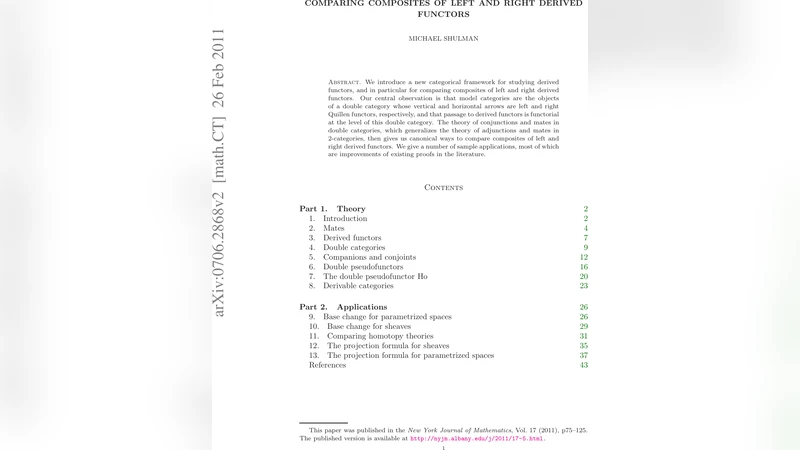
We introduce a new categorical framework for studying derived functors, and in particular for comparing composites of left and right derived functors. Our central observation is that model categories are the objects of a double category whose vertical and horizontal arrows are left and right Quillen functors, respectively, and that passage to derived functors is functorial at the level of this double category. The theory of conjunctions and mates in double categories, which generalizes the theory of adjunctions and mates in 2-categories, then gives us canonical ways to compare composites of left and right derived functors. We give a number of sample applications, most of which are improvements of existing proofs in the literature.
💡 Research Summary
The paper introduces a new categorical framework for comparing composites of left and right derived functors by viewing model categories as objects of a double category. In this double category the vertical arrows are left Quillen functors and the horizontal arrows are right Quillen functors. The authors show that passage to derived functors is functorial already at the level of this double category, which allows one to treat derived functors as morphisms in a coherent two‑dimensional setting rather than as isolated constructions.
A central technical contribution is the adaptation of the theory of conjunctions and mates from ordinary 2‑categories to double categories. In a double category a “square” (a 2‑cell) can be thought of as a natural transformation that simultaneously respects the vertical and horizontal structures. When a square satisfies a suitable compatibility condition—called a conjunction—it gives rise to a pair of mates, i.e. canonical transformations that translate a composite involving a left derived functor into a composite involving a right derived functor, and vice versa. This generalizes the classical adjunction‑mate correspondence and provides a systematic way to compare (\mathbf{L}\circ\mathbf{R}) with (\mathbf{R}\circ\mathbf{L}) whenever the underlying squares commute.
The authors prove several key results. The first, a derived Beck–Chevalley theorem, states that if two squares in the double category are horizontally and vertically compatible, then the corresponding composites of derived functors are naturally isomorphic. This eliminates the need for the traditional Beck–Chevalley hypothesis, which often requires delicate point‑set arguments. The second result shows that Bousfield localizations preserve the double‑categorical structure, so derived functor comparisons remain valid after localization. Finally, they establish a “higher mates” construction that handles chains of alternating left and right derived functors, showing that a whole chain can be replaced by a single mate transformation.
To demonstrate the utility of the framework, the paper revisits several classical contexts. In stable homotopy theory, the authors give a streamlined proof of the compatibility between the derived smash product and function spectrum, avoiding the intricate fibrant‑cofibrant replacements normally required. In homological algebra, they re‑derive the tensor–Hom adjunction for derived functors, showing that the usual Tor–Ext interchange follows directly from a mate in the double category. In sheaf theory, they treat the derived push‑forward and pull‑back functors across a base change square, obtaining the base‑change isomorphism as an immediate consequence of a conjunction.
Throughout, the emphasis is on structural clarity: once the double‑categorical data (objects, vertical and horizontal arrows, and squares) are identified, the existence of the relevant mates is guaranteed by abstract categorical arguments, and no further point‑set verification is needed. This leads to shorter, more conceptual proofs and opens the door to applying the same ideas in more exotic settings, such as semi‑model categories, enriched model categories, or even ((\infty),2)-categories.
In conclusion, by promoting model categories to a double‑categorical environment and exploiting the generalized theory of mates, the authors provide a powerful, uniform method for comparing composites of left and right derived functors. Their approach not only simplifies existing arguments but also suggests new avenues for research, including higher‑dimensional generalizations and applications to areas where multiple Quillen adjunctions interact in complex ways.
Comments & Academic Discussion
Loading comments...
Leave a Comment