Modeling the Dispersal of an Active Region: Quantifying Energy Input into the Corona
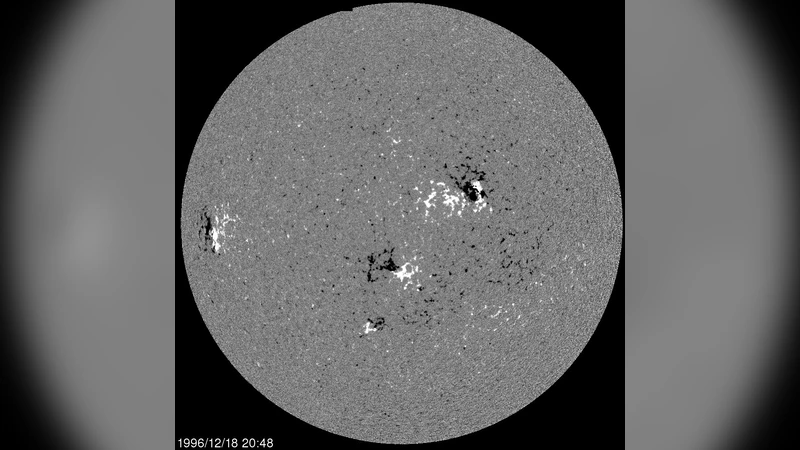
In this paper a new technique for modeling non-linear force-free fields directly from line of sight magnetogram observations is presented. The technique uses sequences of magnetograms directly as lower boundary conditions to drive the evolution of coronal magnetic fields between successive force-free equilibria over long periods of time. It is illustrated by applying it to MDI observations of a decaying active region, NOAA AR 8005. The active region is modeled during a 4 day period around its central meridian passage. Over this time, the dispersal of the active region is dominated by random motions due to small scale convective cells. Through studying the build up of magnetic energy in the model, it is found that such small scale motions may inject anywhere from $2.5-3 \times 10^{25}$ erg s$^{-1}$ of free magnetic energy into the coronal field. Most of this energy is stored within the center of the active region in the low corona, below 30 Mm. After 4 days the build-up of free energy is 10% that of the corresponding potential field. This energy buildup, is sufficient to explain the radiative losses at coronal temperatures within the active region. Small scale convective motions therefore play an integral part in the energy balance of the corona. This new technique has wide ranging applications with the new high resolution, high cadence observations from the SDO:HMI and SDO:AIA instruments.
💡 Research Summary
This paper introduces a novel, observation‑driven technique for modeling the quasi‑static evolution of the solar coronal magnetic field using a sequence of line‑of‑sight (LOS) magnetograms as the lower‑boundary condition. The method builds on a magnetofrictional relaxation scheme that evolves the magnetic vector potential A through the induction equation ∂A/∂t = v × B, where the velocity v is defined as (1/ν)(j × B)/B² to enforce a gradual approach to a force‑free state (j × B = 0). Crucially, the horizontal components of A at the photospheric base are derived directly from each observed B_z map by solving a Poisson equation ∇²Φ = −B_z for a scalar potential Φ, then setting A_x = ∂Φ/∂y and A_y = −∂Φ/∂x. This ensures that the model’s lower boundary reproduces the observed magnetic flux distribution pixel‑by‑pixel every 96 minutes, without any smoothing or idealisation.
The technique is applied to NOAA Active Region 8005, a decaying, isolated bipolar region observed by SOHO/MDI over four days (16–20 December 1996) surrounding its central‑meridian passage. Sixty‑one 96‑minute magnetograms are processed: they are de‑rotated, corrected for foreshortening, and flux‑balanced (a small per‑pixel correction of ≤ 6 G). The region shows a modest increase in polarity separation (from ~68 Mm to ~80 Mm, an 18 % rise) and a 20 % decline in total unsigned flux, with no significant emergence of new bipoles. Motions are dominated by a random walk driven by supergranular convection; no systematic shear or vortical flows are evident.
Running the magnetofrictional simulation with these boundary conditions yields a continuous series of non‑linear force‑free fields that retain memory of previous connectivity and currents. The analysis shows that the small‑scale convective motions inject free magnetic energy at a rate of 2.5–3 × 10²⁵ erg s⁻¹ into the corona. Over the four‑day interval the accumulated free energy reaches roughly 10 % of the corresponding potential‑field energy. The bulk of this free energy is stored low in the corona, below ~30 Mm, where it can readily contribute to heating. The authors compare this energy input with the radiative losses of a typical active‑region corona (≈10⁶ erg cm⁻² s⁻¹) and find that the injected energy is more than sufficient to balance the losses, indicating that supergranular‑scale motions play a vital role in the coronal energy budget.
Beyond the specific case study, the paper emphasizes the broader applicability of the method. Because the lower‑boundary driving uses raw LOS magnetograms, the approach can be directly coupled to the high‑resolution, high‑cadence data from SDO/HMI and SDO/AIA, enabling realistic, time‑dependent NLFFF modeling of active regions, global coronal fields, and eruptive events. The ability to preserve magnetic connectivity and helicity across successive time steps distinguishes this technique from static extrapolation methods, offering a more faithful representation of how photospheric motions translate into coronal energy and helicity buildup.
In summary, the authors demonstrate that (1) a data‑driven magnetofrictional model can faithfully reproduce the observed dispersal of an active region, (2) random supergranular flows inject a substantial, continuously supplied free magnetic energy reservoir into the low corona, and (3) this reservoir can account for the observed radiative energy losses, highlighting the importance of small‑scale convective motions in coronal heating. The methodology opens new avenues for quantitative studies of coronal energetics and magnetic evolution using modern solar observations.
Comments & Academic Discussion
Loading comments...
Leave a Comment