Lightweight Service Oriented Architecture for Pervasive Computing
Pervasive computing appears like a new computing era based on networks of objects and devices evolving in a real world, radically different from distributed computing, based on networks of computers and data storages. Contrary to most context-aware approaches, we work on the assumption that pervasive software must be able to deal with a dynamic software environment before processing contextual data. After demonstrating that SOA (Service oriented Architecture) and its numerous principles are well adapted for pervasive computing, we present our extended SOA model for pervasive computing, called Service Lightweight Component Architecture (SLCA). SLCA presents various additional principles to meet completely pervasive software constraints: software infrastructure based on services for devices, local orchestrations based on lightweight component architecture and finally encapsulation of those orchestrations into composite services to address distributed composition of services. We present a sample application of the overall approach as well as some relevant measures about SLCA performances.
💡 Research Summary
The paper addresses the challenges of pervasive computing, where a multitude of smart devices and objects continuously appear, disappear, and interact in the physical environment. Traditional context‑aware approaches focus only on processing contextual data after it has been collected, assuming a static set of input devices. The authors argue that this is insufficient; instead, the software infrastructure itself must be capable of handling a dynamic set of services before any contextual processing can occur. To this end, they revisit Service‑Oriented Architecture (SOA) and identify three additional principles required for pervasive scenarios: (1) fully decentralized, runtime discovery of services without a central registry; (2) event‑driven communication to propagate real‑world changes instantly; and (3) maximal interoperability through Web‑service standards. Building on these principles, they propose the Service Lightweight Component Architecture (SLCA), which integrates SOA with a lightweight component model (LCA) and event‑based orchestration.
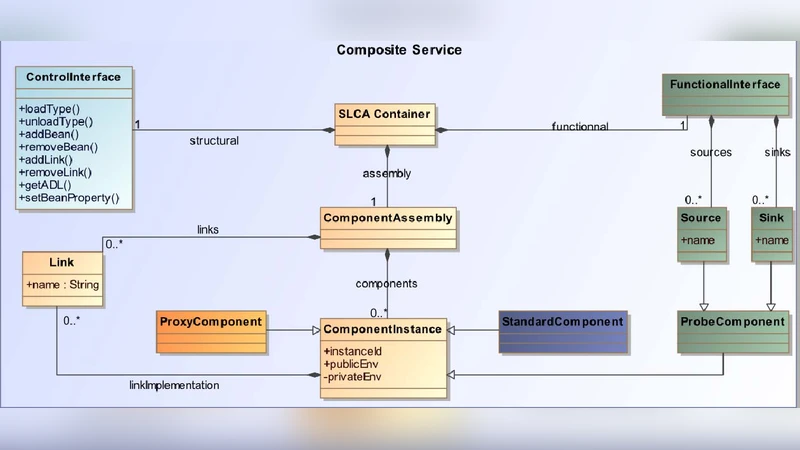
SLCA consists of three layers. The bottom layer is the service infrastructure, where every device (lights, curtains, sensors, etc.) is exposed as a Web service using standards such as WS‑Discovery, SSDP, or DPWS. These services are discovered dynamically in a peer‑to‑peer fashion, eliminating the need for pre‑registered service catalogs. The middle layer is a local orchestration container that hosts lightweight components. Each component has explicit input ports (methods) and output ports (events), resembling JavaBeans or .NET components, and runs in the same process address space as other components. This design yields minimal communication overhead (simple function calls) and a tiny memory footprint, while keeping the components “black boxes” that can be bound or re‑bound at runtime without recompilation. Non‑functional concerns (security, logging, persistence) are treated as additional components that can be plugged into the assembly, preserving scalability. The top layer encapsulates the assembled components into a composite Web service. This composite service can be published, discovered, and further composed with other services, enabling hierarchical, distributed composition across the pervasive environment.
The authors illustrate the approach with a concrete “room” scenario. When a user enters a room, the SLCA runtime discovers all devices present—lights, shutters, HVAC, projector—automatically generates proxy components for each, and loads them into the local container. The user then defines workflows such as “turn on the lights when motion is detected” or “lower the blinds when the projector starts.” These workflows are expressed as event bindings: a motion‑sensor event triggers the “turnOn” method of the light service, and the projector’s “start” event triggers the blind‑control component. If a device disappears (e.g., a lamp is unplugged), the corresponding proxy component can be removed, and the composite service either remains in a degraded state or searches for a compatible replacement.
Performance measurements show that creating or destroying a lightweight component takes roughly 30 ms, while service discovery and binding incur latencies between 150 ms and 300 ms. These figures demonstrate that SLCA can meet the real‑time responsiveness required by pervasive applications. The paper also compares SLCA with existing middleware such as Amigo, Aura, Gaia, and CORTEX, highlighting that none of those systems simultaneously satisfies full discoverability, event‑driven reactivity, interoperability, and dynamic composability.
In conclusion, SLCA offers a coherent architecture that unifies SOA’s strengths (service contracts, loose coupling, discoverability) with a lightweight, event‑centric component model, thereby delivering high adaptability, low overhead, and seamless composition for pervasive computing. The authors acknowledge current limitations, including the management of large‑scale service registries and fine‑grained security policies, and outline future work such as automated service matching, distributed transaction support, and richer adaptation strategies.
Comments & Academic Discussion
Loading comments...
Leave a Comment