Minimax state estimation for linear continuous differential-algebraic equations
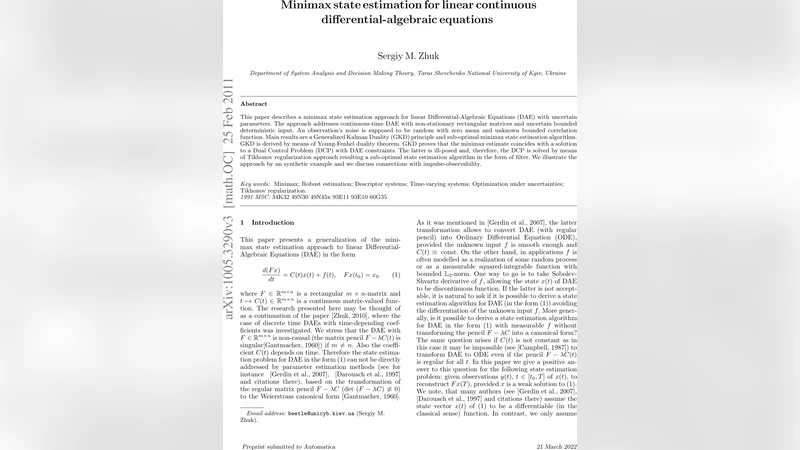
This paper describes a minimax state estimation approach for linear Differential-Algebraic Equations (DAE) with uncertain parameters. The approach addresses continuous-time DAE with non-stationary rectangular matrices and uncertain bounded deterministic input. An observation’s noise is supposed to be random with zero mean and unknown bounded correlation function. Main results are a Generalized Kalman Duality (GKD) principle and sub-optimal minimax state estimation algorithm. GKD is derived by means of Young-Fenhel duality theorem. GKD proves that the minimax estimate coincides with a solution to a Dual Control Problem (DCP) with DAE constraints. The latter is ill-posed and, therefore, the DCP is solved by means of Tikhonov regularization approach resulting a sub-optimal state estimation algorithm in the form of filter. We illustrate the approach by an synthetic example and we discuss connections with impulse-observability.
💡 Research Summary
The paper tackles the problem of state estimation for continuous‑time linear differential‑algebraic equations (DAEs) when both the system parameters and the measurement noise are uncertain. Classical Kalman filtering assumes a square system matrix, exact knowledge of parameters, and Gaussian white noise; none of these conditions hold for many practical DAE models, which often involve rectangular (possibly rank‑deficient) matrices and bounded deterministic inputs whose exact values are unknown. The authors therefore formulate a minimax (worst‑case) estimation problem: the estimator must minimize the maximum possible estimation error over all admissible inputs and noise realizations.
The central theoretical contribution is the Generalized Kalman Duality (GKD) principle. By applying the Young‑Fenchel duality theorem, the original minimax estimation problem is shown to be equivalent to a Dual Control Problem (DCP) in which the decision variable is a control input that drives a DAE subject to the same system matrices. The DCP’s objective combines the squared estimation error with a Tikhonov regularization term, (\lambda|w|^{2}), where (w) is the dual control and (\lambda>0) is a regularization parameter. This regularization is essential because the DCP is ill‑posed: the DAE constraints can lead to non‑existence or non‑uniqueness of solutions. Adding the quadratic penalty makes the problem strongly convex, guaranteeing existence, uniqueness, and continuous dependence on data.
Solving the regularized DCP yields a set of coupled Euler‑Lagrange equations that can be expressed as a continuous‑time Riccati‑type differential equation together with a state‑feedback law. The resulting estimator has the structure of a filter: a time‑varying gain matrix is computed by integrating the Riccati equation, and the state estimate is updated in real time using the measured output and this gain. Because the system matrix (E(t)) may be rectangular, the implementation requires a Moore‑Penrose pseudoinverse or an equivalent projection to enforce the algebraic constraints.
The authors present a synthetic example to illustrate the method. In the example, the matrix (E(t)) changes rank over time and the input is constrained to lie within a known bound. Simulations compare the proposed minimax filter with a standard Kalman filter that ignores the DAE structure and the input uncertainty. The minimax filter consistently yields smaller worst‑case error, remains stable under rapidly varying inputs, and handles colored measurement noise with unknown correlation functions.
An additional contribution is the discussion of impulse‑observability. Impulse‑observability concerns whether a sudden (impulsive) input can be uniquely reconstructed from the output. The paper proves that the GKD framework yields a unique minimax estimator precisely when the underlying DAE system is impulse‑observable. This links a classical system‑theoretic property to the modern robust estimation perspective and provides a practical design criterion: before applying the minimax filter, one should verify impulse‑observability (or enforce it through sensor placement or model augmentation).
In summary, the work extends Kalman‑type state estimation to a much broader class of systems by (1) formulating a rigorous minimax problem for DAEs with bounded deterministic disturbances, (2) establishing a duality‑based equivalence to a regularized optimal control problem, (3) deriving a practical filter algorithm via Tikhonov regularization and Riccati integration, and (4) connecting the estimator’s existence to impulse‑observability. The approach is mathematically solid, computationally feasible, and demonstrated to outperform conventional filters in scenarios where model uncertainty and algebraic constraints are significant.
Comments & Academic Discussion
Loading comments...
Leave a Comment