Energy and environmental aspects of mobile communication systems
The reduction of the energy consumptions of a Telecommunication Power System represents one of the critical factors of the telecommunication technologies, both to allow a sizeable saving of economic resources and to realize “sustainable” development actions. The consumption of about one hundred base stations for mobile phones were monitored for a total of over one thousand days, in order to study the energy consumption in relation to the environmental, electric and logistics parameters of the stations themselves. It was possible to survey, then, the role of the mobile communication systems in the general national energy framework and to plot the best areas of intervention for saving energy and improving the environmental impact, showing the role played by air conditioning and transmission equipments. Finally, new transmission algorithms and the use of renewable energy based techniques have been tested.
💡 Research Summary
The paper presents a comprehensive assessment of the energy consumption and environmental impact of mobile communication base stations (BTS) in Italy. A sample of 95 BTS, representing a cross‑section of urban, suburban and rural sites, was monitored continuously for more than 1,000 days using remote terminal units that fed data to a central energy‑saving software platform. The authors examined a wide range of variables, including instantaneous power, daily energy use, internal and external temperature, BTS typology (shelter, room, outdoor), technology (GSM, DCS, UMTS) and traffic load (measured in erlangs).
Key findings are as follows. The average yearly electricity demand of a single BTS is about 35,500 kWh. Extrapolating to the roughly 60,000 BTS deployed nationwide yields a total consumption of approximately 2.1 TWh per year, which corresponds to 0.6 % of Italy’s total electricity demand, about €300 million in operating costs and roughly 1.2 million tonnes of CO₂‑equivalent emissions. Energy use is dominated by two subsystems: radio transmission equipment accounts for roughly two‑thirds of the total, while cooling (air‑conditioning) contributes about one‑third.
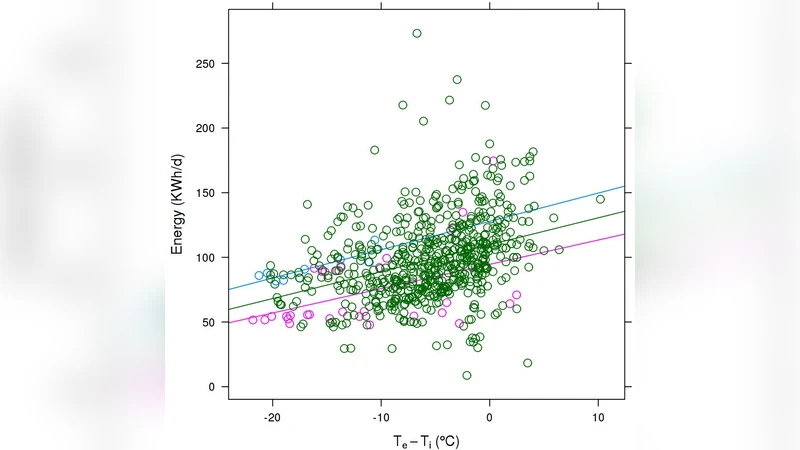
Technology‑level analysis shows that GSM stations consume significantly more power than UMTS stations (≈111 kWh/day versus ≈73 kWh/day). This difference is attributed to the higher transmit power and older modulation schemes used in GSM. The study also reveals a clear linear relationship between external temperature and energy consumption: each 1 °C rise in ambient temperature adds about 2.1 kWh per day, with the effect being most pronounced in shelter and room‑type stations where thermal losses are higher. In contrast, traffic intensity shows no statistically significant correlation with power draw, indicating that current BTS operation does not adapt transmit power to real‑time load.
To address the identified inefficiencies, the authors evaluated two practical energy‑saving strategies. First, they introduced intelligent climate‑control algorithms that dynamically adjust air‑conditioning based on real‑time temperature and humidity, achieving an estimated 5‑10 % reduction in cooling energy. Second, they deployed an Ericsson “power‑saving” feature that places idle transceivers into standby mode during periods of low traffic. Field tests on a suburban BTS with three GSM and three DCS transmitters demonstrated a consistent reduction of more than 10 % in total power consumption when the feature was active, especially during nighttime and weekends when traffic is low. Combining both cooling optimisation and transmission‑side savings yields an overall annual reduction of about 20 % (≈7 MWh per BTS), translating into roughly €1,000 saved per site per year and a decrease of 4 tCO₂‑eq per site per year.
The paper also explores the integration of renewable energy sources. Two rural pilot sites were equipped with photovoltaic arrays (16–20 m²) and, in some cases, micro‑wind turbines. The authors discuss the sizing methodology, the influence of site orientation, shading and local solar‑wind resources, and the distinction between grid‑connected and off‑grid deployments. Results indicate that solar installations can partially or fully meet the power demand of isolated BTS, reducing reliance on diesel generators and further cutting operational costs and emissions.
In conclusion, the study provides a data‑driven quantification of BTS energy consumption, identifies the dominant contributors (radio transmission and cooling), and validates concrete mitigation measures—intelligent climate control, traffic‑aware transmission power management, and on‑site renewable generation. The authors argue that implementing these measures across the national network could yield substantial economic savings, lower CO₂ emissions and advance the sustainability of mobile communication infrastructure.
Comments & Academic Discussion
Loading comments...
Leave a Comment