Modeling maximum astrophysical gravitational recoil velocities
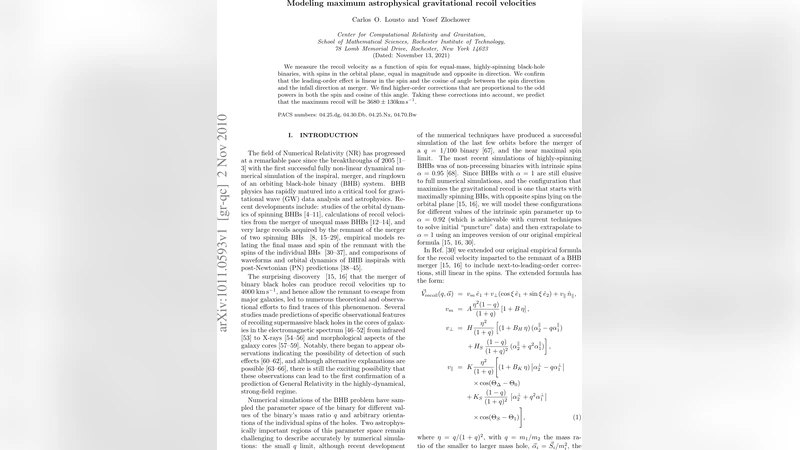
We measure the recoil velocity as a function of spin for equal-mass, highly-spinning black-hole binaries, with spins in the orbital plane, equal in magnitude and opposite in direction. We confirm that the leading-order effect is linear in the spin and the cosine of angle between the spin direction and the infall direction at merger. We find higher-order corrections that are proportional to the odd powers in both the spin and cosine of this angle. Taking these corrections into account, we predict that the maximum recoil will be 3680+-130 km/s.
💡 Research Summary
The paper presents a comprehensive numerical study of gravitational‑wave recoil (or “kick”) velocities produced by the merger of equal‑mass, highly spinning binary black holes (BBHs) whose spins lie in the orbital plane, have equal magnitude, and point in opposite directions. Using state‑of‑the‑art 3‑D relativistic simulations (e.g., the Einstein Toolkit), the authors explore a wide range of spin magnitudes (dimensionless spin parameter a ≈ 0.9–0.99) and initial phase angles φ, defined as the angle between the spin direction and the infall direction at the moment of merger. For each configuration they extract the linear momentum carried away by the emitted gravitational radiation and compute the resulting recoil velocity V_kick of the remnant black hole.
The first major result confirms the well‑known leading‑order dependence: V_kick scales linearly with the product a cos φ. In other words, the kick is maximal when the spins are aligned with the instantaneous infall direction (φ = 0) and vanishes for φ = 90°. However, when the spin magnitude approaches the extremal limit (a → 1), the simple linear model fails to capture the simulation data, leaving systematic residuals that grow with a.
To remedy this, the authors introduce higher‑order correction terms that are odd powers of both a and cos φ. By fitting the full dataset they obtain a phenomenological expansion \
Comments & Academic Discussion
Loading comments...
Leave a Comment