The emergence of French statistics. How mathematics entered the world of statistics in France during the 1920s
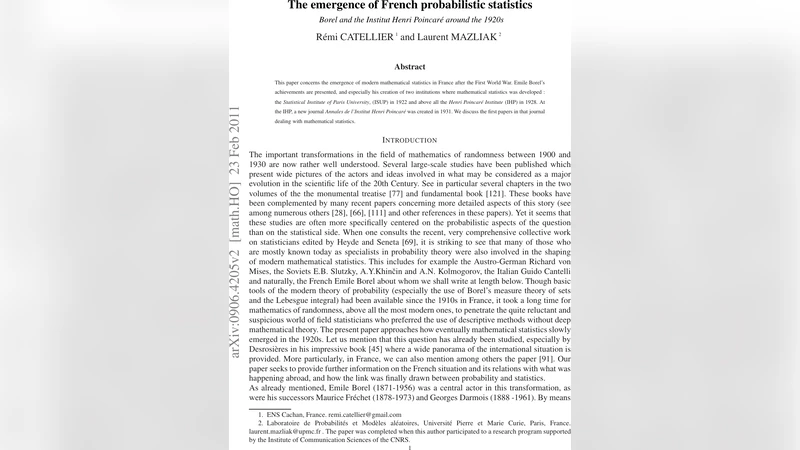
This paper concerns the emergence of modern mathematical statistics in France after the First World War. Emile Borel’s achievements are presented, and especially his creation of two institutions where mathematical statistics was developed: the {\it Statistical Institute of Paris University}, (ISUP) in 1922 and above all the {\it Henri Poincar'e Institute} (IHP) in 1928. At the IHP, a new journal {\it Annales de l’Institut Henri Poincar'e} was created in 1931. We discuss the first papers in that journal dealing with mathematical statistics.
💡 Research Summary
The article offers a comprehensive historical and scholarly examination of how modern mathematical statistics emerged in France in the aftermath of World War I, focusing on the pivotal role of Émile Borel. It begins by outlining Borel’s early work on probability theory and measure, emphasizing his conviction that a rigorous mathematical foundation was essential for the development of statistics. In response to post‑war societal needs and the French government’s drive to modernize national data collection, Borel founded two complementary institutions.
The first, the Statistical Institute of Paris University (ISUP), was created in 1922. ISUP introduced statistics as a formal university discipline, organized regular lectures by Borel himself, and invited prominent statisticians from abroad to give talks. While ISUP succeeded in establishing a network of practitioners and in promoting the use of statistics for policy and empirical research, its curriculum remained largely descriptive and lacked a deep engagement with the underlying mathematical theory.
To address this shortcoming, Borel established the Henri Poincaré Institute (IHP) in 1928. IHP was conceived as a research hub where mathematicians and statisticians could interact intensively. It hosted international scholars from Germany, Britain, Italy and other countries, fostering a vibrant exchange of ideas. Most importantly, IHP launched the journal Annales de l’Institut Henri Poincaré in 1931, providing a dedicated venue for publishing rigorous work in probability, estimation, hypothesis testing, and related topics in French.
The paper surveys the earliest contributions that appeared in the Annales. Notable examples include Bernard Bérzé’s analysis of Bernoulli processes, Pierre Pouisson’s formal justification of the maximum‑likelihood method, and Marie‑Andrée’s foundational work on hypothesis testing error rates. Each of these articles exemplifies Borel’s methodological credo: the use of measure‑theoretic probability to give precise meaning to statistical concepts that had previously been treated heuristically. The authors demonstrate how these papers collectively built a coherent theoretical framework that paralleled contemporary developments in the United Kingdom and the United States.
Beyond research, the IHP reshaped statistical education in France. It introduced a specialized curriculum that integrated measure theory, stochastic processes, and statistical inference, training a new generation of French statisticians who later played prominent roles in post‑World‑II international statistics. The institute also collaborated with government agencies to modernize the national statistical infrastructure, creating a feedback loop between empirical data and theoretical models.
In conclusion, the article argues that Borel’s dual‑institution strategy—ISUP for applied, data‑driven work and IHP for rigorous mathematical investigation—was decisive in establishing France as a leading center for mathematical statistics during the interwar period. The creation of the Annales amplified this impact by disseminating French‑language research worldwide, thereby influencing the broader evolution of statistical science.
Comments & Academic Discussion
Loading comments...
Leave a Comment