Data Base Mappings and Monads: (Co)Induction
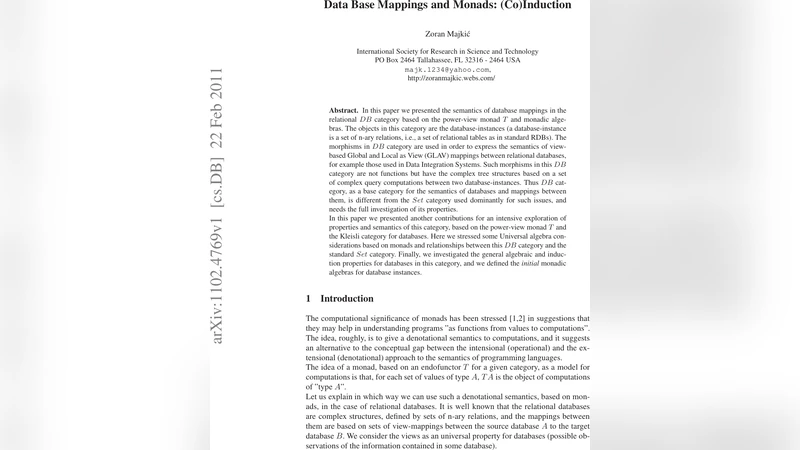
In this paper we presented the semantics of database mappings in the relational DB category based on the power-view monad T and monadic algebras. The objects in this category are the database-instances (a database-instance is a set of n-ary relations, i.e., a set of relational tables as in standard RDBs). The morphisms in DB category are used in order to express the semantics of view-based Global and Local as View (GLAV) mappings between relational databases, for example those used in Data Integration Systems. Such morphisms in this DB category are not functions but have the complex tree structures based on a set of complex query computations between two database-instances. Thus DB category, as a base category for the semantics of databases and mappings between them, is different from the Set category used dominantly for such issues, and needs the full investigation of its properties. In this paper we presented another contributions for an intensive exploration of properties and semantics of this category, based on the power-view monad T and the Kleisli category for databases. Here we stressed some Universal algebra considerations based on monads and relationships between this DB category and the standard Set category. Finally, we investigated the general algebraic and induction properties for databases in this category, and we defined the initial monadic algebras for database instances.
💡 Research Summary
The paper proposes a categorical framework for the semantics of relational database mappings, centered on a newly defined DB category whose objects are database instances (sets of n‑ary relations) and whose morphisms are not ordinary functions but collections of view‑maps built from SPJR U (Select‑Project‑Join‑Union) queries. Each view‑map is characterized by two auxiliary functions ∂₀ and ∂₁ that record, respectively, the set of source relations used as arguments and the resulting view (a relation in the target). Because a morphism may consist of many such view‑maps, composition yields tree‑like structures that can contain “hidden” intermediate relations; the authors therefore distinguish between partial arrows (p‑arrows) and complete arrows (c‑arrows) in a BNF‑style definition of the morphism set.
A central construction is the power‑view endofunctor T: for any object A, T A is the set of all possible views of A, formally the quotient term algebra Ł_A/≈ where ≈ identifies queries that produce the same result relation. T is idempotent (T T A = T A) and monotone (A ⊆ T A). The authors show that T forms a monad (T, η, μ) where both the unit η and multiplication μ are identity natural transformations, and consequently T is also a comonad. This dual nature reflects the fact that views are both computations (via the monad) and observations (via the comonad).
The DB category exhibits a strong self‑duality: DB is equivalent to its opposite DB^op, which implies that every limit has a corresponding colimit with the same objects, and products coincide with coproducts, pullbacks with pushouts, etc. An ordering A ⊑ B is defined by inclusion of view sets (T A ⊆ T B); two objects are isomorphic precisely when their view closures coincide (T A = T B). This ordering makes DB a complete lattice and endows it with the structure of a V‑category, a metric space, and a weak monoidal topos.
To capture the computational aspect of mappings, the paper introduces the Kleisli category DB_T associated with the monad T. In DB_T the same objects are used, but a morphism f : A → B is interpreted as a computation A → T B. This aligns with the standard Kleisli construction in functional programming, where monadic arrows represent effectful computations. The authors use DB_T to formalize GLAV (Global and Local as View) mappings, showing that the “information flux” e_f of any morphism f satisfies e_f = T e_f, i.e., it is closed under the power‑view operator. They further characterize monic, epic, and isomorphic arrows in terms of inclusion relations between the corresponding view closures: an epic arrow implies T A ⊇ T B, a monic arrow implies T A ⊆ T B, and both together yield an isomorphism.
The paper proceeds to develop universal algebraic aspects: T‑algebras (monad algebras) and T‑coalgebras (comonad coalgebras) are defined, and initial T‑algebras as well as final T‑coalgebras are constructed. The initial T‑algebra represents the minimal set of base relations from which all possible views can be generated; this provides a categorical analogue of a “core schema” that can generate any derived view. Dually, the final T‑coalgebra captures the maximal observable behavior of a database. Using these structures, the authors formulate (co)induction principles for databases: any property that holds for the initial algebra and is preserved by the algebraic operations holds for all views, and dually for coalgebras. This gives a rigorous foundation for recursive view definitions and for reasoning about infinite or highly dynamic data integration scenarios.
Finally, the authors discuss several meta‑theoretical properties of DB: it is concrete, small, locally finitely presentable, and enriched over itself. They also outline a metric on objects derived from the degree of view inclusion, and a subobject classifier that turns DB into a weak monoidal topos. These results position DB as a rich categorical environment that bridges database theory, universal algebra, and functional programming semantics.
In summary, the paper establishes a monad‑centric categorical semantics for relational database mappings, introduces a power‑view monad T and its Kleisli category to model GLAV mappings, and leverages initial algebras, final coalgebras, and (co)induction to provide a mathematically robust framework for view‑based data integration, schema evolution, and query reasoning. The work not only deepens the theoretical understanding of database mappings but also opens avenues for applying categorical and monadic techniques to practical problems in data integration and database system design.
Comments & Academic Discussion
Loading comments...
Leave a Comment