Synchronizing Objectives for Markov Decision Processes
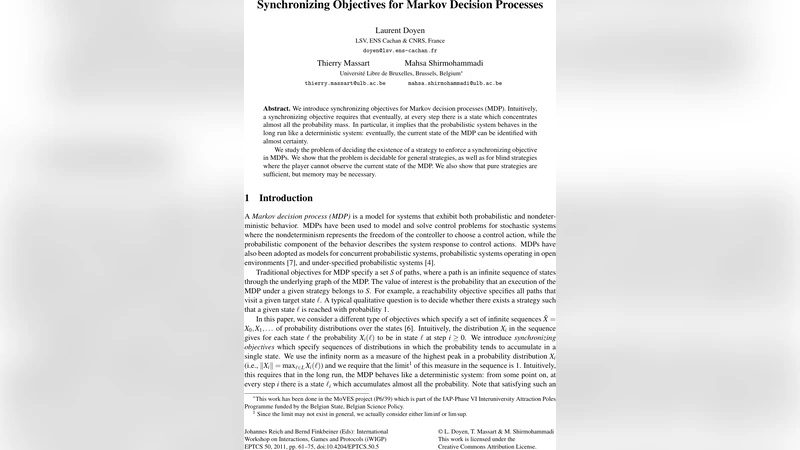
We introduce synchronizing objectives for Markov decision processes (MDP). Intuitively, a synchronizing objective requires that eventually, at every step there is a state which concentrates almost all the probability mass. In particular, it implies that the probabilistic system behaves in the long run like a deterministic system: eventually, the current state of the MDP can be identified with almost certainty. We study the problem of deciding the existence of a strategy to enforce a synchronizing objective in MDPs. We show that the problem is decidable for general strategies, as well as for blind strategies where the player cannot observe the current state of the MDP. We also show that pure strategies are sufficient, but memory may be necessary.
💡 Research Summary
The paper introduces a novel class of objectives for Markov decision processes (MDPs) called “synchronizing objectives.” Unlike traditional MDP objectives that are defined over sets of infinite paths (e.g., reachability, safety, or parity), synchronizing objectives are defined over sequences of probability distributions on the state space. For each step n, the distribution Xₙ gives the probability of being in each state; the objective requires that the infinity‑norm ‖Xₙ‖∞ = maxₛ Xₙ(s) converges to 1. Two variants are distinguished: strong synchronizing (lim infₙ ‖Xₙ‖∞ = 1) meaning that from some point onward every step concentrates almost all probability mass in a single state, and weak synchronizing (lim supₙ ‖Xₙ‖∞ = 1) meaning that this concentration happens infinitely often.
The authors study the decision problem: given an MDP, does there exist a strategy that enforces a synchronizing objective? They consider both perfect‑information strategies (the controller sees the current state) and blind strategies (the controller only knows the round number). Strategies may be randomized or pure; memoryless or with finite/infinite memory.
Key contributions are:
- Decidability – The existence of a synchronizing strategy is decidable for both perfect‑information and blind settings.
- Pure strategies suffice – Randomization is unnecessary; a deterministic (pure) strategy can achieve synchronization whenever any strategy can.
- Memory may be required – The paper provides explicit examples where any synchronizing strategy must use memory (in particular, blind strategies may need unbounded memory).
The technical core relies on two variants of the subset construction, a classic tool for determinising nondeterministic automata. In the perfect‑information subset construction, each cell is a set of MDP states and the alphabet consists of functions σ̂ : L → Σ, allowing each state in the cell to choose its own action. In the blind subset construction, the alphabet is the original action set Σ, forcing all states in a cell to take the same action. Transitions are defined by taking the union of successors under the chosen actions.
A cycle in the resulting deterministic automaton is examined. For a cycle C = s₀ σ̂₀ s₁ … s_{d‑1} σ̂_{d‑1} s₀, the authors define a recurrent cyclic set G = g₀ … g_d where each g_i ⊆ s_i and the successors of g_i under σ̂_i exactly equal g_{i+1}. Minimal recurrent cyclic sets (no proper subset with the same property) are collected in Δ(C). The crucial observation is that if every minimal recurrent cyclic set of a cycle consists of a single state, then the cycle yields a synchronizing strategy: by following the actions prescribed by the cycle, the probability mass eventually collapses onto that single state and stays there.
The paper connects this construction to classical Markov chain theory: transient states have probability mass that vanishes (lim supₙ Xₙ(s)=0), while recurrent states retain a positive lower bound. Therefore, a synchronizing strategy must drive the system into a strongly connected component consisting only of recurrent states, and the subset‑construction cycle analysis guarantees that such a component can be forced to behave deterministically in the limit.
Complexity-wise, the subset constructions have an exponential blow‑up (2^{|L|} cells), but the decision procedure operates within PSPACE, matching known bounds for related problems on MDPs. The authors note that while the theoretical algorithm is exponential, it is feasible for moderate‑size models and can be optimized using symbolic techniques.
Finally, the work relates synchronizing objectives to the classic notion of synchronizing words in deterministic finite automata (Černý’s conjecture). In a DFA, a synchronizing word maps all states to a single state; this corresponds to a blind strategy in an MDP where the transition function is deterministic. The paper shows that synchronizing objectives generalise this concept to stochastic settings, where infinite strategies (rather than finite words) may be required, and where the controller may need to remember past actions.
Potential applications are discussed: controlling stochastic biochemical networks (e.g., DNA transcription), robotic motion planning under uncertainty, and sensor network coordination where a common “consensus” state must eventually dominate. By providing a decidable framework for ensuring that a probabilistic system behaves deterministically in the long run, the paper opens new avenues for verification and synthesis of controllers that need strong convergence guarantees beyond mere reachability.
Comments & Academic Discussion
Loading comments...
Leave a Comment