k-forested choosability of graphs with bounded maximum average degree
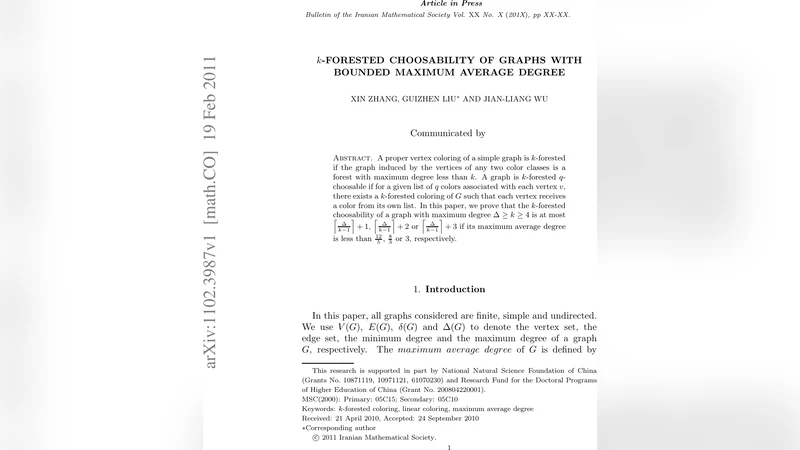
A proper vertex coloring of a simple graph is $k$-forested if the graph induced by the vertices of any two color classes is a forest with maximum degree less than $k$. A graph is $k$-forested $q$-choosable if for a given list of $q$ colors associated with each vertex $v$, there exists a $k$-forested coloring of $G$ such that each vertex receives a color from its own list. In this paper, we prove that the $k$-forested choosability of a graph with maximum degree $\Delta\geq k\geq 4$ is at most $\lceil\frac{\Delta}{k-1}\rceil+1$, $\lceil\frac{\Delta}{k-1}\rceil+2$ or $\lceil\frac{\Delta}{k-1}\rceil+3$ if its maximum average degree is less than 12/5, $8/3 or 3, respectively.
💡 Research Summary
The paper investigates the list‑coloring version of k‑forested colorings, a generalization of acyclic and linear colorings. A proper vertex coloring of a simple graph G is called k‑forested if the subgraph induced by any two color classes is a forest whose maximum degree is strictly less than k. For a given integer q, a graph is k‑forested q‑choosable if, for any assignment of a list of q colors to each vertex, there exists a k‑forested coloring using only colors from the respective lists. The smallest such q is the k‑forested choice number Λₗₖ(G).
The main goal is to bound Λₗₖ(G) in terms of the maximum degree Δ (or a given upper bound M ≥ Δ) and the maximum average degree mad(G). The authors prove three complementary results (Theorem 1.2). Let Q = ⌈M/(k‑1)⌉. If mad(G) < 12/5 then Λₗₖ(G) ≤ Q + 1; if mad(G) < 8/3 then Λₗₖ(G) ≤ Q + 2; and if mad(G) < 3 then Λₗₖ(G) ≤ Q + 3, provided k ≥ 4 and M ≥ k. Substituting M = Δ yields Theorem 1.3, which gives the same bounds directly in terms of Δ.
From these general statements the authors derive corollaries for planar and projective‑planar graphs using the well‑known inequality mad(G) < 2g/(g‑2) where g is the girth. Consequently, a planar (or projective‑planar) graph with girth at least 12 satisfies Λₗₖ(G) = ⌈Δ/(k‑1)⌉ + 1; with girth at least 8 the bound becomes ⌈Δ/(k‑1)⌉ + 2; and with girth at least 6 the bound is ⌈Δ/(k‑1)⌉ + 3.
The proof technique follows the classic minimal counterexample method combined with a discharging argument. Assuming a minimal counterexample G exists, the authors first identify five forbidden configurations (C1–C5) that cannot appear in G; each configuration involves low‑degree vertices or specific adjacency patterns. By carefully analyzing the list assignments and the partial k‑forested coloring of G minus a vertex, they show that any of these configurations would allow an extension of the coloring, contradicting the minimality of G.
Having excluded these configurations, every vertex in G has degree at least two. The authors assign an initial “charge” w(v) = d(v) to each vertex and then redistribute charge according to rules tailored to the three mad thresholds.
-
For mad < 12/5 (part (1)): each 3‑vertex gives 1/5 to each adjacent 2‑vertex, and each vertex of degree at least 4 gives 2/5 to each adjacent 2‑vertex. After redistribution every vertex ends with charge at least 12/5, contradicting the assumption that the average charge (which equals mad) is smaller.
-
For mad < 8/3 (part (2)): each 3‑vertex gives 1/9 to each adjacent 2‑vertex, each 4‑ or 5‑vertex gives 1/3, and each vertex of degree at least 6 gives 5/9. Again all final charges are at least 8/3, yielding a contradiction.
-
For mad < 3 (part (3)): each vertex of degree at least 4 gives 1/2 to each adjacent 2‑vertex. The analysis shows that after this single rule every vertex’s final charge is at least 3, contradicting mad < 3.
Since each part leads to a contradiction, no minimal counterexample can exist, and the stated bounds hold.
The results extend earlier work on linear choosability (the case k = 3) by Esperet, Montassier, and Raspaud, providing a unified framework for any k ≥ 4. The paper’s contribution lies in (i) formulating the k‑forested choice number, (ii) establishing tight (up to an additive constant) upper bounds that depend only on Δ and mad(G), and (iii) demonstrating that a relatively simple discharging scheme suffices for the generalized setting.
Potential directions for future research include: investigating whether the additive constants (+1, +2, +3) are optimal for all k, extending the method to graphs with additional structural constraints (e.g., bounded treewidth, minor‑closed families), or exploring algorithmic aspects of constructing k‑forested list colorings efficiently. The techniques may also be adaptable to other coloring paradigms where local degree restrictions are imposed on the union of color classes.
Comments & Academic Discussion
Loading comments...
Leave a Comment