Egomunities, Exploring Socially Cohesive Person-based Communities
In the last few years, there has been a great interest in detecting overlapping communities in complex networks, which is understood as dense groups of nodes featuring a low outbound density. To date, most methods used to compute such communities stem from the field of disjoint community detection by either extending the concept of modularity to an overlapping context or by attempting to decompose the whole set of nodes into several possibly overlapping subsets. In this report we take an orthogonal approach by introducing a metric, the cohesion, rooted in sociological considerations. The cohesion quantifies the community-ness of one given set of nodes, based on the notions of triangles - triplets of connected nodes - and weak ties, instead of the classical view using only edge density. A set of nodes has a high cohesion if it features a high density of triangles and intersects few triangles with the rest of the network. As such, we introduce a numerical characterization of communities: sets of nodes featuring a high cohesion. We then present a new approach to the problem of overlapping communities by introducing the concept of ego-munities, which are subjective communities centered around a given node, specifically inside its neighborhood. We build upon the cohesion to construct a heuristic algorithm which outputs a node’s ego-munities by attempting to maximize their cohesion. We illustrate the pertinence of our method with a detailed description of one person’s ego-munities among Facebook friends. We finally conclude by describing promising applications of ego-munities such as information inference and interest recommendations, and present a possible extension to cohesion in the case of weighted networks.
💡 Research Summary
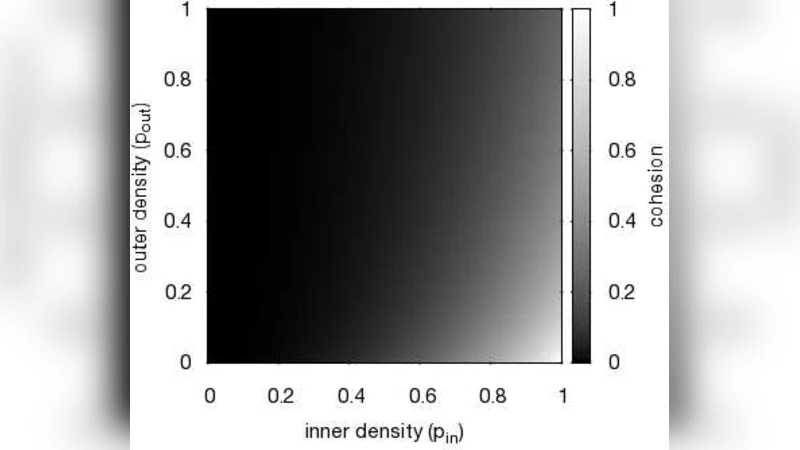
The paper addresses the problem of overlapping community detection in complex networks by proposing a fundamentally different, user‑centric perspective. Instead of seeking a global partition, the authors focus on “ego‑communities” (egomunities), which are subjective, possibly overlapping groups of nodes that reside within the immediate neighbourhood of a given focal node. To evaluate the quality of any candidate set of nodes, they introduce a novel metric called cohesion. Cohesion is defined as the product of two factors: (1) the density of triangles (three‑node cliques) inside the set, measured as the number of internal triangles divided by the total possible number of triangles (|S| choose 3); and (2) the proportion of those internal triangles that are not “leaking” outside, i.e., the ratio of internal triangles to the sum of internal and outward‑pointing triangles (triangles with two vertices inside the set and one outside). Formally, C(S)= (Δ_in(S)/C3|S|)·(Δ_in(S)/(Δ_in(S)+Δ_out(S))). This formulation captures two sociologically motivated ideas: (i) communities are dense in closed triadic relationships, and (ii) weak ties—edges not belonging to any triangle—serve primarily as bridges between communities and should not affect the intrinsic quality of a community. The authors prove that removing all weak ties from the graph does not change the cohesion of any subset, reinforcing the metric’s focus on triadic structure.
Building on cohesion, the authors design a heuristic algorithm to extract egomunities for a given node u. Starting from the singleton {u}, the algorithm iteratively adds neighboring vertices that increase the cohesion of the current set. Triangle counts are pre‑computed so that the incremental effect of adding a vertex on Δ_in and Δ_out can be updated efficiently. The process stops when no further addition yields a higher cohesion, at which point the current set is recorded as one egomunity. The algorithm then repeats with remaining neighbors, allowing multiple overlapping egomunities to be discovered for the same focal node. Because the method optimizes a local quality function, it does not guarantee a global optimum; the final result can depend on the order of candidate vertices and the initial seed.
The authors validate their approach with a case study on a Facebook user. They extract 71 egomunities, each of which aligns well with real‑world social circles such as family, school classmates, and coworkers, demonstrating that cohesion captures intuitive community boundaries better than plain edge density. A larger, ongoing Facebook experiment (tens of thousands of users, millions of edges) shows that the most expensive step—triangle enumeration—can be parallelized, keeping overall runtime within a few minutes, suggesting feasibility for real‑time applications.
Potential applications discussed include personalized information inference, interest recommendation, and targeted advertising. Since egomunities reflect the multiple social roles of an individual, they can be used to infer missing attributes (e.g., likely interests) or to identify influential bridges (weak ties) for viral marketing.
The paper also acknowledges several limitations. Triangle counting, even with efficient algorithms, remains computationally heavy for massive graphs, especially when node degrees are high. The greedy heuristic may converge to sub‑optimal solutions, and the lack of a systematic evaluation against established overlapping community methods (e.g., CPM, OSLOM, fuzzy clustering) limits the ability to quantify performance gains. Moreover, while a weighted‑graph extension of cohesion is proposed, it is not implemented or experimentally tested. Future work is suggested in the directions of approximate triangle counting, multi‑seed strategies, rigorous benchmarking, and full integration of edge weights.
In summary, the work contributes a socially motivated, triangle‑centric quality measure and a practical algorithm for extracting ego‑centric overlapping communities. By shifting the focus from global partitions to local, user‑centered structures, it opens new avenues for analyzing social networks where individuals simultaneously belong to multiple tightly knit groups. Further development on scalability, evaluation, and weighted extensions will be essential to translate this promising concept into widely adopted tools.
Comments & Academic Discussion
Loading comments...
Leave a Comment