The Formation of Massive Star Systems by Accretion
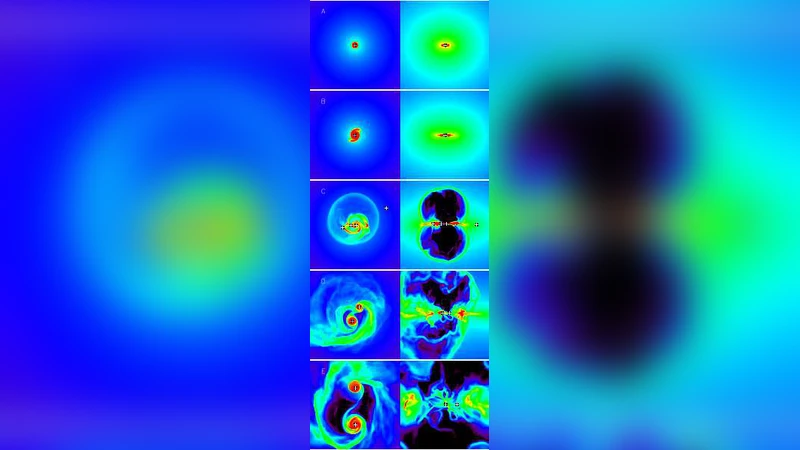
Massive stars produce so much light that the radiation pressure they exert on the gas and dust around them is stronger than their gravitational attraction, a condition that has long been expected to prevent them from growing by accretion. We present three-dimensional radiation-hydrodynamic simulations of the collapse of a massive prestellar core and find that radiation pressure does not halt accretion. Instead, gravitational and Rayleigh-Taylor instabilities channel gas onto the star system through non-axisymmetric disks and filaments that self-shield against radiation, while allowing radiation to escape through optically-thin bubbles. Gravitational instabilities cause the disk to fragment and form a massive companion to the primary star. Radiation pressure does not limit stellar masses, but the instabilities that allow accretion to continue lead to small multiple systems.
💡 Research Summary
The paper tackles a long‑standing paradox in massive star formation: the intense radiation pressure from a luminous protostar should, in theory, exceed its gravitational pull and halt further accretion, imposing an “Eddington limit” on stellar mass. Using state‑of‑the‑art three‑dimensional radiation‑hydrodynamic simulations with adaptive mesh refinement, the authors follow the collapse of a ∼100 M⊙ prestellar core from the onset of gravitational instability through the birth of a massive star and its surrounding environment. Their results overturn the classical picture by demonstrating that radiation pressure does not stop accretion; instead, a suite of multidimensional instabilities creates pathways that continuously feed gas onto the central system while allowing radiation to escape.
When the nascent star ignites nuclear burning, its luminosity inflates low‑density, radiation‑filled bubbles in the surrounding envelope. The interface between these bubbles and the dense gas becomes Rayleigh‑Taylor unstable. The instability drives finger‑like filaments and non‑axisymmetric “ribbons” of gas that thread the bubble walls. These structures self‑shield: the dense gas absorbs and reprocesses the radiation, dramatically reducing the net outward force on the inflowing material. Consequently, gas can stream along the bubble boundaries into a warped, non‑axisymmetric accretion disk. The disk itself is far from the smooth, thin, Keplerian structure assumed in 1‑D or axisymmetric models; it is thick, turbulent, and constantly reshaped by the surrounding radiation field.
Within this disk, gravitational instability quickly grows because the mass loading is high and cooling is efficient. The disk fragments into massive clumps that accrete further material and evolve into a companion star with a mass comparable to the primary. The simulation shows the formation of a close binary (or higher‑order multiple) with a mass ratio near unity, orbiting at separations of a few hundred astronomical units. The emergence of the companion introduces additional asymmetry, opening new low‑optical‑depth channels for radiation to vent, which in turn reinforces the filamentary inflow. Thus, rather than imposing a hard cap on stellar mass, radiation pressure triggers a feedback loop in which instabilities sustain accretion while simultaneously fostering multiplicity.
Radiation escapes primarily through the optically thin bubbles, which expand to ∼10⁴ AU. Inside the bubbles the radiation energy density is high, but the surrounding dense gas is forced to flow around the bubble walls, preserving a pressure gradient that does not choke off infall. This picture reconciles the observed existence of stars well above 100 M⊙ with theoretical expectations.
The authors argue that previous analytic and lower‑dimensional numerical studies missed these crucial processes because they enforced symmetry and could not capture the coupled Rayleigh‑Taylor and gravitational fragmentation modes. Their work suggests that the upper end of the stellar initial mass function is not limited by radiation pressure but by the dynamics of disk fragmentation and the resulting multiplicity statistics.
For observational validation, the paper recommends high‑resolution (≤0.1″) ALMA imaging to detect bubble cavities, filamentary inflows, and disk fragments in young massive protostellar cores, as well as infrared polarimetry to map radiation escape routes. Statistical surveys of massive star multiplicity at early evolutionary stages could test the prediction that most very massive stars form as close binaries or small multiples.
In summary, the study provides a compelling three‑dimensional, radiation‑hydrodynamic mechanism whereby massive stars continue to grow despite overwhelming radiation pressure. The key lies in non‑axisymmetric structures that self‑shield and channel gas, while radiation finds low‑density escape paths. This paradigm shift has profound implications for theories of massive star formation, the shape of the high‑mass end of the IMF, and the origin of massive binary and multiple systems.
Comments & Academic Discussion
Loading comments...
Leave a Comment