The Lookup Technique to Replace Nested-IF Formulas in Spreadsheet Programming
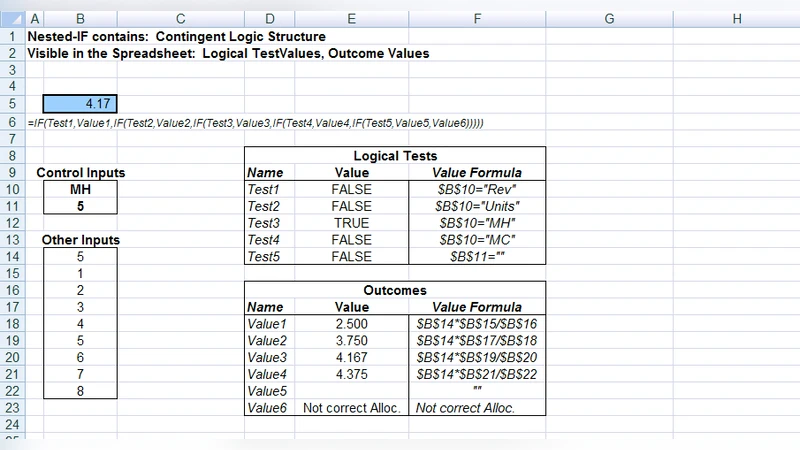
Spreadsheet programmers often implement contingent logic using a nested-IF formula even though this technique is difficult to test and audit and is believed to be risky. We interpret the programming of contingent logic in spreadsheets in the context of traditional computer programming. We investigate the “lookup technique” as an alternative to nested-IF formulas, describe its benefits for testing and auditing, and define its limitations. The lookup technique employs four distinct principles: 1) make logical tests visible; 2) make outcomes visible; 3) make logical structure visible; and 4) replace a multi-function nested-IF formula with a single-function lookup formula. It can be used only for certain simple contingent logic. We describe how the principles can be applied in more complex situations, and suggest avenues for further research.
💡 Research Summary
The paper addresses a pervasive problem in spreadsheet development: the reliance on nested‑IF formulas to implement contingent logic. While nested‑IFs are straightforward to write, they embed multiple logical tests and corresponding outcomes within a single, often lengthy expression. This entanglement makes the formula hard to read, difficult to test in isolation, and prone to errors that are hard to detect during auditing. The authors reinterpret spreadsheet programming through the lens of conventional software engineering and propose an alternative called the “lookup technique.”
The lookup technique is built on four explicit principles. First, each logical test is moved to its own cell, making the test itself visible (test visibility). Second, the value that should be returned when a test evaluates to TRUE is also placed in a separate cell (outcome visibility). Third, the relationship between tests and outcomes is organized into a clear tabular structure (structure visibility). Fourth, the entire nested‑IF construct is replaced by a single lookup function—such as VLOOKUP, HLOOKUP, or INDEX/MATCH—that references the table. By externalizing tests and results, the technique turns a monolithic formula into a set of simple, independently verifiable components. Test cases can be added or modified by editing individual cells, and auditors can verify the logic simply by inspecting the mapping table and the single lookup call.
The authors demonstrate that this approach dramatically improves testability and auditability. Because each test and each possible result are explicit, unit‑testing can be performed on a cell‑by‑cell basis, and regression testing becomes a matter of confirming that the lookup table still yields the expected outputs. Maintenance is also simplified: changing a business rule often requires only an update to the table, not a rewrite of a complex formula.
However, the technique is not a universal replacement for all conditional logic. It works best when the conditions are simple, mutually exclusive, and do not involve intricate combinations of AND/OR operators. In cases where conditions overlap, have hierarchical precedence, or require multi‑criteria evaluation, the size of the mapping table can explode, and additional intermediate calculations become necessary. To address these limitations, the paper outlines two extensions. The first decomposes compound conditions into separate Boolean columns, then uses a secondary lookup to combine the intermediate results. The second leverages dynamic named ranges and array formulas to allow the mapping table to grow automatically as new rules are added, reducing manual table maintenance.
The discussion concludes with several avenues for future research: (1) designing new functions or add‑ins that natively support complex logical branching while preserving the visibility benefits of the lookup technique; (2) empirically measuring performance and error‑rate impacts in large‑scale spreadsheets that adopt this method; and (3) integrating the technique with automated audit tools to provide real‑time verification of business logic. Overall, the paper contributes a practical, theory‑grounded methodology that can replace risky nested‑IF constructions with a more transparent, testable, and auditable lookup‑based pattern, thereby enhancing both the reliability of spreadsheet models and the efficiency of their maintenance.
Comments & Academic Discussion
Loading comments...
Leave a Comment