Revealing the nature of high-mass X-ray binaries through multi-wavelength and statistical analyses
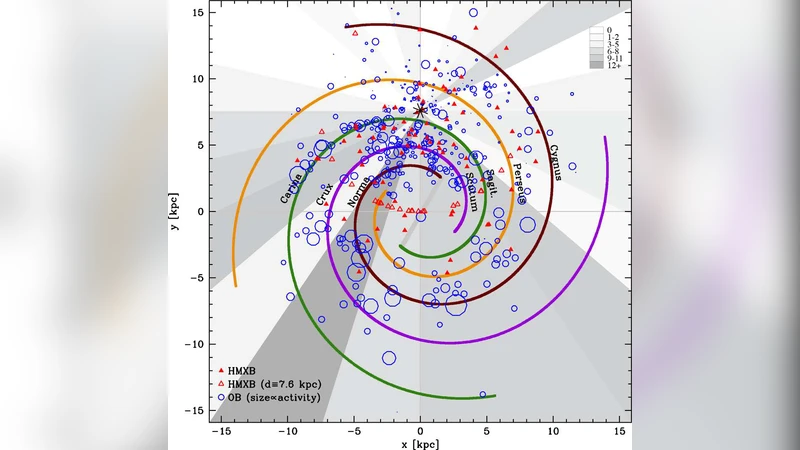
We summarize the results of our long-running campaign to help understand the nature of high-mass X-ray binaries (HMXBs), emphasizing recent Suzaku observations of IGR J16207-5129 and IGR J17391-3021. Thanks to the expanding ranks of HMXBs in our Galaxy, we are able to perform more reliable statistical analyses on the three currently-known sub-classes of HMXB: those with supergiant companions (SGXBs); those with Be companions (BEXBs); and the enigmatic Supergiant Fast X-ray Transients (SFXTs). We discuss new diagnostic tools, akin to the “Corbet diagram,” in which HMXBs tend to segregate based on their dominant accretion mechanism. We show how SFXTs span across the divided populations of BEXBs and SGXBs, bolstering the intriguing possibility that some SFXTs represent an evolutionary link. The use of HMXBs as tracers of recent massive star formation is revisited as we present the first ever spatial correlation function for HMXBs and OB star-forming complexes. Our results indicate that at distances less than a few kpc from a given HMXB, it is more likely to have neighbors that are known massive-star forming regions as opposed to objects drawn from random distributions. The characteristic scale of the correlation function holds valuable clues to HMXB evolutionary timescales.
💡 Research Summary
This paper presents a comprehensive, multi‑wavelength and statistical investigation of high‑mass X‑ray binaries (HMXBs) in the Milky Way, with a particular focus on the three recognized subclasses: supergiant X‑ray binaries (SGXBs), Be‑star X‑ray binaries (BEXBs), and the more recently identified Supergiant Fast X‑ray Transients (SFXTs). The authors begin by reporting new Suzaku observations of two representative sources: IGR J16207‑5129, a canonical SGXB, and IGR J17391‑3021, an SFXT. The SGXB was observed for ~30 ks and displayed a remarkably steady X‑ray flux with no significant spectral evolution, a behavior the authors tentatively attribute to an eclipse of the compact object by its supergiant companion. In contrast, the SFXT showed a series of weak flares (peak luminosities only a factor of ~5 above quiescence) accompanied by a clear increase in the measured hydrogen column density (N_H). This simultaneous brightening and absorption is interpreted as the accretion of dense clumps in the stellar wind, supporting the “clumpy wind” model for SFXTs.
Building on these case studies, the authors assemble the largest HMXB sample to date (several hundred objects) and examine three key physical parameters: the line‑of‑sight X‑ray absorption (N_H), the orbital period, and the neutron‑star spin period. A weak anti‑correlation (Spearman ρ ≈ ‑0.3) is found between N_H and orbital period, reflecting the intuitive expectation that wider binaries have lower ambient wind densities. Conversely, N_H and spin period show a modest positive correlation (ρ ≈ +0.3), suggesting that systems embedded in denser winds experience stronger spin‑down torques. When plotted on the N_H–spin period diagram, SGXBs and BEXBs occupy distinct regions, while SFXTs bridge the gap, reinforcing the hypothesis that SFXTs may represent an evolutionary link between the two more established classes. The authors also overlay theoretical equilibrium spin‑period curves derived from the wind‑accretion model of Waters & van Kerkwijk (1989), finding that most HMXBs lie above the equilibrium lines unless unusually strong magnetic fields (>10^12 G) are invoked.
A major novelty of the work is the introduction of a two‑dimensional spatial correlation function ξ(r) to quantify the association between HMXBs and massive star‑forming complexes (OB associations). Using the catalog of 464 OB complexes compiled by Russeil (2003) and the positions of HMXBs with known distances, the authors construct concentric annuli of 1 kpc thickness around each HMXB and count the number of observed OB complexes (DD pairs) versus the number expected from three different randomization schemes (Gaussian ring, uniform disk, uniform disk with inner hole). Applying both the Peebles (1980) estimator and the Landy‑Szalay (1993) estimator, they find ξ(r) > 1 for separations r ≤ 3 kpc, with statistical significances ranging from 7σ to 17σ. This result demonstrates that HMXBs are significantly clustered with OB associations on scales of a few kiloparsecs, as expected for young systems that have not migrated far from their birthplaces. In contrast, a similar analysis using globular clusters (old stellar populations) yields ξ ≈ 0, confirming that the clustering signal is specific to recent star‑formation sites.
The spatial analysis also reveals an asymmetry in the Galactic distribution of heavily absorbed HMXBs, which are concentrated toward the Norma arm—coincident with the highest density of OB complexes—while the opposite side of the Galaxy shows far fewer such sources. This asymmetry persists after accounting for observational biases and suggests a genuine link between high line‑of‑sight absorption and proximity to active star‑forming regions.
In the concluding section, the authors argue that multi‑wavelength observations are essential for characterizing the accretion environment (e.g., wind density, clumpiness, obscuration) and for securing reliable optical/IR counterparts. Meanwhile, multi‑parameter statistical studies (absorption, timing, spatial distribution) validate theoretical expectations such as the wind‑accretion torque model and the association of HMXBs with recent massive‑star formation. The identification of SFXTs as a transitional population between BEXBs and SGXBs offers a promising avenue for constructing a unified evolutionary framework for HMXBs. The authors anticipate that forthcoming precise astrometric data (e.g., from Gaia) combined with the correlation‑function methodology will enable direct measurement of HMXB migration velocities and lifetimes, thereby refining models of binary evolution and Galactic structure. Overall, the paper provides a robust, data‑driven synthesis that advances our understanding of the nature, formation, and evolution of high‑mass X‑ray binaries.
Comments & Academic Discussion
Loading comments...
Leave a Comment