Koszul duality of the category of trees and bar construction for operads
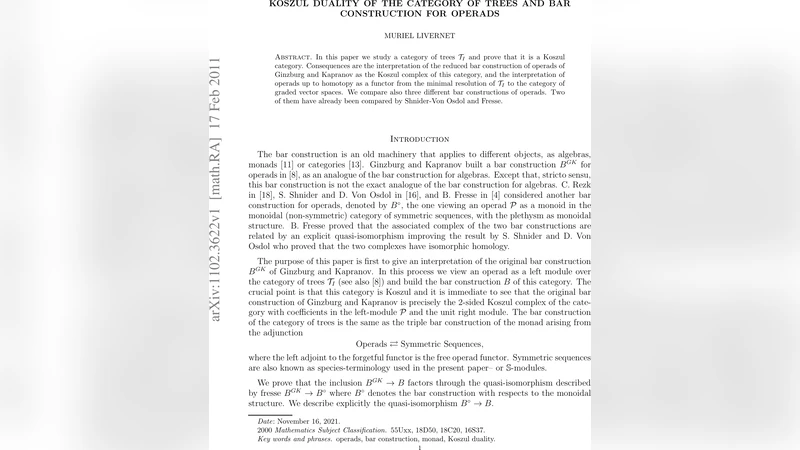
In this paper we study a category of trees TI and prove that it is a Koszul category. Consequences are the interpretation of the reduced bar construction of operads of Ginzburg and Kapranov as the Koszul complex of this category, and the interpretation of operads up to homotopy as a functor from the minimal resolution of TI to the category of graded vector spaces. We compare also three different bar constructions of operads. Two of them have already been compared by Shnider-Von Osdol and Fresse.
💡 Research Summary
The paper investigates a combinatorial category TI whose objects are reduced rooted trees whose leaves are bijectively labelled by a finite set I. Morphisms are obtained by contracting a chosen subset of internal edges; such a contraction is unique when it exists. After k‑linearising the category to obtain kTI, the author introduces left and right TI‑modules as covariant and contravariant functors to the category of differential graded vector spaces, and defines the balanced tensor product R⊗TI L which computes Tor groups.
Section 1 constructs the standard bar resolution B(TI,TI,TI) as a simplicial bifunctor. Its n‑simplices are chains of composable morphisms, with face maps given by composition and degeneracy maps by insertion of identities. The normalized bar complex N is obtained by quotienting out degeneracies; both B and N are free resolutions of the identity bimodule kTI, in accordance with Mitchell’s theory of bar constructions for linear categories. Consequently, for any right module R and left module L one has Tor_TΙ(R,L)≅H_*(B(R,TI,L)).
The core of the work is the definition of a Koszul complex K(TI,TI,TI). For a morphism t→s given by contracting a set E of internal edges, one splits E into a pair F⊔G. The component of K corresponding to this data is kTI(t/(F⊔G),s)⊗Λ|G|(k
Comments & Academic Discussion
Loading comments...
Leave a Comment