The Banff Challenge: Statistical Detection of a Noisy Signal
Particle physics experiments such as those run in the Large Hadron Collider result in huge quantities of data, which are boiled down to a few numbers from which it is hoped that a signal will be detected. We discuss a simple probability model for this and derive frequentist and noninformative Bayesian procedures for inference about the signal. Both are highly accurate in realistic cases, with the frequentist procedure having the edge for interval estimation, and the Bayesian procedure yielding slightly better point estimates. We also argue that the significance, or $p$-value, function based on the modified likelihood root provides a comprehensive presentation of the information in the data and should be used for inference.
💡 Research Summary
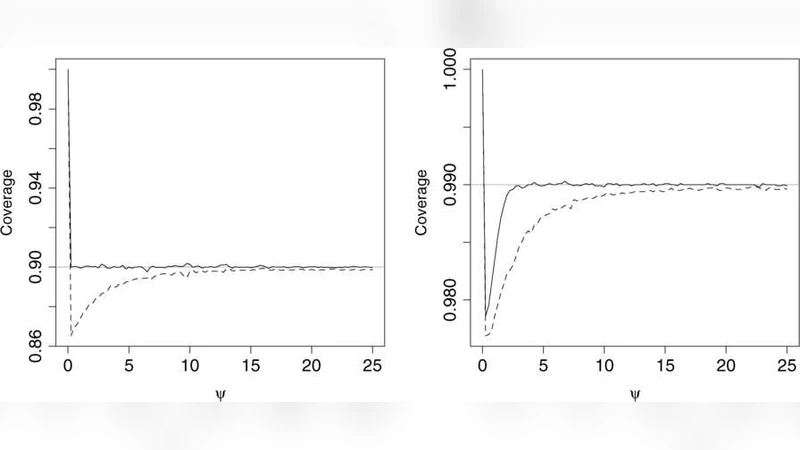
The paper addresses a fundamental problem in high‑energy physics: how to infer the presence and magnitude of a faint signal when the raw data consist of huge numbers of particle collisions that must be reduced to a few summary counts. The authors propose a simple yet realistic probabilistic model and develop both frequentist and non‑informative Bayesian inference procedures, comparing their performance through extensive simulation studies.
Statistical Model
The observable count (n) from the main experiment is modeled as a Poisson random variable with mean (\lambda = b + s), where (b) denotes the unknown background rate and (s) the unknown signal rate. An auxiliary control measurement yields a count (y) that follows (\text{Pois}(\tau b)), with (\tau) a known scaling factor (often the ratio of exposure times). The joint likelihood is therefore
\
Comments & Academic Discussion
Loading comments...
Leave a Comment