Morphology Scaling of Drop Impact onto a Granular Layer
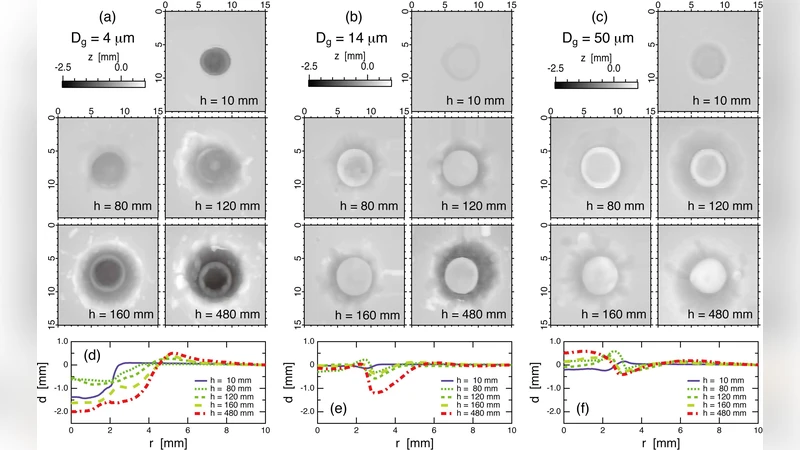
We investigate the impact of a free-falling water drop onto a granular layer. First, we constructed a phase diagram of crater shapes with two control parameters, impact speed and grain size. A low-speed impact makes a deeper cylindrical crater in a fluffy granular target. After high-speed impacts, we observed a convex bump higher than the initial surface level instead of a crater. The inner ring can be also observed in medium impact speed regime. Quantitatively, we found a scaling law for crater radius with a dimensionless number consisting of impact speed and density ratio between the bulk granular layer and water drop. This scaling demonstrates that the water drop deformation is crucial to understand the crater morphology.
💡 Research Summary
The authors investigate how a free‑falling water droplet deforms a granular bed upon impact, focusing on the morphology of the resulting crater or surface protrusion. By systematically varying two control parameters—impact speed (adjusted via drop height) and grain size (10 µm to 500 µm)—they construct a phase diagram that delineates three distinct regimes. At low impact speeds with fine grains, the droplet penetrates deeply, producing a cylindrical crater whose depth scales roughly linearly with the kinetic energy of the drop. In an intermediate regime, a thin raised ring appears around a shallow central depression; this “inner‑ring” morphology reflects partial spreading of the droplet along the granular surface while still displacing material radially. At high speeds with coarse grains, the droplet undergoes rapid expansion, pushing the grains aside and forming a convex bump that rises above the original surface level, effectively suppressing crater formation.
To quantify these observations, the authors introduce a dimensionless group ξ that combines impact velocity v, droplet diameter D, water surface tension γ, and the density ratio between the granular medium (ρ_g) and water (ρ_w): ξ = (ρ_g/ρ_w)·(v² D/γ). This number can be viewed as a modified Weber number that explicitly incorporates the bulk density of the target. Plotting crater radius R against ξ for all experimental conditions collapses the data onto a single power law, R ∝ ξ^{1/3}. The exponent of one‑third indicates that the characteristic length scale is set by a balance between the dynamic pressure of the impacting droplet and the resistance of the granular matrix, with the droplet’s surface tension governing the deformation.
The paper further compares two characteristic timescales: the droplet deformation time τ = √(ρ_w D³/γ) and the granular response time t ≈ D/v. When ξ ≈ 1, τ and t become comparable, and the system transitions sharply from crater‑forming to bump‑forming behavior. In the τ ≫ t limit (low speed, fine grains) the droplet remains relatively rigid during impact, leading to deep penetration. In the τ ≪ t limit (high speed, coarse grains) the droplet spreads almost instantaneously, generating the convex protrusion.
Beyond the specific water‑granular system, the authors argue that their scaling framework should be applicable to a broad class of liquid‑granular impacts, including higher‑viscosity fluids, non‑Newtonian liquids, and granular beds of varying cohesion or porosity. Such generalization could improve our understanding of natural phenomena—such as raindrop or hailstone impacts on soil—and inform industrial processes like spray coating, spray cooling, or additive manufacturing where droplet‑granular interactions dictate surface texture and material properties.
In summary, the study demonstrates that the morphology of impact craters on granular layers is governed not merely by impact energy but by a coupled interplay of droplet deformation, surface tension, and the bulk density of the target. The identified ξ ∝ R³ scaling provides a concise, predictive tool for anticipating crater size and shape across a wide range of impact conditions.
Comments & Academic Discussion
Loading comments...
Leave a Comment