Eta cocycles, relative pairings and the Godbillon-Vey index theorem
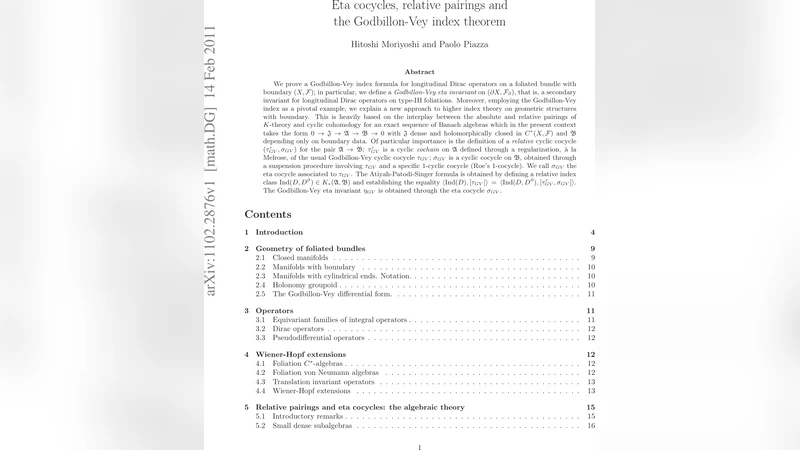
We prove a Godbillon-Vey index formula for longitudinal Dirac operators on a foliated bundle with boundary; in particular, we define a Godbillon-Vey eta invariant on the boundary-foliation; this is a secondary invariant for longitudinal Dirac operators on type-III foliations. Moreover, employing the Godbillon-Vey index as a pivotal example, we explain a new approach to higher index theory on geometric structures with boundary. This is heavily based on the interplay between the absolute and relative pairings of K-theory and cyclic cohomology for an exact sequence of Banach algebras which in the present context takes the form $0\to J\to A\to B\to 0$, with J dense and holomorphically closed in the C^-algebra of the foliation and B depending only on boundary data. Of particular importance is the definition of a relative cyclic cocycle $(\tau_{GV}^r,\sigma_{GV})$ for the pair $A\to B$; $\tau_{GV}^r$ is a cyclic cochain on A defined through a regularization, `a la Melrose, of the usual Godbillon-Vey cyclic cocycle $\tau_{GV}$; $\sigma_{GV}$ is a cyclic cocycle on B, obtained through a suspension procedure involving $\tau_{GV}$ and a specific 1-cyclic cocycle (Roe’s 1-cocycle). We call $\sigma_{GV}$ the eta cocycle associated to $\tau_{GV}$. The Atiyah-Patodi-Singer formula is obtained by defining a relative index class $\Ind (D,D^\partial)\in K_ (A,B)$ and establishing the equality <\Ind (D),[\tau_{GV}]>=<\Ind (D,D^\partial), [\tau^r_{GV}, \sigma_{GV}]>$. The Godbillon-Vey eta invariant $\eta_{GV}$ is obtained through the eta cocycle $\sigma_{GV}$.
💡 Research Summary
The paper develops a comprehensive higher index theory for longitudinal Dirac operators on foliated bundles with boundary, focusing on the Godbillon‑Vey (GV) class as a guiding example. The authors begin by recalling the classical GV index theorem for closed foliated bundles, where the pairing of the C(^*)-algebraic index class with the GV cyclic 2‑cocycle yields the GV invariant (\langle\operatorname{Ind}(D),
Comments & Academic Discussion
Loading comments...
Leave a Comment