Matching, Merging and Structural Properties of Data Base Category
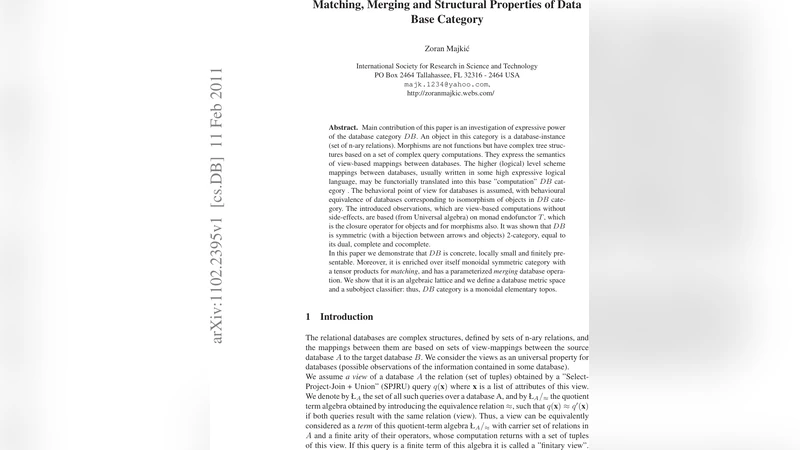
Main contribution of this paper is an investigation of expressive power of the database category DB. An object in this category is a database-instance (set of n-ary relations). Morphisms are not functions but have complex tree structures based on a set of complex query computations. They express the semantics of view-based mappings between databases. The higher (logical) level scheme mappings between databases, usually written in some high expressive logical language, may be functorially translated into this base “computation” DB category . The behavioral point of view for databases is assumed, with behavioural equivalence of databases corresponding to isomorphism of objects in DB category. The introduced observations, which are view-based computations without side-effects, are based (from Universal algebra) on monad endofunctor T, which is the closure operator for objects and for morphisms also. It was shown that DB is symmetric (with a bijection between arrows and objects) 2-category, equal to its dual, complete and cocomplete. In this paper we demonstrate that DB is concrete, locally small and finitely presentable. Moreover, it is enriched over itself monoidal symmetric category with a tensor products for matching, and has a parameterized merging database operation. We show that it is an algebraic lattice and we define a database metric space and a subobject classifier: thus, DB category is a monoidal elementary topos.
💡 Research Summary
The paper introduces a novel categorical framework, denoted DB, in which database instances are objects and view‑based mappings are morphisms. An object is a collection of n‑ary relations; the universal object Υ contains all relations from every instance and serves as the top element of the category. For each object A, a monadic endofunctor T is defined, mapping A to T A, the database consisting of every possible view of A obtainable by SPJRU (Select‑Project‑Join‑Union) queries. T acts as a closure operator: A ⊆ T A, T (T A)= T A, and closed objects satisfy A = T A. The subcategory of closed objects, DB_sk, is skeletal and equivalent to the full DB, establishing concreteness via a faithful functor to Set.
Morphisms are not ordinary functions but sets of view‑maps. Each view‑map q_Ai is a SPJRU query characterized by its input relation set ∂₀(q_Ai) and its output view ∂₁(q_Ai). A morphism f:A→B is a collection of such view‑maps whose outputs lie in B. Composition of morphisms is defined by tree‑like merging of the underlying query structures, yielding a new set of view‑maps; the composition respects the partial order induced by inclusion of ∂₀ and ∂₁. This order gives rise to 2‑cells (denoted α:f⊑g) and makes DB a 2‑category. Moreover, every morphism possesses a reversible counterpart, establishing that DB is self‑dual (DB ≅ DB^op). Consequently, limits and colimits coincide: products equal coproducts, pullbacks equal pushouts, and the empty database ⊥₀ serves simultaneously as initial and terminal object.
The authors prove that DB is complete, cocomplete, locally small, and finitely presentable. They further enrich DB over itself, defining a symmetric monoidal tensor ⊗ interpreted as a “matching” operation that extracts common views between two databases. A parameterized “merging” operation ⊕ combines databases into a single integrated instance. These structures turn DB into a V‑category (enriched over itself) with a monoidal closed structure.
On the algebraic side, DB forms an algebraic lattice. The authors construct a subobject classifier Ω by associating each sub‑database with a characteristic morphism into Ω, and they define a metric d(A,B)=|T A Δ T B| (the size of the symmetric difference of view‑closures). This metric quantifies observational distance between databases. The presence of exponentials, a subobject classifier, and all finite limits/colimits shows that DB satisfies the axioms of a monoidal elementary topos.
In summary, the paper provides a rigorous categorical semantics for view‑based database mappings, matching, and merging. By treating queries as morphisms in a symmetric 2‑category equipped with monadic closure, tensorial matching, and lattice‑theoretic structure, it offers a unified mathematical foundation for data integration, schema transformation, and high‑level database design. The results bridge database theory with advanced category theory, opening avenues for formal reasoning about complex data‑centric systems.
Comments & Academic Discussion
Loading comments...
Leave a Comment