Exact Solution to Terzaghis Consolidation Equation
The application of the consolidation equation is based on Taylor’s approximate solution alone. The existence of the exact solution emerged from the analysis of the logical structure of d’Alambert’s, Fourier’ and Laplace’s differential equations. This led to a nonlinear equation - based on the properties of elastic waves and elastic functions - which is able to simulate excess pore pressure transmission in the soil. The research is completed with the application of the solution obtained, thereby discovering that consolidation decay times may be calculated both through the construction of dissipation curves and through he analytical research of the time value satisfying the condition Delta u(z,t100) = 0. Finally, decay times match the approximate solution eliminating in fact the introduction of Taylor’s additional parameters.
💡 Research Summary
The paper challenges the long‑standing reliance on Taylor’s approximate solution for Terzaghi’s one‑dimensional consolidation equation and proposes an exact analytical solution derived from the structural similarities among d’Alembert’s wave equation, Fourier’s heat‑diffusion equation, and Laplace’s steady‑state equation. By combining the oscillatory nature of d’Alembert’s solutions with the exponential damping inherent in Laplace’s harmonic functions, the author arrives at a damped‑wave form for excess pore pressure:
u(z,t) = u₀ exp(‑k z) cos(ω t ‑ k z)
where the “consolidation variable” k and angular frequency ω are linked to the primary consolidation coefficient c_v and time t through the relations k² = 2 c_v / t and ω = k c_v. Consequently, the solution depends only on c_v—obtainable from standard oedometer tests—eliminating the need for Taylor’s dimensionless parameters Z and T_v.
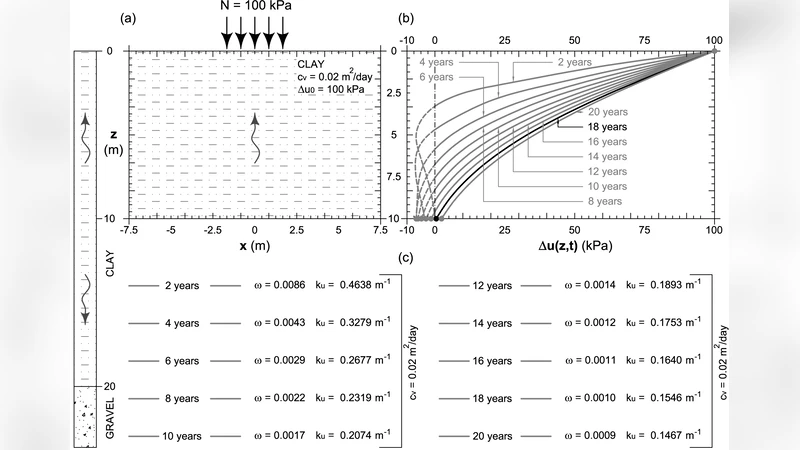
The author validates the formulation with a practical example: a 20 m thick clay layer (drainage path H = 10 m) subjected to a 100 kPa static load and characterized by c_v = 0.02 m² day⁻¹. By varying ω and k, a series of “dissipation curves” spanning 2 to 20 years are generated, enabling the determination of the complete consolidation time t₁₀₀ ≈ 17.5–18 years. This matches the time predicted by Taylor’s method (t₉₅ ≈ 15.5 years) and demonstrates that the exact solution reproduces the same decay times while providing a physically transparent description of pore‑pressure attenuation with depth.
Furthermore, the paper shows that the exact solution can be inverted: given an experimental Δu‑t curve, one can solve for t₁₀₀ and back‑calculate c_v, offering an alternative to traditional methods such as Casagrande’s. The author reports consistency between c_v values derived from the exact solution and those obtained from conventional oedometer analysis.
In conclusion, the study delivers a mathematically rigorous, physically intuitive exact solution for Terzaghi’s consolidation equation, confirms its equivalence to Taylor’s approximate results in predicting consolidation times, and highlights its potential for broader applications, including three‑dimensional consolidation modeling. Limitations include the assumption of instantaneous loading, linear elastic behavior, and single‑drainage conditions, which the author acknowledges as avenues for future research.
Comments & Academic Discussion
Loading comments...
Leave a Comment