Predictors of short-term decay of cell phone contacts in a large scale communication network
Under what conditions is an edge present in a social network at time t likely to decay or persist by some future time t + Delta(t)? Previous research addressing this issue suggests that the network range of the people involved in the edge, the extent to which the edge is embedded in a surrounding structure, and the age of the edge all play a role in edge decay. This paper uses weighted data from a large-scale social network built from cell-phone calls in an 8-week period to determine the importance of edge weight for the decay/persistence process. In particular, we study the relative predictive power of directed weight, embeddedness, newness, and range (measured as outdegree) with respect to edge decay and assess the effectiveness with which a simple decision tree and logistic regression classifier can accurately predict whether an edge that was active in one time period continues to be so in a future time period. We find that directed edge weight, weighted reciprocity and time-dependent measures of edge longevity are highly predictive of whether we classify an edge as persistent or decayed, relative to the other types of factors at the dyad and neighborhood level.
💡 Research Summary
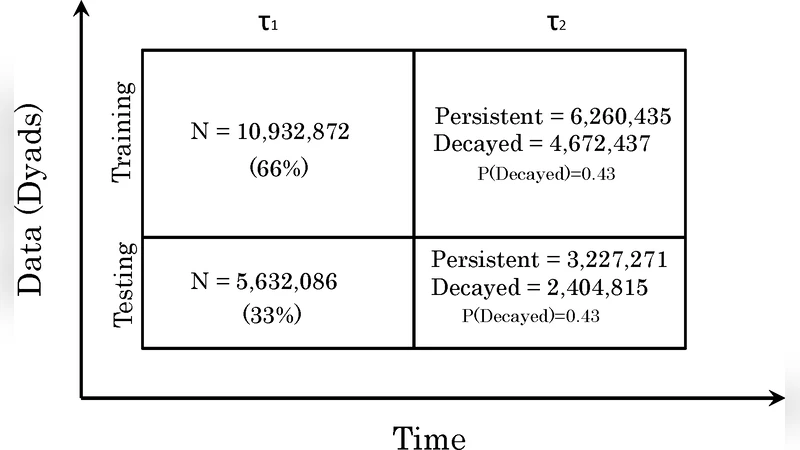
This paper investigates the short‑term decay of ties in a large‑scale mobile phone communication network. Using eight weeks of call detail records from a major U.S. carrier, the authors construct a directed, weighted network where edge weight corresponds to the number of calls from one subscriber to another during the first four‑week observation window (τ₁). They then label each edge as “persistent” if it also appears in the subsequent four‑week window (τ₂) and as “decayed” otherwise, thereby formulating a binary classification problem they call the decay prediction problem.
Four families of predictors are examined: (1) dyadic variables – the directed call count (weight) from i to j, the reciprocal weight from j to i, and the ratio of the two (weighted reciprocity); (2) local‑structural variables – number of common neighbors, embeddedness measured as the sum of weights of shared neighbors, and whether the dyad participates in a triangle; (3) vertex‑level variables – out‑degree (range) and in‑degree of both endpoints, capturing the social “reach” of each subscriber; and (4) temporal variables – the age of the edge (how long it existed before τ₁) and recency of the last call within τ₁.
To assess predictive power, the authors train two non‑parametric classifiers: a CART decision tree and a logistic regression model. Data are split 70 %/30 % for training and testing, and performance is evaluated with accuracy, precision, recall, and the area under the ROC curve (AUC). Feature importance is extracted from both models to determine which variables most influence the outcome.
Results show that dyadic weight and weighted reciprocity dominate the importance rankings. Edges with low call volume (≤ 5 calls in τ₁) have a markedly higher probability of disappearing, while those with balanced two‑way communication are substantially more stable. Embeddedness contributes moderately: dyads that close a triangle are about 12 % less likely to decay than those that do not. Vertex‑level range (out‑degree) is the weakest predictor, suggesting that having many contacts does not by itself make a specific tie fragile. Temporal age is also influential; newly formed ties (created within one week before τ₁) decay 1.8 times faster than older ties, confirming the “liability of newness” hypothesis from earlier sociological work.
In terms of classification performance, logistic regression achieves an AUC of 0.78 and overall accuracy of 73 %, while the decision tree reaches an AUC of 0.75 and accuracy of 71 %. When only weight‑related features are used, the AUC remains above 0.71, outperforming models that rely solely on structural features (AUC ≈ 0.64). This demonstrates that the strength of interaction, captured by weighted call counts and reciprocity, is a more powerful predictor of tie survival than traditional topological measures.
The authors acknowledge several limitations. Phone calls represent only one channel of social interaction; face‑to‑face meetings, messaging, or social‑media contacts are omitted, potentially biasing the observed network toward stronger ties. Very weak but socially important relationships may be invisible in the data. Moreover, the models treat each dyad independently and ignore possible temporal dependencies across edges. Future work is suggested to incorporate multimodal communication data, apply time‑aware models such as recurrent neural networks or hidden Markov models, and explore non‑linear interactions among predictors.
Overall, the study makes two substantive contributions: it empirically validates the central role of weighted interaction strength and reciprocity in predicting short‑term edge decay, and it demonstrates the utility of supervised machine‑learning techniques for social‑network dynamics at a scale of millions of actors. These findings have practical implications for churn prediction, organizational communication monitoring, and the broader theoretical understanding of how social ties evolve in the “wild”.
Comments & Academic Discussion
Loading comments...
Leave a Comment