📝 Original Info
- Title: Spectral States of XTE J1701-462: Link between Z and Atoll Sources
- ArXiv ID: 0901.0031
- Date: 2011-02-11
- Authors: Researchers from original ArXiv paper
📝 Abstract
We have analyzed 866 RXTE observations of the 2006-2007 outburst of the accreting neutron star XTE J1701-462, during which the source evolves from super-Eddington luminosities to quiescence. The X-ray color evolution first resembles the Cyg X-2 subgroup of Z sources, with frequent excursions on the horizontal and normal branches (HB/NB). The source then decays and evolves to the Sco X-1 subgroup, with increasing focus on the flaring branch (FB) and the lower vertex of the "Z". Finally, the FB subsides, and the source transforms into an atoll source, with the lower vertex evolving to the atoll soft state. Spectral analyses suggest that the atoll stage is characterized by a constant inner disk radius, while the Z stages exhibit a luminosity-dependent expansion of the inner disk, which we interpret as effects related to the local Eddington limit. Contrary to the view that the mass accretion rate ($\dot{m}$) changes along the Z, we find that changes in $\dot{m}$ are instead responsible for the secular evolution of the Z and the subclasses. Motion along the Z branches appears to be caused by three different mechanisms that may operate at roughly constant $\dot{m}$. For the Sco X-1-like Z stage, we find that the FB is an instability track that proceeds off the lower vertex when the inner disk radius shrinks from the value set by the X-ray luminosity toward the value measured for the atoll soft state. Excursions up the NB occur when the apparent size of the boundary layer increases while the disk exhibits little change. The HB is associated with Comptonization of the disk emission. The Z branches for the Cyg X-2-like stage are more complicated, and their origin is unclear. Finally, our spectral results lead us to hypothesize that the lower and upper Z vertices correspond to a standard thin disk and a slim disk, respectively.
💡 Deep Analysis
Deep Dive into Spectral States of XTE J1701-462: Link between Z and Atoll Sources.
We have analyzed 866 RXTE observations of the 2006-2007 outburst of the accreting neutron star XTE J1701-462, during which the source evolves from super-Eddington luminosities to quiescence. The X-ray color evolution first resembles the Cyg X-2 subgroup of Z sources, with frequent excursions on the horizontal and normal branches (HB/NB). The source then decays and evolves to the Sco X-1 subgroup, with increasing focus on the flaring branch (FB) and the lower vertex of the “Z”. Finally, the FB subsides, and the source transforms into an atoll source, with the lower vertex evolving to the atoll soft state. Spectral analyses suggest that the atoll stage is characterized by a constant inner disk radius, while the Z stages exhibit a luminosity-dependent expansion of the inner disk, which we interpret as effects related to the local Eddington limit. Contrary to the view that the mass accretion rate ($\dot{m}$) changes along the Z, we find that changes in $\dot{m}$ are instead responsible for
📄 Full Content
Based on their X-ray spectral and timing properties, the luminous and weakly magnetized neutron stars (NSs) in low-mass X-ray binaries (LMXBs) are classified into atoll and Z sources, named after the patterns that they trace out in X-ray color-color diagrams (CDs) or hardness-intensity diagrams (HIDs) (Hasinger & van der Klis 1989;van der Klis 2006). Z sources typically radiate at luminosities close to Eddington luminosity (L EDD ), and they trace out roughly Zshaped tracks in CDs/HIDs within a few days. Atoll sources cover a lower and larger luminosity range (∼0.001-0.5 L EDD ), and they trace out their patterns in CDs/HIDs on longer timescales (days to weeks). Although extensive coverage by the Rossi X-ray Timing Explorer (RXTE ) has shown that atoll patterns can have Zlike shapes (Muno et al. 2002;Gierliński & Done 2002), they are different from the Z-source tracks in shape, color ranges, and evolution timescales. Furthermore, the spectra of Z sources are very soft on all three branches of the "Z", whereas the spectra of atoll sources are soft at high luminosities, but hard when they are faint. Properties like the rapid X-ray variability and the order in which the branches are traced out are also different for the two classes (Barret & Olive 2002;van Straaten et al. 2003;Reig et al. 2004;van der Klis 2006). The upper, diagonal and lower branches of the Z-shaped tracks for Z sources are called horizontal, normal and flar-1 email: lindc@mit.edu ing branches (HB/NB/FB), respectively, while for atoll sources, they are called the extreme island, island, and banana states. To stay consistent with our previous work on atoll sources, however, we refer to the atoll branches as hard, transitional and soft states (HS/TS/SS), respectively.
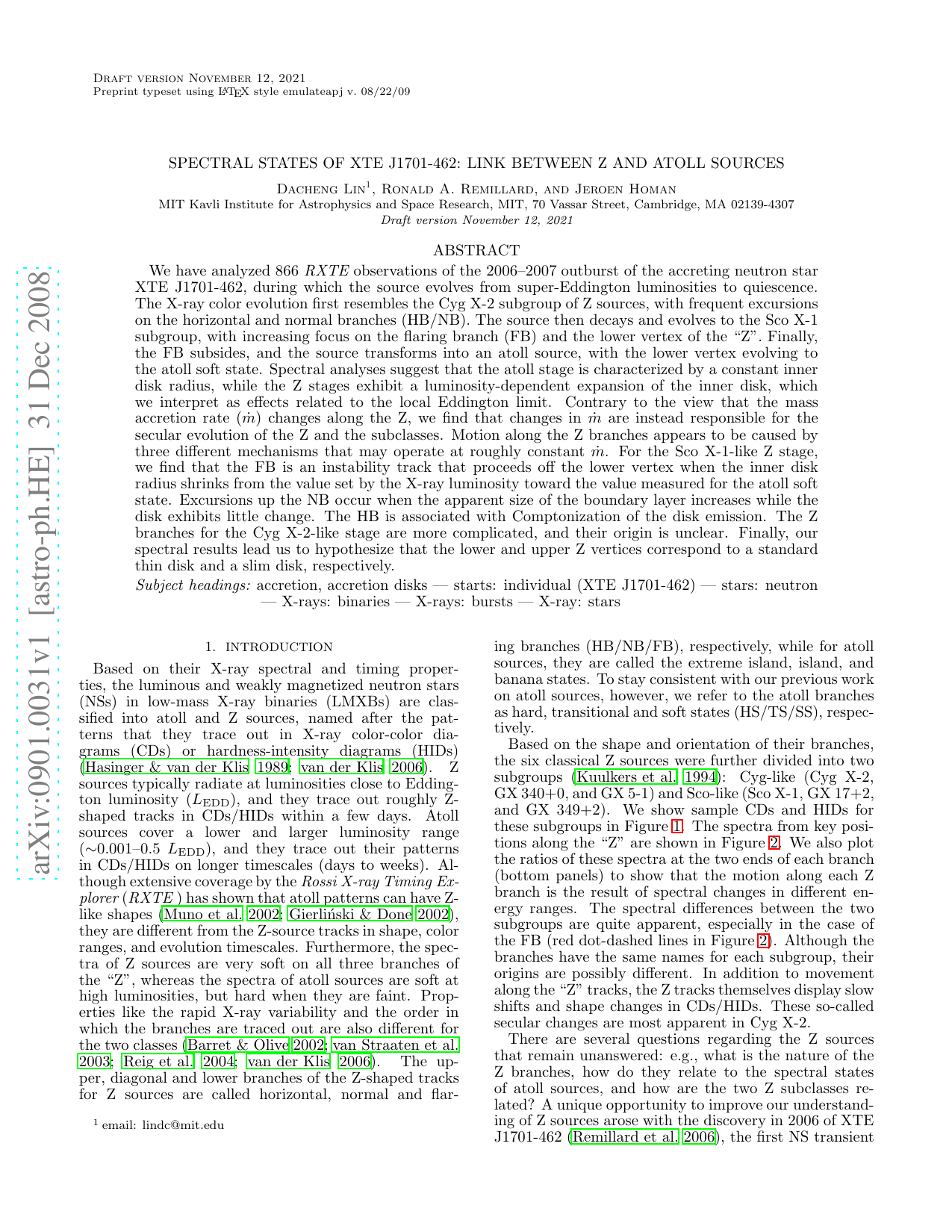
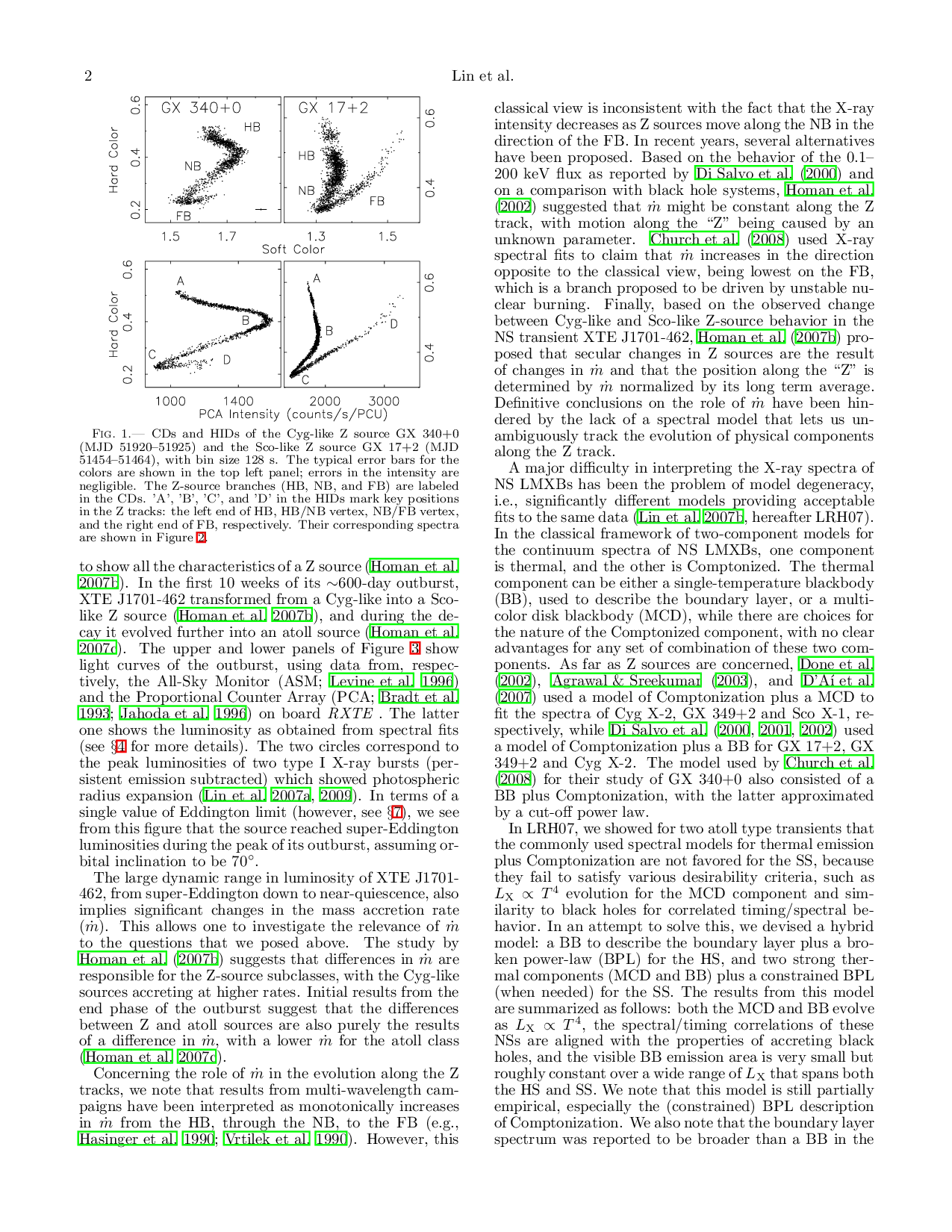
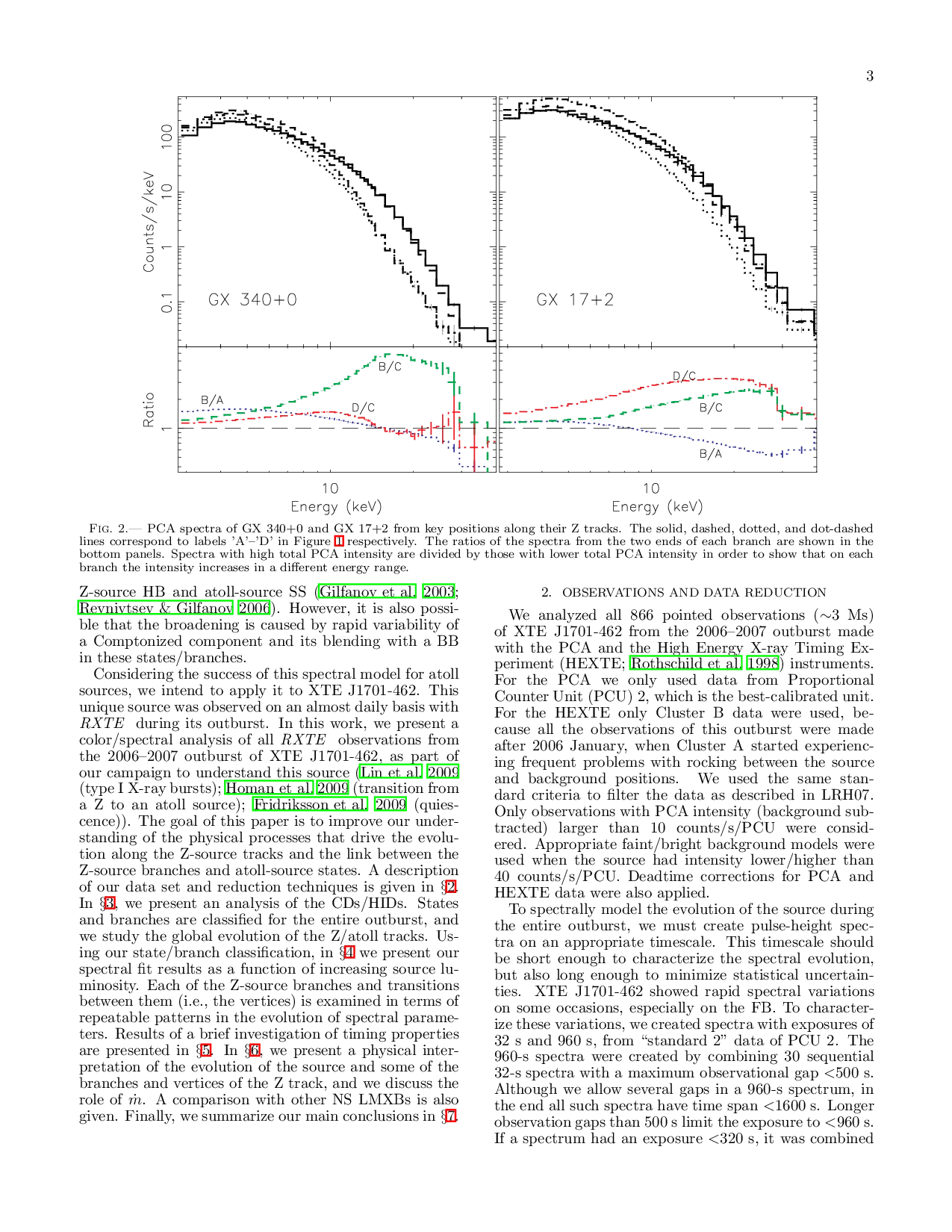
Based on the shape and orientation of their branches, the six classical Z sources were further divided into two subgroups (Kuulkers et al. 1994): Cyg-like (Cyg X-2, GX 340+0, and GX 5-1) and Sco-like (Sco X-1, GX 17+2, and GX 349+2). We show sample CDs and HIDs for these subgroups in Figure 1. The spectra from key positions along the “Z” are shown in Figure 2. We also plot the ratios of these spectra at the two ends of each branch (bottom panels) to show that the motion along each Z branch is the result of spectral changes in different energy ranges. The spectral differences between the two subgroups are quite apparent, especially in the case of the FB (red dot-dashed lines in Figure 2). Although the branches have the same names for each subgroup, their origins are possibly different. In addition to movement along the “Z” tracks, the Z tracks themselves display slow shifts and shape changes in CDs/HIDs. These so-called secular changes are most apparent in Cyg X-2.
There are several questions regarding the Z sources that remain unanswered: e.g., what is the nature of the Z branches, how do they relate to the spectral states of atoll sources, and how are the two Z subclasses related? A unique opportunity to improve our understanding of Z sources arose with the discovery in 2006 of XTE J1701-462 (Remillard et al. 2006), the first NS transient to show all the characteristics of a Z source (Homan et al. 2007b). In the first 10 weeks of its ∼600-day outburst, XTE J1701-462 transformed from a Cyg-like into a Scolike Z source (Homan et al. 2007b), and during the decay it evolved further into an atoll source (Homan et al. 2007c). The upper and lower panels of Figure 3 show light curves of the outburst, using data from, respectively, the All-Sky Monitor (ASM; Levine et al. 1996) and the Proportional Counter Array (PCA; Bradt et al. 1993;Jahoda et al. 1996) on board RXTE . The latter one shows the luminosity as obtained from spectral fits (see §4 for more details). The two circles correspond to the peak luminosities of two type I X-ray bursts (persistent emission subtracted) which showed photospheric radius expansion (Lin et al. 2007a(Lin et al. , 2009)). In terms of a single value of Eddington limit (however, see §7), we see from this figure that the source reached super-Eddington luminosities during the peak of its outburst, assuming orbital inclination to be 70 • .
The large dynamic range in luminosity of XTE J1701-462, from super-Eddington down to near-quiescence, also implies significant changes in the mass accretion rate ( ṁ). This allows one to investigate the relevance of ṁ to the questions that we posed above. The study by Homan et al. (2007b) suggests that differences in ṁ are responsible for the Z-source subclasses, with the Cyg-like sources accreting at higher rates. Initial results from the end phase of the outburst suggest that the differences between Z and atoll sources are also purely the results of a difference in ṁ, with a lower ṁ for the atoll class (Homan et al. 2007c).
Concerning the role of ṁ in the evolution along the Z tracks, we note that results from multi-wavelength campaigns have been interpreted as monotonically increases in ṁ from the HB, through the NB, to
…(Full text truncated)…
📸 Image Gallery
Reference
This content is AI-processed based on ArXiv data.