Profiles of spectral lines from failed and decelerated winds from neutron stars and black holes
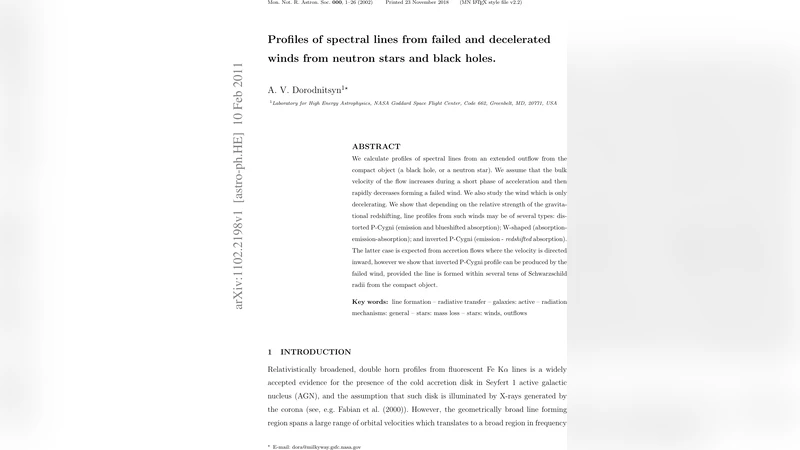
We calculate profiles of spectral lines from an extended outflow from the compact object (a black hole or a neutron star). We assume that the bulk velocity of the flow increases during a short phase of acceleration and then rapidly decreases forming a failed wind. We also study the wind which is only decelerating. We show that depending on the relative strength of the gravitational redshifting line profiles from such winds may be of several types: distorted P-Cygni (emission and blueshifted absorption); W-shaped (absorption-emission-absorption) and inverted P-Cygni (emission-redshifted absorption). The latter case is expected from accretion flows where the velocity is directed inwards; however, we show that inverted P-Cygni profile can be produced by the failed wind, provided the line is formed within several tens of Schwarzschild radii from the compact object.
💡 Research Summary
This paper investigates the formation of spectral line profiles in outflows that either accelerate briefly and then decelerate (“failed winds”) or decelerate monotonically from the launch point (“decelerated winds”) around compact objects such as black holes (BHs) and neutron stars (NSs). Building on the Sobolev approximation framework introduced in the author’s earlier work (Paper I), the study incorporates both Doppler shifts and gravitational redshift up to second‑order terms (v²/c², φ/c²) to treat photon propagation in the strong‑field regime (a few tens of Schwarzschild radii). Two gravitational potentials are considered: the Newtonian potential and the pseudo‑Newtonian Paczynski‑Wiita potential, the latter reproducing key relativistic features such as the innermost stable circular orbit at 3 r_g and the marginally bound orbit at 2 r_g.
The wind is assumed to be spherically symmetric, launched from a photospheric radius R_c, and characterized by a dimensionless gravity parameter g₀ = R_c/r_g that quantifies the importance of gravitational redshift. Velocity laws are prescribed as v(r) ∝ (1 − R_c/r)^m (stellar‑type) or v(r) ∝ r⁻ᵐ for decelerating flows, with the exponent m > 0 controlling how rapidly the flow slows. For failed winds a short acceleration phase is followed by a transition to the decelerating law; the transition is described by a smooth bridging function. The authors explore a range of m, focusing on m ≥ 3 where the deceleration is sufficiently abrupt to produce pronounced redshifted absorption.
Within the Sobolev formalism, the resonance condition for a photon is expressed in dimensionless variables (frequency shift y, radius x = r/R_c, velocity u = v/v_th, and gravitational potential Φ). The Sobolev length L_sob = v_th/|dv/ds + (1/c)dφ/ds| includes the gradient of the gravitational potential, making the optical depth τ_sob directly sensitive to the local gravity. The line opacity χ₀ is computed from atomic parameters (oscillator strength, level populations) and the Sobolev optical depth is written as τ_l = τ_r ×
Comments & Academic Discussion
Loading comments...
Leave a Comment