X-ray emission from HESS J1731-347/SNR G353.6-0.7 and Central Compact Source XMMS J173203-344518
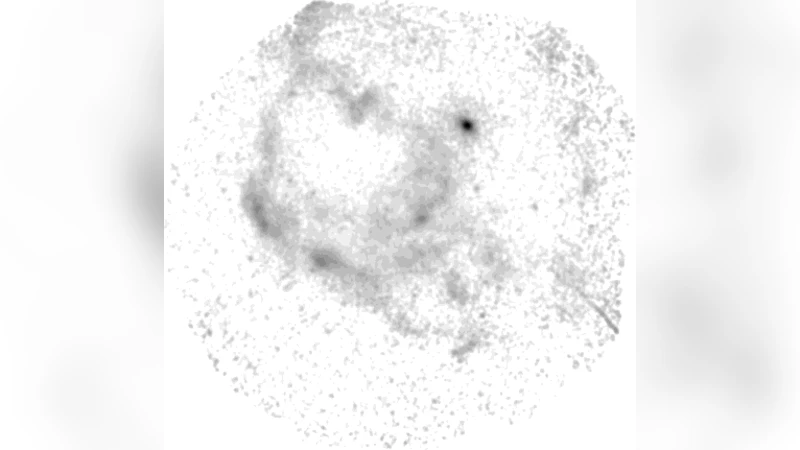
We present new results of the HESS J1731-347/SNR G353.6-0.7 system from XMM-NEWTOM and Suzaku X-ray observations, and Delinha CO observations. We discover extended hard X-rays coincident with the bright, extended TeV source HESS J1731-347 and the shell of the radio SNR. We find that spatially-resolved X-ray spectra can generally be characterized by an absorbed power-law model, with photon-index of ~ 2, typical of non-thermal emission. A bright X-ray compact source, XMMS J173203-344518, is also detected near the center of the SNR. We find no evidence of a radio counterpart or an extended X-ray morphology for this source, making it unlikely to be a pulsar wind nebular (PWN). The spectrum of the source can be well fitted by an absorbed blackbody with a temperature of ~ 0.5 keV plus a power-law tail with a photon-index of ~ 5, reminiscent of the X-ray emission of a magnetar. CO observations toward the inner part of the HESS source reveal a bright cloud component at -20+/-4 km s^{-1}, which is likely located at the same distance of ~ 3.2 kpc as the SNR. Based on the probable association between the X-ray and $\gamma$-ray emissions and likely association between the CO cloud and the SNR, we argue that the extended TeV emission originates from the interaction between the SNR shock and the adjacent CO clouds rather than from a PWN.
💡 Research Summary
The authors present a multi‑wavelength investigation of the HESS J1731‑347 / SNR G353.6‑0.7 system, combining deep X‑ray observations from XMM‑Newton (NEWTOM) and Suzaku with molecular‑line data from the Delinha CO survey. Their X‑ray imaging reveals extended hard (2–10 keV) emission that closely follows the bright TeV morphology of HESS J1731‑347 and the radio shell of the supernova remnant. Spatially resolved spectroscopy shows that virtually all shell regions are well described by an absorbed power‑law with photon indices Γ≈1.9–2.2 and column densities N_H≈(1–2)×10²² cm⁻², indicating non‑thermal synchrotron radiation from shock‑accelerated electrons, a hallmark of young shell‑type remnants.
In addition to the shell, a compact X‑ray source, XMMS J173203‑344518, is detected near the geometric centre of the SNR. No radio counterpart or extended nebular emission is found, arguing against a pulsar‑wind‑nebula (PWN) interpretation. Its spectrum requires two components: an absorbed blackbody with kT≈0.5 keV and a very soft power‑law tail with Γ≈5. This combination resembles the thermal plus magnetospheric emission seen in magnetars, suggesting that the source could be a central compact object (CCO) of the magnetar class rather than a conventional rotation‑powered pulsar.
The CO observations uncover a bright molecular cloud component at a line‑of‑sight velocity of –20 ± 4 km s⁻¹. Using a standard Galactic rotation curve, the authors assign a kinematic distance of ≈3.2 kpc to this cloud, which matches independent distance estimates for the SNR. The spatial coincidence of the cloud with the interior of the TeV source implies a physical interaction between the SNR shock and dense ambient material.
The authors argue that the extended TeV emission is most naturally explained by hadronic processes: shock‑accelerated protons collide with the dense CO cloud, producing neutral pions that decay into γ‑rays. This scenario is supported by the alignment of the non‑thermal X‑ray shell (tracing electron acceleration) with the TeV morphology, and by the lack of a powerful central engine capable of powering a leptonic PWN. While a leptonic inverse‑Compton or bremsstrahlung origin cannot be completely ruled out, the required electron energy density would be unrealistically high given the observed X‑ray flux and the absence of a bright PWN.
In summary, the paper provides compelling evidence that (1) the shell of SNR G353.6‑0.7 emits non‑thermal X‑rays with a photon index near 2, (2) the central compact source XMMS J173203‑344518 exhibits a magnetar‑like spectrum, and (3) the TeV γ‑ray emission from HESS J1731‑347 is most likely generated by the interaction of the SNR shock with a nearby molecular cloud at ~3 kpc. This work underscores the importance of coordinated X‑ray, γ‑ray, and molecular observations for disentangling the origins of high‑energy emission in complex Galactic environments.
Comments & Academic Discussion
Loading comments...
Leave a Comment