The Frequency of Low-mass Exoplanets
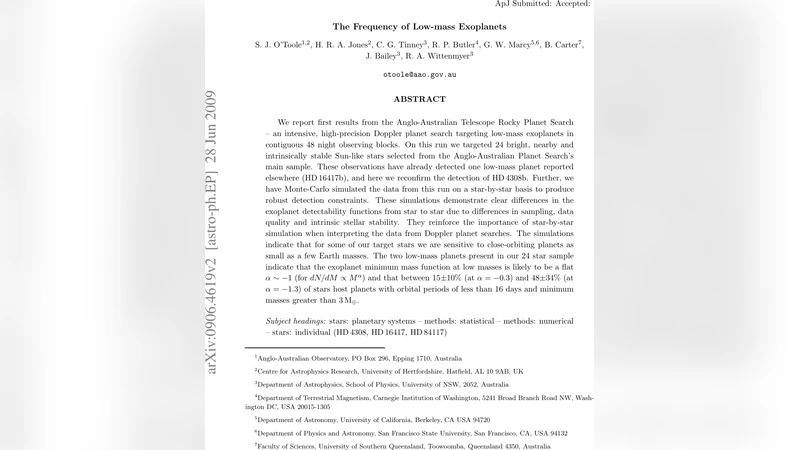
We report first results from the Anglo-Australian Telescope Rocky Planet Search - an intensive, high-precision Doppler planet search targeting low-mass exoplanets in contiguous 48 night observing blocks. On this run we targeted 24 bright, nearby and intrinsically stable Sun-like stars selected from the Anglo-Australian Planet Search’s main sample. These observations have already detected one low-mass planet reported elsewhere (HD16417b), and here we reconfirm the detection of HD4308b. Further, we have Monte-Carlo simulated the data from this run on a star-by-star basis to produce robust detection constraints. These simulations demonstrate clear differences in the exoplanet detectability functions from star to star due to differences in sampling, data quality and intrinsic stellar stability. They reinforce the importance of star-by-star simulation when interpreting the data from Doppler planet searches. The simulations indicate that for some of our target stars we are sensitive to close-orbiting planets as small as a few Earth masses. The two low-mass planets present in our 24 star sample indicate that the exoplanet minimum mass function at low masses is likely to be a flat alpha ~ -1 (for dN/dM proportional to M^alpha) and that between 15+/-10% (at alpha=-0.3) and 48+/-34% (at alpha=-1.3) of stars host planets with orbital periods of less than 16 days and minimum masses greater than 3 Mearth.
💡 Research Summary
The paper presents the first results of the Anglo‑Australian Telescope (AAT) Rocky Planet Search, a dedicated high‑precision Doppler survey designed to detect low‑mass exoplanets in short‑period orbits. The authors selected 24 bright, nearby, and intrinsically stable Sun‑like stars from the main Anglo‑Australian Planet Search (AAPS) sample and observed them continuously over a 48‑night block, obtaining densely sampled radial‑velocity (RV) time series with an average internal precision of ~1 m s⁻¹.
Two low‑mass planets are highlighted. The previously reported super‑Earth HD 16417b is re‑detected, confirming the reliability of the data reduction pipeline, and the authors independently recover HD 4308b, providing an additional validation point. Both planets have minimum masses below 20 M⊕ and orbital periods of 10–15 days, illustrating that the survey can indeed reach the regime of a few Earth masses.
A central methodological contribution is the star‑by‑star Monte‑Carlo simulation framework. For each target, the authors generated 10⁴ synthetic RV datasets that preserve the exact observation times, measurement uncertainties, and intrinsic stellar jitter of the real data. Artificial planets spanning a grid of masses (1–20 M⊕) and periods (1–30 days) were injected, and a Lomb‑Scargle periodogram with a false‑alarm probability threshold of 1 % was used to assess detectability. The simulations reveal a wide spread in detection sensitivity among the 24 stars, driven primarily by differences in sampling cadence, data quality, and stellar activity levels. For the best‑sampled stars, planets as small as a few Earth masses are detectable at periods shorter than ~10 days, whereas for less favorable targets the detection limit rises to ~10 M⊕.
By combining the observed detections with the detection probability maps, the authors performed a Bayesian inference on the underlying planetary mass function, parameterized as dN/dM ∝ M^α. The posterior peaks near α ≈ ‑1, indicating a roughly flat distribution in logarithmic mass (i.e., the number of planets per decade of mass does not decline sharply toward lower masses). Assuming α values ranging from –0.3 to –1.3, the inferred fraction of stars hosting planets with minimum masses > 3 M⊕ and orbital periods < 16 days spans 15 % ± 10 % (for α = ‑0.3) up to 48 % ± 34 % (for α = ‑1.3). These percentages, albeit with sizable uncertainties due to the small sample, suggest that short‑period low‑mass planets are relatively common around Sun‑like stars.
The paper emphasizes the importance of star‑by‑star detection simulations. Traditional approaches that apply a single, survey‑wide detection threshold can misrepresent the true sensitivity, especially when the sample includes stars with heterogeneous jitter and sampling patterns. The authors argue that robust occurrence‑rate estimates for low‑mass planets demand individualized completeness analyses.
In the discussion, the authors place their findings in the context of planet‑formation theory. A flat or slightly rising mass function toward lower masses supports core‑accretion models where the efficiency of forming Earth‑mass cores is high, and it aligns with recent results from Kepler and other Doppler surveys that report a high prevalence of super‑Earths and mini‑Neptunes. They also note that the current survey’s limited temporal baseline restricts sensitivity to longer‑period planets; extending the monitoring to several years would enable probing the transition between short‑period super‑Earths and the more distant population of Neptune‑mass planets.
Future work outlined includes expanding the target list, improving the treatment of stellar activity (e.g., incorporating Ca II H&K indices), and combining Doppler data with transit photometry to break the sin i degeneracy and obtain true planetary masses and radii. The authors conclude that the AAT Rocky Planet Search demonstrates that ground‑based Doppler spectroscopy, when coupled with intensive, well‑sampled observing campaigns and rigorous star‑specific simulations, can reliably detect planets down to a few Earth masses and provide meaningful constraints on their occurrence rates.
Comments & Academic Discussion
Loading comments...
Leave a Comment