Substellar-mass companions to the K-dwarf BD +14 4559 and the K-giants HD 240210 and BD +20 2457
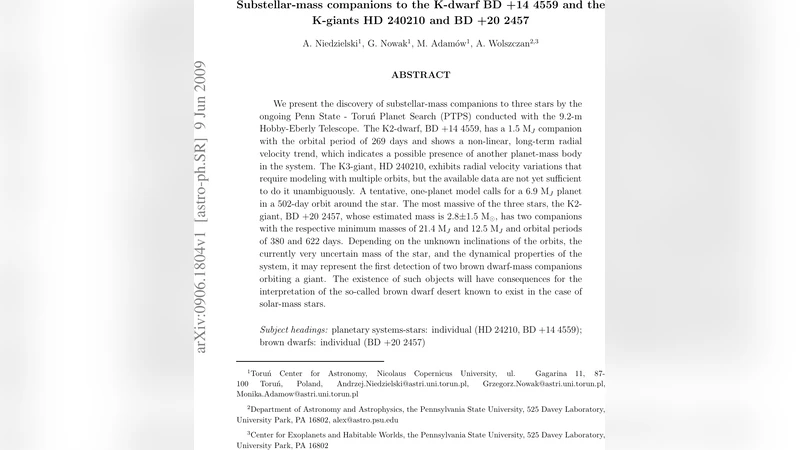
We present the discovery of substellar-mass companions to three stars by the ongoing Penn State - Toru' n Planet Search (PTPS) conducted with the 9.2-m Hobby-Eberly Telescope. The K2-dwarf, BD +14 4559, has a 1.5 M$_{J}$ companion with the orbital period of 269 days and shows a non-linear, long-term radial velocity trend, which indicates a possible presence of another planet-mass body in the system. The K3-giant, HD 240210, exhibits radial velocity variations that require modeling with multiple orbits, but the available data are not yet sufficient to do it unambiguously. A tentative, one-planet model calls for a 6.9 M$J$ planet in a 502-day orbit around the star. The most massive of the three stars, the K2-giant, BD +20 2457, whose estimated mass is 2.8$\pm$1.5 M$\odot$, has two companions with the respective minimum masses of 21.4 M$_J$ and 12.5 M$_J$ and orbital periods of 380 and 622 days. Depending on the unknown inclinations of the orbits, the currently very uncertain mass of the star, and the dynamical properties of the system, it may represent the first detection of two brown dwarf-mass companions orbiting a giant. The existence of such objects will have consequences for the interpretation of the so-called brown dwarf desert known to exist in the case of solar-mass stars.
💡 Research Summary
The paper reports the discovery of sub‑stellar companions around three K‑type stars—one dwarf (BD +14 4559) and two giants (HD 240210 and BD +20 2457)—as part of the Penn State‑Torun Planet Search (PTPS) using the 9.2‑m Hobby‑Eberly Telescope (HET). High‑resolution echelle spectra were obtained over a period of several years, and radial‑velocity (RV) measurements were derived with an iodine cell, achieving a typical precision of 3–5 m s⁻¹. Stellar parameters (effective temperature, metallicity, surface gravity, mass) were determined from the spectra and evolutionary tracks, with particular attention to the large mass uncertainty of the most massive target, BD +20 2457 (2.8 ± 1.5 M⊙).
BD +14 4559 (K2 V) – The RV time series exhibits a clear, sinusoidal variation with a period of 269 days, semi‑amplitude ≈ 45 m s⁻¹, and modest eccentricity (e ≈ 0.2). A Keplerian fit yields a minimum mass (m sin i) of 1.5 MJ and a semi‑major axis of ~0.8 AU. In addition, a long‑term, non‑linear trend is present, suggesting a second, more distant companion of planetary mass. The system therefore resembles many multi‑planet main‑sequence stars already known from RV surveys.
HD 240210 (K3 III) – The RV curve is more complex. A single‑planet model with P ≈ 502 days, m sin i ≈ 6.9 MJ, and e ≈ 0.15 provides a reasonable fit, but the residuals display additional power at periods of a few hundred days. The current data set (≈ 35 measurements) is insufficient to uniquely determine whether a second planet, stellar activity, or pulsations are responsible. The authors present the one‑planet solution as provisional and emphasize the need for continued monitoring.
BD +20 2457 (K2 III) – This star shows two robust RV signals with periods of 380 days and 622 days. The derived Keplerian parameters are:
- Inner companion: m sin i ≈ 21.4 MJ, a ≈ 1.1 AU, e ≈ 0.1.
- Outer companion: m sin i ≈ 12.5 MJ, a ≈ 1.6 AU, e ≈ 0.2.
Both minimum masses fall within the brown‑dwarf regime (13–80 MJ). Because the stellar mass is poorly constrained, the true masses could be substantially larger if the orbital inclination is low. Dynamical analysis (N‑body integrations) shows that the two bodies are near a 3:2 mean‑motion resonance and remain stable over ≥10⁶ yr, indicating a dynamically viable configuration.
Scientific implications – The detection of two brown‑dwarf‑mass companions around a single giant challenges the “brown‑dwarf desert” observed around solar‑type stars, where companions in the 30–80 MJ range are rare. The authors argue that the desert may be a function of host‑star mass: more massive stars possess more massive protoplanetary disks, potentially allowing direct gravitational collapse (disk instability) or rapid core accretion to produce brown‑dwarf‑mass objects. The presence of a long‑term trend in BD +14 4559 and the ambiguous signal in HD 240210 further illustrate that multi‑planet systems are common even around evolved stars, supporting the notion that planet formation is not strongly suppressed by stellar evolution.
Methodological notes – The study demonstrates the capability of long‑baseline RV surveys with moderate‑size telescopes to detect sub‑stellar companions around evolved stars, despite increased stellar jitter and larger radii. The authors stress the importance of complementary data (e.g., astrometry from Gaia, high‑contrast imaging) to break the sin i degeneracy and to confirm the nature (planet vs. brown dwarf) of the companions.
Conclusions – The PTPS has identified a 1.5 MJ planet around a K‑dwarf, a tentative 6.9 MJ planet around a K‑giant, and a pair of brown‑dwarf candidates orbiting a massive K‑giant. These findings expand the known population of sub‑stellar companions to higher‑mass hosts and suggest that the brown‑dwarf desert may be less pronounced—or even absent—around intermediate‑mass giants. Continued RV monitoring, combined with astrometric and direct‑imaging follow‑up, will be essential to refine orbital parameters, determine true masses, and elucidate the formation pathways of such massive companions.
Comments & Academic Discussion
Loading comments...
Leave a Comment