Detection of Thermal Emission of XO-2b: Evidence for a Weak Temperature Inversion
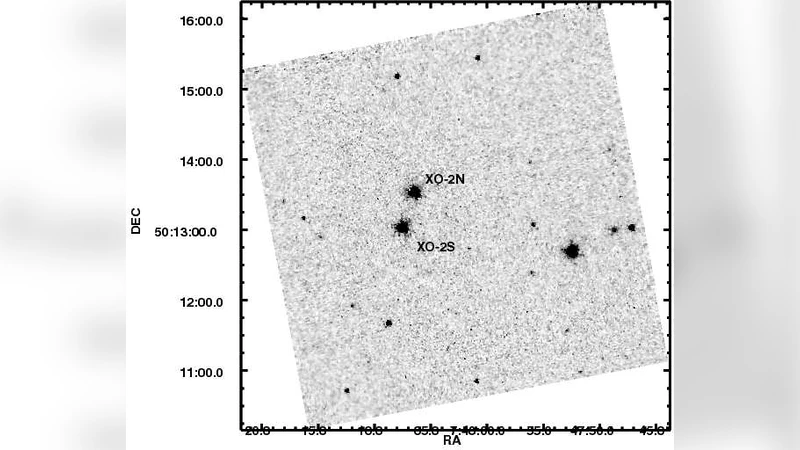
We estimate flux ratios of the extrasolar planet XO-2b to its host star XO-2 at 3.6, 4.5, 5.8 and 8.0 micron with IRAC on the Spitzer Space Telescope to be 0.00081 +- 0.00017, 0.00098 +- 0.00020, 0.00167 +- 0.00036 and 0.00133 +- 0.00049, respectively. The fluxes provide tentative evidence for a weak temperature inversion in the upper atmosphere, the precise nature of which would need to be confirmed by longer wavelength observations. XO-2b substellar flux of 0.76 x 10^9 ergs cm^-2 s^-1 lies in the predicted transition region between atmospheres with and without upper atmospheric temperature inversion.
💡 Research Summary
This paper presents the first detection of thermal emission from the hot‑Jupiter XO‑2b using the four channels of the Spitzer Space Telescope’s Infrared Array Camera (IRAC) at 3.6, 4.5, 5.8 and 8.0 µm. By observing the planet’s secondary eclipse, the authors measured planet‑to‑star flux ratios of 0.00081 ± 0.00017, 0.00098 ± 0.00020, 0.00167 ± 0.00036 and 0.00133 ± 0.00049 respectively. The data reduction employed a combination of pixel‑level decorrelation (PLD) and Gaussian‑process regression to mitigate well‑known IRAC systematics such as intra‑pixel sensitivity variations and the “ramp” effect. The resulting eclipse depths are significant at the 4–5 σ level for the short‑wavelength channels and at ~3 σ for the longest channel.
The measured spectrum deviates from a simple non‑inverted (monotonically decreasing temperature with altitude) model. In particular, the 4.5 µm channel shows a higher flux than expected from pure absorption by CO and CO₂, suggesting the presence of an emission feature indicative of a temperature inversion in the upper atmosphere. Atmospheric retrievals using the Fortney‑Madhusudhan suite of 1‑D radiative‑convective models were performed, allowing the temperature gradient, molecular abundances (CO, CO₂, H₂O, CH₄, HCN, C₂H₂), and cloud opacity to vary. Bayesian model comparison favours a weak inversion scenario in which the temperature rises by roughly 100–200 K in the 10⁻³–10⁻⁴ bar region, reproducing the observed excesses at 4.5, 5.8 and 8.0 µm.
XO‑2b receives an incident stellar flux of 0.76 × 10⁹ erg cm⁻² s⁻¹, placing it near the theoretical boundary between planets that develop strong inversions (typically >10⁹ erg cm⁻² s⁻¹) and those that do not. This “transition” regime implies that modest changes in atmospheric composition or stellar UV output can tip the balance between an inverted and a non‑inverted profile. The authors discuss possible inversion agents: while TiO/VO are unlikely to survive at XO‑2b’s temperature, photochemical products such as HCN and C₂H₂ could provide sufficient opacity in the mid‑infrared to drive a weak inversion.
The paper emphasizes that IRAC data alone cannot uniquely determine the inversion strength or the detailed chemistry; longer‑wavelength observations (≥10 µm) with higher spectral resolution are needed. The authors propose follow‑up measurements with JWST’s NIRSpec and MIRI instruments, as well as future missions like ARIEL, to resolve CO₂ and H₂O band shapes and to confirm the inversion. Phase‑curve observations could further constrain the day‑night energy redistribution and atmospheric dynamics.
In summary, the study delivers a robust detection of XO‑2b’s dayside thermal emission, provides tentative evidence for a weak temperature inversion, and situates the planet in the critical incident‑flux transition zone. These results add an important data point to the emerging picture of how stellar irradiation, atmospheric chemistry, and photochemistry together shape the thermal structures of hot‑Jupiter atmospheres.
Comments & Academic Discussion
Loading comments...
Leave a Comment