The Star Formation Rate in the Reionization Era as Indicated by Gamma-ray Bursts
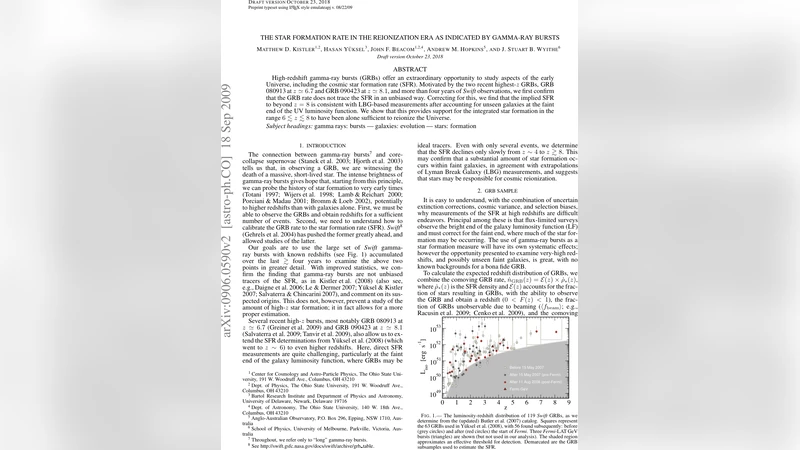
High-redshift gamma-ray bursts (GRBs) offer an extraordinary opportunity to study aspects of the early Universe, including the cosmic star formation rate (SFR). Motivated by the two recent highest-z GRBs, GRB 080913 at z = 6.7 and GRB 090423 at z = 8.1, and more than four years of Swift observations, we first confirm that the GRB rate does not trace the SFR in an unbiased way. Correcting for this, we find that the implied SFR to beyond z = 8 is consistent with LBG-based measurements after accounting for unseen galaxies at the faint end of the UV luminosity function. We show that this provides support for the integrated star formation in the range 6 < z < 8 to have been alone sufficient to reionize the Universe.
💡 Research Summary
The paper investigates how high‑redshift gamma‑ray bursts (GRBs) can be used to infer the cosmic star‑formation rate (SFR) during the epoch of reionization. Motivated by the two record‑breaking GRBs—GRB 080913 at z = 6.7 and GRB 090423 at z = 8.1—and more than four years of Swift observations, the authors first demonstrate that the raw GRB detection rate does not trace the underlying SFR in an unbiased manner. This discrepancy arises because GRB production is sensitive to factors such as metallicity, the initial mass function (IMF), and the star‑formation environment, which evolve with redshift.
To correct for these biases, the authors compare the observed GRB rate with the SFR derived from Lyman‑break galaxy (LBG) surveys. LBG studies rely on the ultraviolet (UV) luminosity function, but current observations miss a substantial population of faint galaxies below the detection threshold. By assuming a steep faint‑end slope (α ≈ ‑2.0) for the UV luminosity function and integrating down to very low luminosities, the authors estimate the contribution of these unseen galaxies to the total SFR density. After applying this correction, the GRB‑inferred SFR at 6 < z < 8 aligns closely with the SFR obtained from LBG measurements, especially at z ≈ 8 where the GRB data fill in the gap left by incomplete galaxy surveys.
With a bias‑corrected SFR in hand, the authors calculate the production rate of ionizing photons required to keep the intergalactic medium ionized. Their analysis shows that the integrated star formation in the redshift interval 6 < z < 8 produces enough ionizing photons to sustain reionization, even without invoking additional sources such as quasars or exotic particle decay. This result supports the hypothesis that ordinary star formation alone could have driven the reionization of the Universe.
The study acknowledges several caveats. The conversion from GRB rate to SFR assumes that GRB production is only weakly dependent on metallicity at these early epochs, that the IMF does not dramatically differ from the local one, and that the escape fraction of ionizing photons remains roughly constant. These assumptions introduce systematic uncertainties that future observations must address. The authors highlight the importance of upcoming facilities—particularly the James Webb Space Telescope (JWST), Euclid, and the Roman Space Telescope—to directly detect the faint galaxy population and to refine measurements of metallicity and IMF at very high redshift.
In summary, the paper demonstrates that high‑redshift GRBs, when properly calibrated against galaxy surveys, provide a powerful complementary probe of early star formation. By accounting for the missing faint galaxies, the GRB‑derived SFR matches existing LBG estimates and confirms that the star‑forming activity between redshifts 6 and 8 is sufficient to explain the reionization of the Universe. This work thus strengthens the case for using GRBs as cosmological tools and sets the stage for more precise constraints on the early Universe with next‑generation observations.
Comments & Academic Discussion
Loading comments...
Leave a Comment