Coronal radiation belts
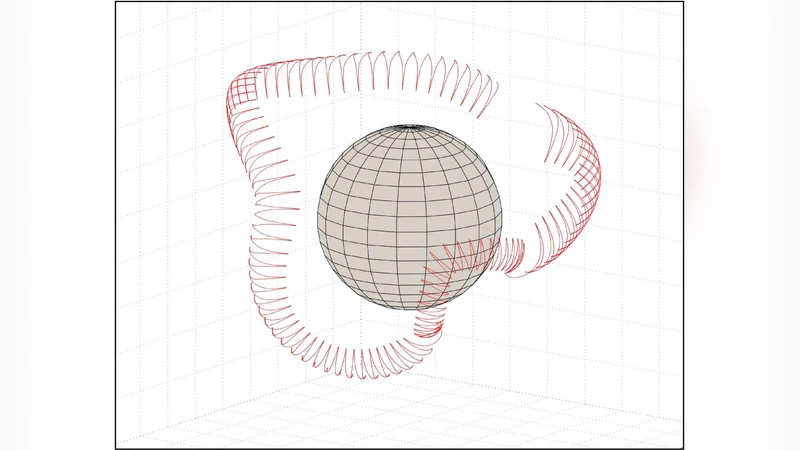
The magnetic field of the solar corona has a large-scale dipole character, which maps into the bipolar field in the solar wind. Using standard representations of the coronal field, we show that high-energy ions can be trapped stably in these large-scale closed fields. The drift shells that describe the conservation of the third adiabatic invariant may have complicated geometries. Particles trapped in these zones would resemble the Van Allen Belts and could have detectable consequences. We discuss potential sources of trapped particles.
💡 Research Summary
The paper investigates the possibility that the large‑scale magnetic field of the solar corona can trap high‑energy ions in a manner analogous to Earth’s Van Allen radiation belts. Using standard coronal magnetic field models—specifically the Potential Field Source Surface (PFSS) extrapolation—the authors demonstrate that, up to roughly 2.5 solar radii, a substantial fraction of magnetic field lines are closed, forming large‑scale dipolar loops that map into the bipolar heliospheric field. Within these closed loops, charged particles experience the three adiabatic invariants: (1) the magnetic moment associated with gyration, (2) the bounce motion between magnetic mirror points, and (3) the drift motion around the Sun that conserves the magnetic flux enclosed by the drift shell. The third invariant gives rise to “drift shells” that can have highly non‑spherical, twisted geometries because the coronal field is not perfectly axisymmetric.
The authors perform test‑particle simulations to assess the stability of such drift shells. They find that particles with energies from a few tens of MeV up to several hundred MeV can remain confined for times ranging from several hours to a few days, depending on local plasma density and the degree of magnetic field line curvature. Two principal loss mechanisms are identified: (i) collisional energy loss and pitch‑angle scattering with the ambient coronal plasma, which shortens lifetimes in denser regions, and (ii) the opening of previously closed field lines during solar activity cycles (e.g., CME eruptions or large‑scale reconnection), which can abruptly release trapped particles. Even with these losses, the simulations show that a quasi‑steady population of energetic ions can be maintained in the closed‑field zones.
Potential sources of the trapped particles are discussed in detail. First, solar flares and coronal mass ejections (CMEs) can accelerate ions to the required energies via impulsive electric fields and shock waves; a fraction of these ions may be injected into the closed loops before the field opens. Second, the solar wind itself contains suprathermal ions that can be further accelerated by drift‑induced electric fields at the boundary of the closed region, effectively “re‑charging” the belt. Third, galactic cosmic rays (GCRs) and interstellar energetic particles may penetrate the outer corona and become trapped if their rigidity is sufficient to follow the curved field lines without immediate loss.
If such a coronal radiation belt exists, it would have observable consequences. Trapped ions undergoing pitch‑angle scattering or occasional precipitation could produce enhanced hard X‑ray and γ‑ray emission, potentially accounting for some of the unexplained high‑energy solar photon events observed by RHESSI, Fermi‑GBM, and other instruments. Moreover, ion precipitation would locally increase ionization in the low corona, altering the refractive index for radio waves and possibly leading to transient radio scintillation or absorption features. Finally, the occasional release of belt particles during magnetic restructuring could generate short‑duration bursts of energetic particles in interplanetary space, influencing space‑weather conditions near Earth.
In summary, the paper provides a theoretical framework showing that the Sun’s large‑scale dipolar coronal field can support stable, long‑lived drift shells capable of trapping high‑energy ions. By combining magnetic topology analysis with test‑particle dynamics, the authors argue that a “coronal radiation belt” is a plausible, though as yet unobserved, component of the solar environment. They call for targeted high‑energy observations and refined MHD models to verify the existence and assess the impact of such belts on solar and heliospheric physics.
Comments & Academic Discussion
Loading comments...
Leave a Comment