Observation of Extended VHE Emission from the Supernova Remnant IC 443 with VERITAS
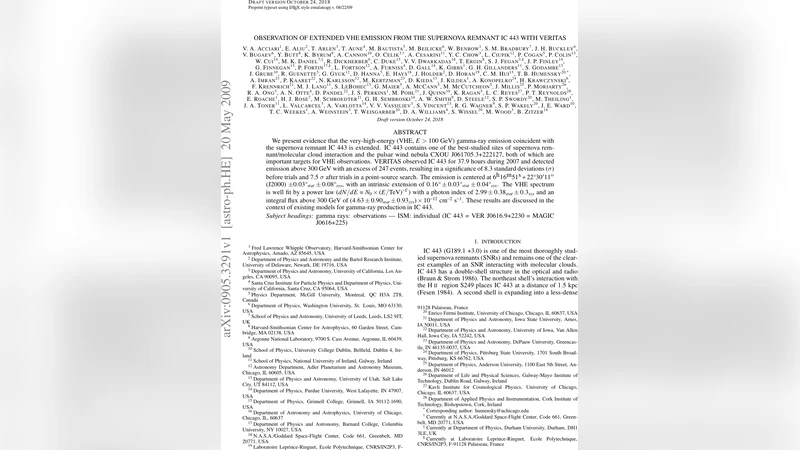
We present evidence that the very-high-energy (VHE, E > 100 GeV) gamma-ray emission coincident with the supernova remnant IC 443 is extended. IC 443 contains one of the best-studied sites of supernova remnant/molecular cloud interaction and the pulsar wind nebula CXOU J061705.3+222127, both of which are important targets for VHE observations. VERITAS observed IC 443 for 37.9 hours during 2007 and detected emission above 300 GeV with an excess of 247 events, resulting in a significance of 8.3 standard deviations (sigma) before trials and 7.5 sigma after trials in a point-source search. The emission is centered at 06 16 51 +22 30 11 (J2000) +- 0.03_stat +- 0.08_sys degrees, with an intrinsic extension of 0.16 +- 0.03_stat +- 0.04_sys degrees. The VHE spectrum is well fit by a power law (dN/dE = N_0 * (E/TeV)^-Gamma) with a photon index of 2.99 +- 0.38_stat +- 0.3_sys and an integral flux above 300 GeV of (4.63 +- 0.90_stat +- 0.93_sys) * 10^-12 cm^-2 s^-1. These results are discussed in the context of existing models for gamma-ray production in IC 443.
💡 Research Summary
The paper reports the first clear detection of spatially extended very‑high‑energy (VHE, E > 100 GeV) gamma‑ray emission from the supernova remnant (SNR) IC 443 using the VERITAS array. Observations were carried out in 2007 for a total live time of 37.9 hours. After standard data quality selection and background estimation with the reflected‑region method, an excess of 247 events above 300 GeV was found, corresponding to a pre‑trial significance of 8.3σ and a post‑trial significance of 7.5σ for a point‑source search.
The centroid of the emission is located at J2000 RA 06 h 16 m 51 s, Dec +22° 30′ 11″, with statistical uncertainties of ±0.03° and systematic uncertainties of ±0.08°. By fitting a two‑dimensional Gaussian convolved with the instrument point‑spread function, the intrinsic extension was measured as 0.16° ± 0.03° (stat) ± 0.04° (sys). This extension is significantly larger than the point‑like source reported by MAGIC and aligns with the region of dense molecular material known to be interacting with the SNR shock.
The differential spectrum between 300 GeV and ∼2 TeV is well described by a power law dN/dE = N₀ · (E/TeV)⁻ᵞ with photon index Γ = 2.99 ± 0.38 (stat) ± 0.30 (sys) and normalization N₀ = 8.38 × 10⁻¹³ TeV⁻¹ cm⁻² s⁻¹. The integral flux above 300 GeV is (4.63 ± 0.90 (stat) ± 0.93 (sys)) × 10⁻¹² cm⁻² s⁻¹, roughly 3 % of the Crab Nebula flux. The relatively soft spectrum and modest flux suggest either a limited acceleration efficiency or rapid energy losses of the highest‑energy particles.
The authors discuss two principal scenarios for the origin of the VHE emission. In the hadronic picture, protons accelerated at the SNR shock interact with the adjacent molecular cloud, producing neutral pions that decay into gamma rays. This model is supported by the spatial coincidence of the VHE centroid with the densest parts of the cloud (as traced by CO and HI surveys) and by the soft spectral index, which is compatible with a proton spectrum steepened by diffusion or energy‑dependent escape. In the leptonic picture, relativistic electrons from the nearby pulsar wind nebula (PWN CXOU J061705.3+222127) could generate gamma rays via inverse‑Compton scattering on ambient photon fields or via non‑thermal bremsstrahlung. However, the PWN lies ≈0.1° offset from the VHE centroid, and the required electron population would suffer severe synchrotron losses in the likely magnetic field, making a dominant leptonic contribution less plausible.
Comparison with earlier MAGIC results shows that VERITAS, thanks to its larger effective area and finer angular resolution, can resolve the source morphology and confirm its extended nature. The paper emphasizes that future observations with the Cherenkov Telescope Array (CTA) will be able to map the emission with sub‑0.05° resolution, disentangle contributions from the shock‑cloud interaction and the PWN, and constrain key physical parameters such as the diffusion coefficient, cloud density, and magnetic field strength.
In conclusion, the VERITAS detection of extended VHE gamma‑ray emission from IC 443 provides strong evidence that the interaction between an SNR shock and a dense molecular cloud can accelerate particles to at least several hundred GeV. The measured morphology and spectrum favor a hadronic origin, although a minor leptonic component cannot be ruled out. These results add an important data point to the growing body of evidence that middle‑aged SNRs interacting with ambient material are significant contributors to the Galactic cosmic‑ray population.
Comments & Academic Discussion
Loading comments...
Leave a Comment