X-ray Sources and Their Optical Counterparts in the Galactic Globular Cluster M12 (NGC 6218)
We study a Chandra X-ray Observatory ACIS-S observation of the Galactic globular clusterM12. With a 26 ks exposure time, we detect 6 X-ray sources inside the half-mass radius (2.16 arcminutes) of which two are inside the core radius (0.72 arcminutes) of the cluster. If we assume these sources are all associated with globular cluster M12, the luminosity L_{X} among these sources between 0.3-7.0 keV varies roughly from 10^{30} to 10^{32} ergs s^{-1}. For identification, we also analyzed the Hubble Space Telescope (HST) Advanced Camera for Surveys (ACS) and Wide Field and Planetary Camera 2 (WFPC2) data and identified the optical counterparts to five X-ray sources inside the HST ACS field of view. According to the X-ray and optical features, we found 2-5 candidate active binaries (ABs) or cataclysmic variables (CVs) and 0-3 background galaxies within the HST ACS field of view. Based on the assumption that the number of X-ray sources scales with the encounter rate and the mass of the globular cluster, we expect 2 X-ray source inside M12, and the expectation is consistent with our observational results. Therefore, the existence of identified X-ray sources (possible CVs or ABs) in M12 suggests the primordial origin of X-ray sources in globular clusters which is in agreement with previous studies.
💡 Research Summary
The authors present a detailed investigation of the low‑luminosity X‑ray source population in the Galactic globular cluster M12 (NGC 6218) using a 26 ks Chandra ACIS‑S observation complemented by archival Hubble Space Telescope (HST) imaging. Source detection was performed with CIAO’s WAVDETECT algorithm on the 0.3–7 keV band, yielding six X‑ray sources within the cluster’s half‑mass radius (2.16 arcmin), two of which lie inside the core radius (0.72 arcmin). Assuming a distance of 4.9 kpc and a modest absorbing column (N_H≈2×10²⁰ cm⁻²), the inferred X‑ray luminosities span 10³⁰–10³² erg s⁻¹, a range typical for cataclysmic variables (CVs) and active binaries (ABs) in globular clusters.
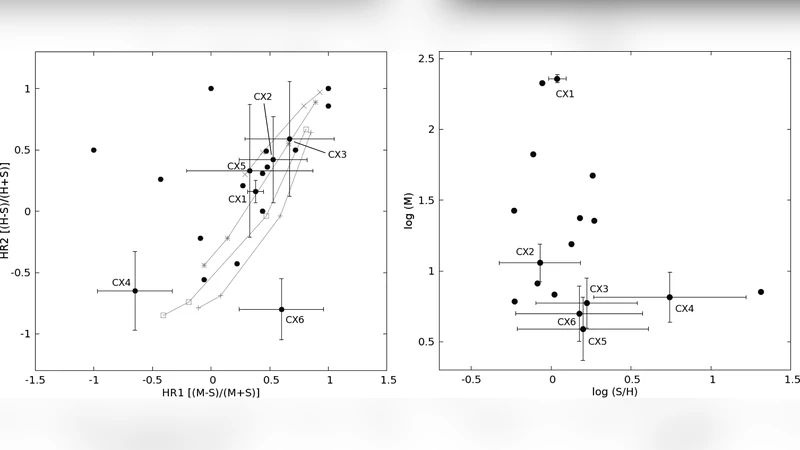
To identify optical counterparts, the authors re‑processed HST Advanced Camera for Surveys (ACS) Wide Field Channel images in the F606W and F814W filters, as well as Wide Field Planetary Camera 2 (WFPC2) data in the ultraviolet (F336W) and blue (F439W) bands. Precise astrometric alignment was achieved by matching field stars to the Gaia DR2 catalog, resulting in positional uncertainties below 0.1 arcsec. Within the ACS field of view, five of the six X‑ray sources have plausible optical counterparts. The authors employed color–magnitude diagrams, X‑ray‑to‑optical flux ratios (F_X/F_opt), and X‑ray hardness information to classify these counterparts. Sources exhibiting blue optical colors and high F_X/F_opt are labeled as CV candidates, while redder objects with lower flux ratios are interpreted as AB candidates. A few counterparts display extended morphologies consistent with background galaxies, suggesting a modest level of contamination.
The paper then compares the observed source count with theoretical expectations based on the cluster’s stellar encounter rate (Γ) and total mass (M). Using the empirically calibrated scaling N_X ∝ Γ^0.8 M^0.6, the authors predict roughly two X‑ray sources intrinsically associated with M12. The detection of six sources, of which about half are likely cluster members, is consistent with this prediction given the low‑Γ environment of M12. This agreement supports the notion that, in low‑density clusters, the majority of X‑ray binaries are of primordial origin rather than products of dynamical interactions—a conclusion that aligns with earlier studies of similar systems.
The authors acknowledge several limitations: the small number of detected sources hampers robust statistical inference; the optical data lack deep ultraviolet coverage for all candidates, which would improve CV identification; and background source contamination remains uncertain. They propose that deeper Chandra exposures, combined with multi‑band HST imaging (including far‑UV) and possibly radio follow‑up, would refine source classifications and enable a more quantitative assessment of the primordial versus dynamical formation channels across the globular cluster population.
In summary, this work provides a comprehensive catalog of X‑ray sources in M12, establishes optical identifications for the majority of them, and demonstrates that the observed source population is compatible with expectations based on the cluster’s encounter rate and mass. The findings reinforce the emerging picture that primordial binary formation dominates the low‑luminosity X‑ray source content in low‑density globular clusters.
Comments & Academic Discussion
Loading comments...
Leave a Comment