Planetesimal Disk Microlensing
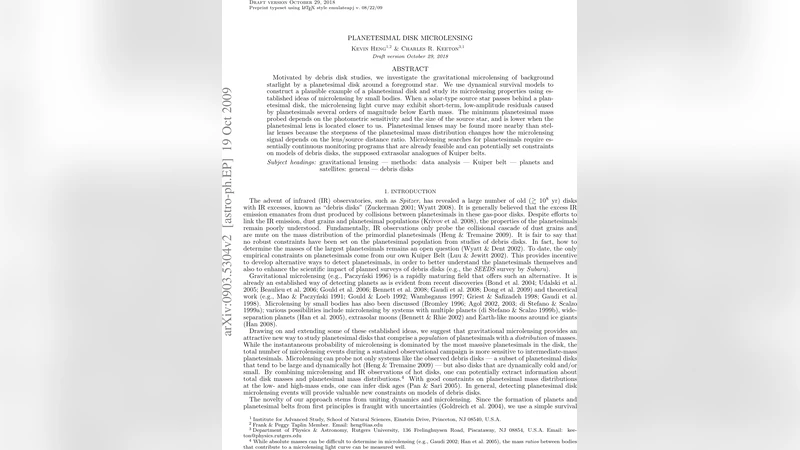
Motivated by debris disk studies, we investigate the gravitational microlensing of background starlight by a planetesimal disk around a foreground star. We use dynamical survival models to construct a plausible example of a planetesimal disk and study its microlensing properties using established ideas of microlensing by small bodies. When a solar-type source star passes behind a planetesimal disk, the microlensing light curve may exhibit short-term, low-amplitude residuals caused by planetesimals several orders of magnitude below Earth mass. The minimum planetesimal mass probed depends on the photometric sensitivity and the size of the source star, and is lower when the planetesimal lens is located closer to us. Planetesimal lenses may be found more nearby than stellar lenses because the steepness of the planetesimal mass distribution changes how the microlensing signal depends on the lens/source distance ratio. Microlensing searches for planetesimals require essentially continuous monitoring programs that are already feasible and can potentially set constraints on models of debris disks, the supposed extrasolar analogues of Kuiper belts.
💡 Research Summary
The paper investigates the feasibility of detecting planetesimal disks—exoplanetary analogues of the Kuiper Belt—through gravitational microlensing of background stars. Using a dynamical survival model, the authors construct a realistic planetesimal disk around a solar‑type foreground star. The model incorporates collisional evolution, gravitational stirring, and stellar wind erosion, yielding a mass distribution that follows a power‑law (dN/dM \propto M^{-q}) with (q) between 1.5 and 2.0, similar to observed debris disks.
The microlensing analysis extends the classic point‑mass lens formalism to include the finite size of both the planetesimal lens and the source star. Finite‑source effects reduce the peak magnification but lengthen the event duration, allowing even sub‑Earth‑mass bodies (down to (10^{-6} M_{\oplus})) to produce detectable signatures if the source star is sufficiently compact (≤0.1 R⊙). The resulting light‑curve perturbations are short (minutes to a few hours) and low‑amplitude (0.5 %–2 % of the total flux).
A key insight is the strong dependence of detectability on the lens‑observer distance. Because the Einstein radius shrinks for nearby lenses, a given planetesimal mass yields a larger magnification when the lens is close to the observer. Moreover, the steepness of the planetesimal mass function amplifies this distance effect, making nearby planetesimal lenses more common in the observable sample than distant stellar lenses.
The authors argue that existing microlensing surveys (e.g., OGLE, KMTNet) already possess the photometric precision (≈1 %) and cadence (≤10 min) required to capture such events, provided that monitoring is essentially continuous. Real‑time alerts would enable follow‑up with high‑resolution imaging or spectroscopy to further characterize the lensing system.
Finally, the study demonstrates that a systematic search for planetesimal microlensing events can place quantitative constraints on debris‑disk models, offering a novel probe of the population, mass spectrum, and spatial distribution of planetesimals in the Galaxy. The approach is technically feasible with current facilities and promises to complement infrared and sub‑millimeter observations of debris disks, deepening our understanding of planetary system formation and evolution.
Comments & Academic Discussion
Loading comments...
Leave a Comment