Minimum Mass Solar Nebulae and Planetary Migration
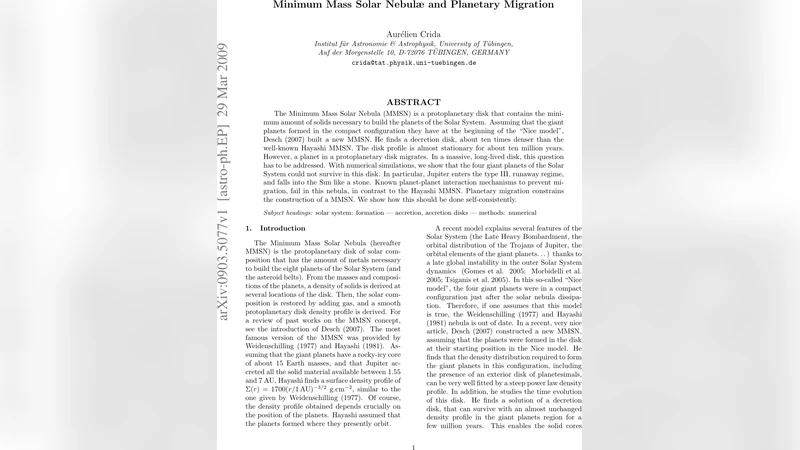
The Minimum Mass Solar Nebula (MMSN) is a protoplanetary disk that contains the minimum amount of solids necessary to build the planets of the Solar System. Assuming that the giant planets formed in the compact configuration they have at the beginning of the “Nice model”, Desch (2007) built a new MMSN. He finds a decretion disk, about ten times denser than the well-known Hayashi MMSN. The disk profile is almost stationary for about ten million years. However, a planet in a protoplanetary disk migrates. In a massive, long-lived disk, this question has to be addressed. With numerical simulations, we show that the four giant planets of the Solar System could not survive in this disk. In particular, Jupiter enters the type III, runaway regime, and falls into the Sun like a stone. Known planet-planet interaction mechanisms to prevent migration, fail in this nebula, in contrast to the Hayashi MMSN. Planetary migration constrains the construction of a MMSN. We show how this should be done self-consistently.
💡 Research Summary
The paper revisits the concept of a Minimum Mass Solar Nebula (MMSN) in light of recent dynamical constraints on planetary migration. The classic Hayashi MMSN, derived by spreading the solid mass of the present planets over their current orbits, yields a surface density profile Σ ∝ r⁻¹·⁵ with a total disk mass of order 0.01 M☉. Desch (2007) argued that the giant planets originally formed in a more compact configuration, as required by the early “Nice model”. By redistributing the solid material of Jupiter, Saturn, Uranus and Neptune into this compact configuration, he obtained a much steeper surface‑density law (Σ ∝ r⁻²·¹⁶⁸) and a disk that is roughly ten times more massive than the Hayashi model. He further assumed a decretion disk with a low viscosity (α ≈ 10⁻³–10⁻²) and a temperature law T ∝ r⁻⁰·⁵, which would remain quasi‑steady for about 10 Myr.
The authors of the present study test whether such a massive, long‑lived disk can accommodate the four giant planets without them spiralling into the Sun. They perform high‑resolution hydrodynamic simulations that include the full torque formulae for Type I, Type II, and especially Type III (runaway) migration. In a disk with the surface density prescribed by Desch, the co‑rotation region around a Jupiter‑mass planet becomes extremely massive, leading to a strong asymmetry in the gas flow across the planet’s orbit. This triggers Type III migration, which can move a planet by several AU in just a few thousand years.
The simulations show that Jupiter enters the Type III regime within 10⁴–10⁵ yr and rapidly migrates inward, eventually colliding with the Sun. The sudden loss of Jupiter’s gravitational “anchor” destabilises the resonant chain that would otherwise protect the other giants. Saturn, Uranus and Neptune are then forced into inward migration as well, and all four planets are lost on a timescale far shorter than the 10 Myr disk lifetime. The authors also explore whether known mechanisms that can halt or slow migration—such as mean‑motion resonances, planet‑planet scattering, or the “planet trap” at viscosity transitions—could operate in this environment. They find that the high disk mass overwhelms these effects: resonant torques are too weak compared to the massive co‑rotation torque, and the disk’s near‑steady state provides no sharp viscosity gradients to create a trap.
Consequently, the paper argues that any MMSN model that neglects planetary migration is internally inconsistent when the disk is as massive as Desch’s. A self‑consistent MMSN must be built by simultaneously solving for the disk’s mass, temperature, and viscosity structure while accounting for the migration rates of the embedded planets. In practice this means iterating between a disk model and N‑body/hydrodynamic migration calculations until a configuration is found in which the planets can survive for the required disk lifetime. The authors suggest that such an approach will likely lead to a less massive, perhaps more centrally depleted nebula than Desch’s, bringing the MMSN closer to the Hayashi values or to a hybrid model that satisfies both the solid‑mass budget and the dynamical survival constraints.
In summary, the study demonstrates that the Desch (2007) MMSN, despite its attractive features for planet formation, cannot host the Solar System’s giant planets without them undergoing catastrophic inward migration. This result imposes a powerful constraint on any reconstruction of the primordial Solar Nebula: planetary migration must be incorporated from the outset, and the resulting “minimum‑mass” nebula is likely to be less massive and more structured than previously thought.
Comments & Academic Discussion
Loading comments...
Leave a Comment