Planet-planet scattering leads to tightly packed planetary systems
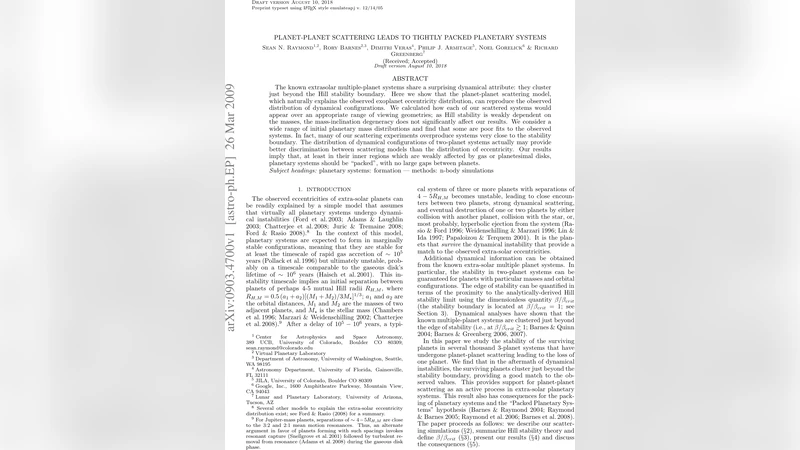
The known extrasolar multiple-planet systems share a surprising dynamical attribute: they cluster just beyond the Hill stability boundary. Here we show that the planet-planet scattering model, which naturally explains the observed exoplanet eccentricity distribution, can reproduce the observed distribution of dynamical configurations. We calculated how each of our scattered systems would appear over an appropriate range of viewing geometries; as Hill stability is weakly dependent on the masses, the mass-inclination degeneracy does not significantly affect our results. We consider a wide range of initial planetary mass distributions and find that some are poor fits to the observed systems. In fact, many of our scattering experiments overproduce systems very close to the stability boundary. The distribution of dynamical configurations of two-planet systems actually may provide better discrimination between scattering models than the distribution of eccentricity. Our results imply that, at least in their inner regions which are weakly affected by gas or planetesimal disks, planetary systems should be “packed”, with no large gaps between planets.
💡 Research Summary
The paper investigates why the known extrasolar multiple‑planet systems are clustered just beyond the Hill‑stability boundary, a dynamical feature that had previously received little theoretical attention. Hill stability provides a criterion for long‑term orbital safety: two planets are stable if their mutual separation exceeds a critical distance that depends on their masses and orbital elements. The authors express this condition with the dimensionless parameter β = Δ/Δ_Hill, where Δ is the actual orbital spacing and Δ_Hill is the Hill‑critical spacing. Observational surveys show that most two‑planet systems have β values only slightly larger than unity, indicating that the planets are packed tightly together with no large gaps.
To test whether the planet‑planet scattering model—already successful at reproducing the observed eccentricity distribution—can also generate this “packed” configuration, the authors performed a large suite of N‑body simulations. They explored four distinct initial mass distributions: (1) equal‑mass planets, (2) a log‑normal distribution, (3) a power‑law distribution that mimics the observed mass function, and (4) a distribution heavily weighted toward very massive planets. Each simulation began with three to five planets on initially well‑spaced, near‑circular orbits. Over hundreds of millions of years the planets interacted gravitationally, leading to close encounters, collisions, ejections, and ultimately a reduced system that often retained only two planets.
Because real observations measure only m sin i, the authors generated synthetic observations for each surviving two‑planet system over a wide range of viewing inclinations. This step allowed them to assess the impact of the mass‑inclination degeneracy on the derived β values. They found that β is only weakly dependent on the true masses; the dominant factor is the orbital spacing, which is directly observable from the periods. Consequently, the synthetic β distribution is a reliable proxy for what would be measured in actual radial‑velocity or transit surveys.
The main results are as follows. First, the majority of scattered systems end up with β values clustered near 1.0–1.2, reproducing the observed excess of systems just beyond the Hill limit. Second, the mass‑inclination degeneracy does not significantly shift the β distribution, confirming that the observed clustering is not an artifact of unknown inclinations. Third, the shape of the β distribution is sensitive to the assumed initial mass function. Simulations with equal‑mass planets or a log‑normal mass spread produce β histograms that match the data best, whereas a population dominated by very massive planets over‑populates the β≈1 region and fails to reproduce the observed tail toward larger β. This demonstrates that the dynamical spacing distribution can discriminate between different scattering scenarios more effectively than eccentricity alone.
The authors argue that these findings have important implications for planetary system architecture. In the inner regions of planetary systems—where gas disks have largely dissipated and planetesimal disks exert only modest torques—planet‑planet scattering naturally drives the surviving planets into a tightly packed configuration that hovers just above the Hill stability threshold. This “packed” architecture explains why current surveys rarely find large empty zones between adjacent planets. Moreover, because the β distribution is a direct outcome of energy and angular‑momentum redistribution during scattering, it offers a new observational test for formation models.
In conclusion, the study shows that planet‑planet scattering not only accounts for the observed eccentricity distribution but also reproduces the observed clustering of planetary systems near the Hill stability boundary. The work highlights the utility of the β parameter as a diagnostic tool, suggests that inner planetary systems are generally packed, and points to future work that should combine high‑precision radial‑velocity and transit‑timing measurements with more extensive scattering simulations to further refine our understanding of planetary system formation.
Comments & Academic Discussion
Loading comments...
Leave a Comment