Supernova feedback efficiency and mass loading in the starburst and galactic superwind exemplar M82
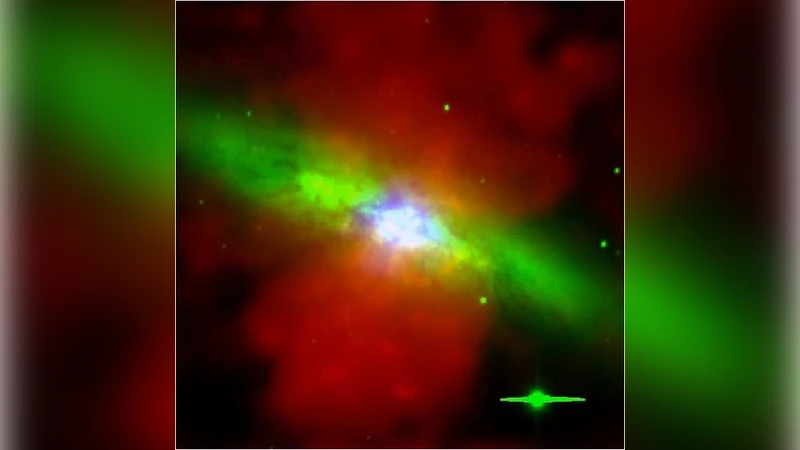
We measure the net energy efficiency of supernova and stellar wind feedback in the starburst galaxy M82 and the degree of mass-loading of the hot gas piston driving its superwind by comparing a large suite of 1 and 2-dimensional hydrodynamical models to a set of observational constraints derived from hard X-ray observations of the starburst region (the fluxes of the He-alpha and Ly-alpha-like lines of S, Ar, Ca and Fe, along with the total diffuse E=2–8 keV X-ray luminosity). These are the first direct measurements of the feedback efficiency and mass-loading of supernova heated and enriched plasma in a starburst galaxy. All the models that satisfy the existing observational constraints have medium to high thermalization efficiencies (30% <= epsilon <= 100$%) and the volume-filling wind fluid that flows out of the starburst region is only mildly centrally mass loaded (1.0 <= beta <= 2.8). These results imply a temperature of the plasma within the starburst region in the range 30–80 million Kelvin, a mass flow rate of the wind fluid out of the starburst region of Mdot_tot ~ 1.4–3.6 Msol/yr and a terminal velocity of the wind in the range v_infinity = 1410–2240 km/s. This velocity is considerably larger than the escape velocity from M82 (v_esc <~ 460 km/s) and the velocity of the H-alpha emitting clumps and filaments within M82’s wind (v_H-alpha ~ 600 km/s). Drawing on these results we provide a prescription for implementing starburst-driven superwinds in cosmological models of galaxy formation and evolution. (Abridged)
💡 Research Summary
The paper presents a quantitative determination of the supernova (SN) and stellar‑wind feedback efficiency (ε) and the degree of mass‑loading (β) in the prototypical starburst galaxy M82. The authors exploit hard X‑ray observations (2–8 keV) of the starburst core, focusing on the fluxes of He‑α and Ly‑α‑like lines of sulfur, argon, calcium and iron, together with the total diffuse X‑ray luminosity, to construct a set of observational constraints that any viable wind model must satisfy.
A large suite of hydrodynamic simulations is generated, ranging from one‑dimensional Chevalier‑Clegg style analytic wind solutions to fully two‑dimensional axisymmetric numerical models. The simulations explore a broad parameter space: the thermalization efficiency ε (the fraction of SN and stellar‑wind mechanical energy that is converted into thermal energy of the hot plasma), the mass‑loading factor β (the ratio of total mass injected into the wind to the mass supplied directly by SNe and stellar winds), the size and density profile of the starburst region, and the metal abundance of the ejecta. For each model the authors compute the temperature, density, velocity structure of the wind fluid and synthesize the expected X‑ray line emissivities using atomic databases.
By comparing the synthetic line ratios and total X‑ray luminosities to the observed values, the authors identify the region of (ε, β) space that is compatible with the data. The key findings are:
- The thermalization efficiency lies between 30 % and 100 %, indicating that a substantial fraction of the mechanical energy from SNe and stellar winds is retained as thermal energy in the hot phase rather than being radiated away.
- The mass‑loading factor is modest, 1.0 ≤ β ≤ 2.8, meaning that the wind fluid is only mildly enriched by entrained ambient interstellar material.
- The resulting plasma temperature inside the starburst region is 3 × 10⁷ K to 8 × 10⁷ K.
- The total mass outflow rate of the hot wind fluid is 1.4–3.6 M⊙ yr⁻¹, roughly 10–30 % of the total mass injection rate from massive stars.
- The asymptotic wind speed v∞ is 1 410–2 240 km s⁻¹, far exceeding M82’s escape velocity (≈ 460 km s⁻¹) and the observed velocities of the cooler H‑α‑emitting filaments (≈ 600 km s⁻¹).
These results imply that the hot wind fluid can freely escape the galaxy, carrying both energy and metals into the circum‑galactic medium, while the cooler phases observed in optical emission lines are likely swept up and decelerated by the fast, low‑density wind. The authors also discuss the implications for the multiphase nature of galactic superwinds, emphasizing that the hot, volume‑filling component dominates the energetics and mass transport, whereas the dense clumps traced by H‑α represent a minor, decelerated fraction.
Finally, the paper provides a practical prescription for incorporating starburst‑driven superwinds into cosmological simulations of galaxy formation. The authors propose scaling relations that express ε and β as functions of the star‑formation rate and metallicity, allowing modelers to compute the initial wind temperature, mass‑loading, and terminal velocity without performing full hydrodynamic calculations. This recipe bridges the gap between detailed, small‑scale wind physics and the large‑scale, sub‑grid treatments required in modern cosmological codes.
In summary, by directly linking hard X‑ray spectroscopy to wind dynamics, the study delivers the first empirical constraints on the efficiency and mass‑loading of supernova‑heated plasma in a starburst galaxy, and it offers a robust framework for implementing realistic feedback in galaxy evolution models.