Evidence for X-ray synchrotron emission from simultaneous mid-IR to X-ray observations of a strong Sgr A* flare
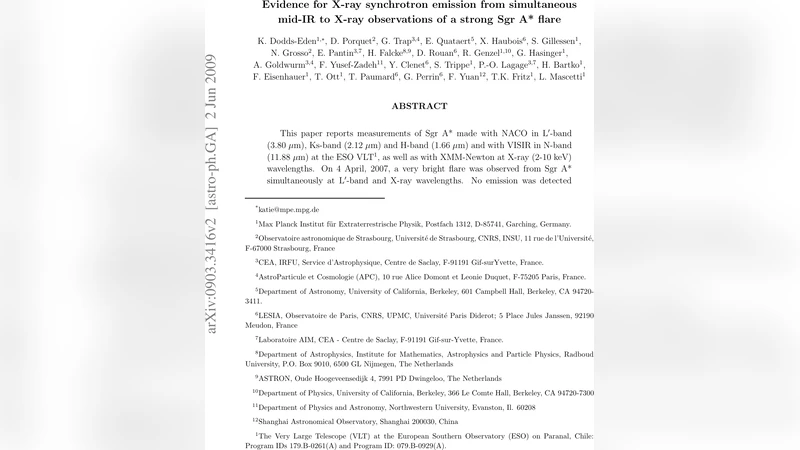
This paper reports measurements of Sgr A* made with NACO in L’ -band (3.80 um), Ks-band (2.12 um) and H-band (1.66 um) and with VISIR in N-band (11.88 um) at the ESO VLT, as well as with XMM-Newton at X-ray (2-10 keV) wavelengths. On 4 April, 2007, a very bright flare was observed from Sgr A* simultaneously at L’-band and X-ray wavelengths. No emission was detected using VISIR. The resulting SED has a blue slope (beta > 0 for nuL_nu ~ nu^beta, consistent with nuL_nu ~ nu^0.4) between 12 micron and 3.8 micron. For the first time our high quality data allow a detailed comparison of infrared and X-ray light curves with a resolution of a few minutes. The IR and X-ray flares are simultaneous to within 3 minutes. However the IR flare lasts significantly longer than the X-ray flare (both before and after the X-ray peak) and prominent substructures in the 3.8 micron light curve are clearly not seen in the X-ray data. From the shortest timescale variations in the L’-band lightcurve we find that the flaring region must be no more than 1.2 R_S in size. The high X-ray to infrared flux ratio, blue nuL_nu slope MIR to L’ -band, and the soft nuL_nu spectral index of the X-ray flare together place strong constraints on possible flare emission mechanisms. We find that it is quantitatively difficult to explain this bright X-ray flare with inverse Compton processes. A synchrotron emission scenario from an electron distribution with a cooling break is a more viable scenario.
💡 Research Summary
The paper presents a coordinated multi‑wavelength campaign on the Galactic centre supermassive black hole Sgr A* conducted on 4 April 2007, using the ESO Very Large Telescope (VLT) instruments NACO (L′‑band 3.80 µm, Kₛ‑band 2.12 µm, H‑band 1.66 µm) and VISIR (N‑band 11.88 µm), together with XMM‑Newton observations in the 2–10 keV X‑ray band. A very bright flare was simultaneously detected in the L′‑band and in X‑rays, while the mid‑infrared (MIR) VISIR data yielded only an upper limit. The resulting spectral energy distribution (SED) between 12 µm and 3.8 µm is characterised by a “blue” slope, νLν ∝ ν^β with β≈0.4, indicating that the luminosity rises toward higher frequencies in this range.
The authors achieved a time resolution of a few minutes for both the infrared (IR) and X‑ray light curves, allowing a direct comparison of their temporal behaviour. The peaks of the L′‑band and X‑ray flares are coincident to within ≲3 min, demonstrating that the two emission components are produced essentially simultaneously. However, the IR flare is broader: it begins earlier, ends later, and exhibits pronounced sub‑structures on timescales of ∼5–10 min that are absent in the X‑ray data. By analysing the shortest variability timescale in the L′‑band (≈30 s) the authors infer an upper limit on the size of the emitting region of ≤1.2 R_S (Schwarzschild radii), i.e. the flare originates from a region comparable to the event‑horizon scale.
The flare displays a high X‑ray‑to‑IR flux ratio and a relatively soft X‑ray spectrum (νLν ∝ ν^−0.25). These observational constraints pose a serious challenge to inverse‑Compton scenarios such as synchrotron‑self‑Compton (SSC) or external Compton (EC). In SSC/EC models the X‑ray photons are produced by up‑scattering of lower‑energy seed photons (IR or sub‑mm) by relativistic electrons. To reproduce the observed X‑ray brightness while respecting the VISIR upper limit and the compact source size would require an implausibly high electron density or magnetic field, and would predict a steeper X‑ray spectrum than observed.
Instead, the authors favour a synchrotron model in which the same non‑thermal electron population produces both the IR and X‑ray emission, but the electron energy distribution contains a cooling break. Below the break (γ ≲ 10^3) electrons radiate efficiently in the IR, while above the break (γ ≳ 10^4) rapid synchrotron cooling steepens the distribution, yielding a softer X‑ray spectrum and a lower X‑ray flux relative to the IR. This framework naturally accounts for the blue νLν slope in the MIR–L′ band, the modest X‑ray spectral index, and the observed temporal differences: the IR sub‑structures reflect fluctuations in the injection of lower‑energy electrons, whereas the X‑ray emission, being dominated by the cooled high‑energy tail, smooths out these variations.
The paper therefore concludes that inverse‑Compton processes are quantitatively disfavoured for this bright flare, while a synchrotron origin with a cooling break provides a self‑consistent explanation of the spectral shape, flux ratios, and timing properties. The work showcases the power of simultaneous high‑resolution IR and X‑ray monitoring for probing particle acceleration and radiative processes in the immediate vicinity of a supermassive black hole, and sets stringent constraints on theoretical models of Sgr A* flares.
Comments & Academic Discussion
Loading comments...
Leave a Comment