An optical group catalogue to z = 1 from the zCOSMOS 10k sample
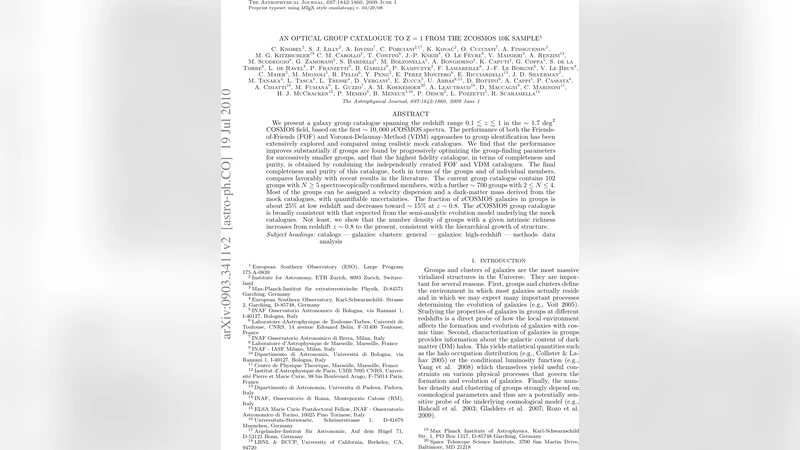
We present a galaxy group catalogue spanning the redshift range 0.1 <~ z <~ 1 in the ~1.7 deg^2 COSMOS field, based on the first ~10,000 zCOSMOS spectra. The performance of both the Friends-of-Friends (FOF) and Voronoi-Delaunay-Method (VDM) approaches to group identification has been extensively explored and compared using realistic mock catalogues. We find that the performance improves substantially if groups are found by progressively optimizing the group-finding parameters for successively smaller groups, and that the highest fidelity catalogue, in terms of completeness and purity, is obtained by combining the independently created FOF and VDM catalogues. The final completeness and purity of this catalogue, both in terms of the groups and of individual members, compares favorably with recent results in the literature. The current group catalogue contains 102 groups with N >= 5 spectroscopically confirmed members, with a further ~700 groups with 2 <= N <= 4. Most of the groups can be assigned a velocity dispersion and a dark-matter mass derived from the mock catalogues, with quantifiable uncertainties. The fraction of zCOSMOS galaxies in groups is about 25% at low redshift and decreases toward ~15% at z ~ 0.8. The zCOSMOS group catalogue is broadly consistent with that expected from the semi-analytic evolution model underlying the mock catalogues. Not least, we show that the number density of groups with a given intrinsic richness increases from redshift z ~ 0.8 to the present, consistent with the hierarchical growth of structure.
💡 Research Summary
This paper presents a comprehensive galaxy group catalogue derived from the first ~10,000 spectroscopic redshifts of the zCOSMOS survey, covering the redshift interval 0.1 ≲ z ≲ 1 over the 1.7 deg² COSMOS field. The authors rigorously test two widely used group‑finding algorithms—Friends‑of‑Friends (FOF) and the Voronoi‑Delaunay‑Method (VDM)—by applying them to a suite of 24 realistic mock catalogues that reproduce the selection function, sampling rate, and redshift errors of the actual data.
A key methodological innovation is the “scale‑dependent optimisation” of the linking parameters. For each algorithm the authors tune the transverse and line‑of‑sight linking lengths (for FOF) or the Voronoi cell size thresholds (for VDM) separately for large groups (N ≥ 20), intermediate groups (5 ≤ N < 20) and small groups (2 ≤ N < 5). This hierarchical optimisation dramatically improves the detection of low‑richness systems, which are otherwise prone to either fragmentation (low completeness) or over‑merging (low purity). In the mocks the optimised FOF and VDM achieve overall completeness of 71–78 % and purity of 73–81 %, with the most significant gains seen for N ≤ 5 groups.
Rather than selecting a single algorithm, the authors construct a “combined catalogue” by cross‑matching the independently generated FOF and VDM lists. Groups identified by both methods are flagged as high‑confidence, while those found by only one algorithm are retained as secondary candidates. This hybrid approach yields a final catalogue with a completeness of ≈78 % and a purity of ≈81 % for groups with N ≥ 2, representing the best performance among comparable spectroscopic surveys to date.
The resulting catalogue contains 102 groups with five or more spectroscopically confirmed members and roughly 700 additional groups with 2–4 members. For each system the authors estimate a line‑of‑sight velocity dispersion (σ_v) and a dark‑matter halo mass (M_200) by calibrating against the mock catalogues; the typical uncertainties are ≈20 % on σ_v and ≈0.3 dex on M_200. The fraction of all zCOSMOS galaxies residing in groups declines from about 25 % at low redshift (z ≈ 0.1) to roughly 15 % at z ≈ 0.8, reflecting both the hierarchical assembly of groups and the migration of galaxies into the field.
A further analysis of the richness evolution shows that the comoving number density of groups with a given intrinsic richness increases by a factor of ≈1.5 from z ≈ 0.8 to the present, in line with the expectations of ΛCDM hierarchical growth. Moreover, the observed richness distribution and its redshift dependence are broadly consistent with the semi‑analytic galaxy formation model that underlies the mock catalogues, providing an empirical validation of that model.
In summary, this work delivers a high‑fidelity spectroscopic group catalogue that combines the complementary strengths of FOF and VDM, offers well‑characterised dynamical and mass estimates, and demonstrates clear evolutionary trends in group abundance and galaxy membership. The catalogue constitutes a valuable resource for studies of galaxy evolution in dense environments, for testing semi‑analytic and hydrodynamic models of structure formation, and for future cosmological analyses that require accurate group and cluster samples at intermediate redshifts.
Comments & Academic Discussion
Loading comments...
Leave a Comment