Primordial Circumstellar Disks in Binary Systems: Evidence for Reduced Lifetimes
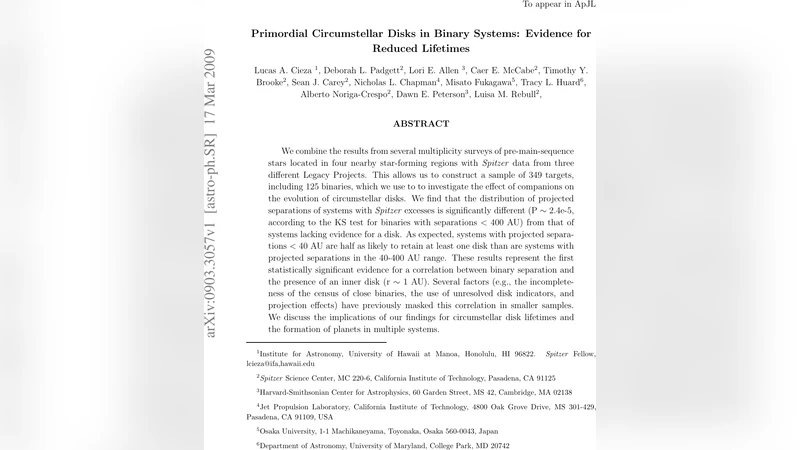
We combine the results from several multiplicity surveys of pre-main-sequence stars located in four nearby star-forming regions with Spitzer data from three different Legacy Projects. This allows us to construct a sample of 349 targets, including 125 binaries, which we use to to investigate the effect of companions on the evolution of circumstellar disks. We find that the distribution of projected separations of systems with Spitzer excesses is significantly different (P ~2.4e-5, according to the KS test for binaries with separations < 400 AU) from that of systems lacking evidence for a disk. As expected, systems with projected separations < 40 AU are half as likely to retain at least one disk than are systems with projected separations in the 40-400 AU range. These results represent the first statistically significant evidence for a correlation between binary separation and the presence of an inner disk (r ~ 1 AU). Several factors (e.g., the incompleteness of the census of close binaries, the use of unresolved disk indicators, and projection effects) have previously masked this correlation in smaller samples. We discuss the implications of our findings for circumstellar disk lifetimes and the formation of planets in multiple systems.
💡 Research Summary
The paper presents a comprehensive statistical investigation of how stellar companions influence the evolution of circumstellar disks around pre‑main‑sequence stars. By merging multiplicity surveys from four nearby star‑forming regions (Orion, Taurus, Ophiuchus, and Carina) with Spitzer infrared data from three Legacy programs, the authors assembled a sample of 349 young stars, of which 125 are identified as binary systems. Disk presence is inferred from infrared excesses measured by Spitzer’s IRAC and MIPS bands, a proxy that reliably traces inner disks at radii of order 1 AU.
The authors focus on binaries with projected separations less than 400 AU and apply a Kolmogorov‑Smirnov (KS) test to compare the separation distributions of stars with and without infrared excesses. The KS test yields a probability of ~2.4 × 10⁻⁵, indicating a highly significant difference between the two groups. Specifically, binaries tighter than 40 AU are about half as likely to retain at least one disk compared with binaries in the 40–400 AU range. This result constitutes the first statistically robust evidence that binary separation correlates with the survival of inner circumstellar material.
The study also addresses why earlier works failed to detect this correlation. First, incompleteness in detecting close companions (limited angular resolution and spectroscopic sensitivity) leads to an underestimation of the true close‑binary fraction. Second, many prior investigations relied on unresolved disk indicators, which cannot distinguish which component hosts the disk. Third, projection effects blur the relationship between observed separations and true three‑dimensional distances. By employing a large, homogeneous dataset and restricting the analysis to well‑characterized separations, the authors mitigate these biases.
Implications are far‑reaching for disk lifetime models and planet formation theories. The markedly reduced disk retention in binaries tighter than ~40 AU suggests that gravitational truncation or accelerated dispersal shortens disk lifetimes to roughly 1–2 Myr in such systems. Consequently, the window for forming gas‑giant planets is dramatically narrowed, potentially explaining the observed paucity of massive planets in close binary systems. The findings also hint that planet formation efficiency may be intrinsically lower in multiple‑star environments.
Future work should aim to resolve individual disks in binary components using facilities such as ALMA or high‑contrast imaging, enabling direct measurement of disk masses, radii, and temperature structures. Such observations will allow a quantitative mapping between binary separation, disk truncation radius, and subsequent planet‑forming potential, refining our understanding of how multiplicity shapes planetary system architectures.
Comments & Academic Discussion
Loading comments...
Leave a Comment