BayesCLUMPY: Bayesian Inference with Clumpy Dusty Torus Models
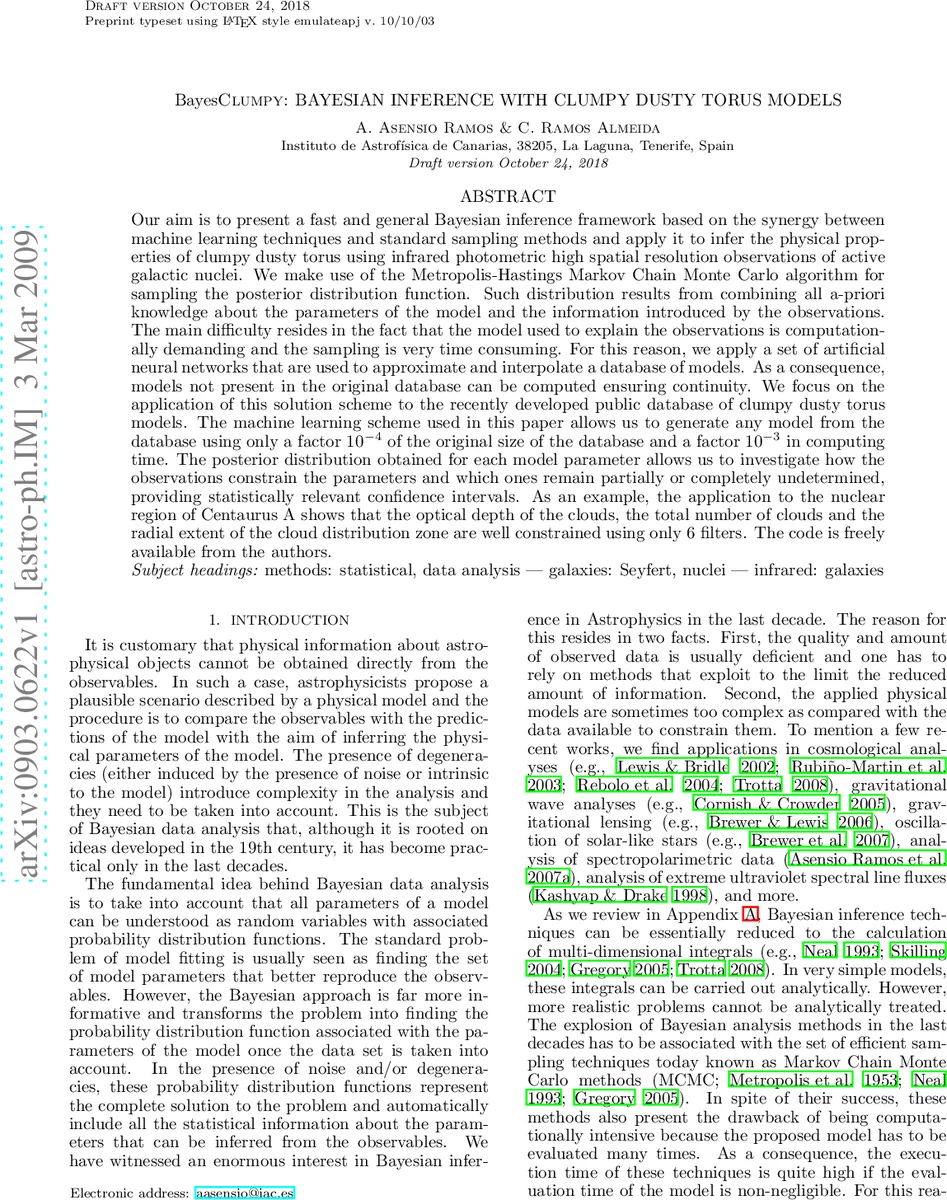
Our aim is to present a fast and general Bayesian inference framework based on the synergy between machine learning techniques and standard sampling methods and apply it to infer the physical properties of clumpy dusty torus using infrared photometric high spatial resolution observations of active galactic nuclei. We make use of the Metropolis-Hastings Markov Chain Monte Carlo algorithm for sampling the posterior distribution function. Such distribution results from combining all a-priori knowledge about the parameters of the model and the information introduced by the observations. The main difficulty resides in the fact that the model used to explain the observations is computationally demanding and the sampling is very time consuming. For this reason, we apply a set of artificial neural networks that are used to approximate and interpolate a database of models. As a consequence, models not present in the original database can be computed ensuring continuity. We focus on the application of this solution scheme to the recently developed public database of clumpy dusty torus models. The machine learning scheme used in this paper allows us to generate any model from the database using only a factor 10^-4 of the original size of the database and a factor 10^-3 in computing time. The posterior distribution obtained for each model parameter allows us to investigate how the observations constrain the parameters and which ones remain partially or completely undetermined, providing statistically relevant confidence intervals. As an example, the application to the nuclear region of Centaurus A shows that the optical depth of the clouds, the total number of clouds and the radial extent of the cloud distribution zone are well constrained using only 6 filters.
💡 Research Summary
The paper introduces “BayesCLUMPY,” a Bayesian inference framework that couples machine‑learning surrogate modeling with traditional Markov Chain Monte Carlo (MCMC) sampling to extract physical parameters of clumpy dusty tori in active galactic nuclei (AGN) from high‑resolution infrared photometry. The authors start from the publicly available CLUMPY torus model grid, which is computationally intensive because each point in the multi‑dimensional parameter space (optical depth of individual clouds τ_V, number of clouds along an equatorial ray N₀, radial extent Y, angular distribution index q, torus opening angle σ, viewing angle i, etc.) requires a full radiative‑transfer simulation. To make Bayesian sampling feasible, they train a feed‑forward artificial neural network (ANN) on 10⁴ pre‑computed models. The ANN learns the mapping from the six torus parameters to the emergent spectral energy distribution (SED). Validation shows that the ANN reproduces unseen grid points with a mean absolute error below 1 %, effectively providing a continuous, differentiable surrogate of the original grid. Because the ANN model occupies only 0.01 % of the original database size and evaluates a spectrum in ≈10⁻³ s, it reduces the computational burden of MCMC by three orders of magnitude.
With the surrogate in hand, the authors formulate a Bayesian problem. Priors are chosen based on physical intuition and previous literature (uniform or log‑uniform distributions over plausible ranges). The likelihood is constructed from the observed fluxes in six infrared filters (3.6, 4.5, 5.8, 8.0, 12, and 18 µm) and their uncertainties, assuming Gaussian errors. They employ the Metropolis‑Hastings algorithm to draw samples from the posterior distribution, monitoring convergence with Gelman‑Rubin diagnostics and discarding an adaptive burn‑in phase. The resulting posterior provides marginal probability density functions for each parameter, credible intervals (1σ, 2σ), and joint distributions that reveal correlations (e.g., τ_V and N₀ are positively correlated, Y and i show an anti‑correlation).
The methodology is first tested on synthetic data to confirm that the ANN surrogate does not bias the inference. The posterior recovered from the surrogate‑based MCMC matches that obtained using the full radiative‑transfer grid within statistical uncertainties, demonstrating that the surrogate’s interpolation error is negligible for Bayesian purposes.
The framework is then applied to real observations of the nucleus of Centaurus A, a nearby radio galaxy with a well‑studied dusty torus. Using only six high‑resolution infrared fluxes, BayesCLUMPY yields tight constraints on three key parameters: τ_V≈45–55, N₀≈4–6, and Y≈15–25 (all at the 68 % credible level). The angular distribution index q and viewing angle i remain loosely constrained (q≈0.5–2.0, i≈30°–70°), reflecting the limited sensitivity of the chosen filter set to these aspects of torus geometry. The posterior also quantifies the degeneracies inherent in SED fitting, allowing the authors to identify which parameters are genuinely informed by the data and which are dominated by priors.
In the discussion, the authors highlight several strengths of BayesCLUMPY: (1) dramatic speed‑up enabling full Bayesian exploration of a high‑dimensional model space; (2) the ability to generate spectra at arbitrary points in parameter space, ensuring continuity and avoiding grid‑edge artifacts; (3) rigorous quantification of uncertainties and parameter correlations, which is essential for interpreting AGN torus properties. They also acknowledge limitations: the ANN is only reliable within the training domain, extrapolation can be unsafe; the current implementation treats the torus as a single component, whereas real AGN may require multi‑component or time‑variable models; and the inference quality depends on the filter coverage—more bands (e.g., from JWST) would tighten constraints on q and i.
Future work is outlined, including expanding the training set to cover broader parameter ranges, incorporating more sophisticated neural architectures (e.g., Bayesian neural networks) to capture model uncertainties, and applying the framework to large AGN samples from upcoming infrared surveys. The authors conclude that BayesCLUMPY provides a scalable, statistically robust tool for interpreting dusty torus observations, bridging the gap between computationally demanding physical models and the need for rapid, reliable parameter estimation in the era of big astronomical data.
Comments & Academic Discussion
Loading comments...
Leave a Comment