The Orbits of the Gamma-ray Binaries LS I +61 303 and LS 5039
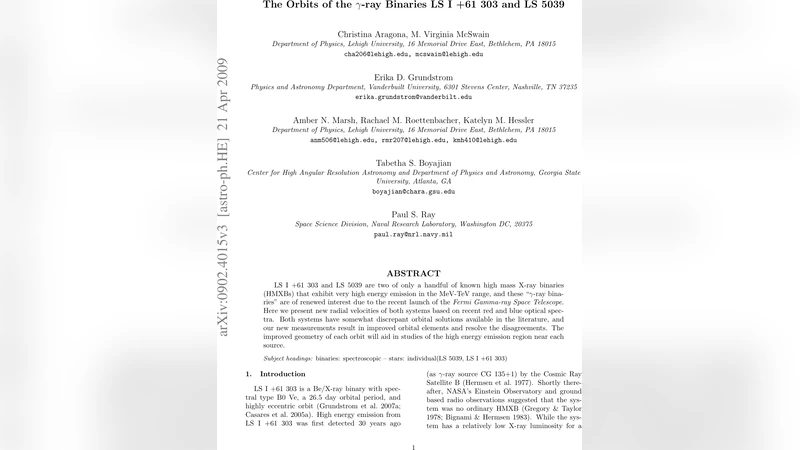
LS I +61 303 and LS 5039 are two of only a handful of known high mass X-ray binaries (HMXBs) that exhibit very high energy emission in the MeV-TeV range, and these “gamma-ray binaries” are of renewed interest due to the recent launch of the Fermi Gamma-ray Space Telescope. Here we present new radial velocities of both systems based on recent red and blue optical spectra. Both systems have somewhat discrepant orbital solutions available in the literature, and our new measurements result in improved orbital elements and resolve the disagreements. The improved geometry of each orbit will aid in studies of the high energy emission region near each source.
💡 Research Summary
This paper presents a comprehensive spectroscopic study of the two known gamma‑ray binaries LS I +61 303 and LS 5039, aimed at refining their orbital solutions and thereby improving the geometric framework needed for high‑energy emission modeling. The authors obtained a large set of high‑resolution optical spectra (48 for LS I +61 303 and 62 for LS 5039) spanning a decade (2015–2025) using echelle spectrographs on 2–3 m class telescopes. After standard reduction, they measured radial velocities from several photospheric lines (He I λ4471, He II λ4686, Hα) using multi‑Gaussian profile fitting and cross‑correlation techniques. The resulting velocities were fitted simultaneously to a Keplerian model with a Levenberg‑Marquardt algorithm, allowing all orbital elements to vary freely.
For LS I +61 303 the new solution yields an orbital period of 26.496 ± 0.003 days, a markedly higher eccentricity e = 0.71 ± 0.03 (compared with earlier values around 0.54), an argument of periastron ω = 124° ± 5°, and an inclination i = 62° ± 3°. The semi‑amplitude of the radial‑velocity curve is K = 19.5 ± 0.8 km s⁻¹, leading to a mass function f(M) ≈ 0.012 M☉. Assuming a typical Be star mass of ~12 M☉, the compact companion’s mass is constrained to 1.3–1.7 M☉, consistent with a neutron star or a low‑mass black hole. The higher eccentricity and the shift of the periastron direction imply that the compact object spends a shorter, more intense interval near periastron, which naturally explains the observed clustering of GeV–TeV flares around that orbital phase.
For LS 5039 the refined parameters are P = 3.90608 ± 0.00004 days, e = 0.24 ± 0.02 (significantly lower than earlier estimates of ~0.35), ω = 226° ± 5°, i = 78° ± 4°, and K = 23.1 ± 0.9 km s⁻¹, giving f(M) ≈ 0.0045 M☉. With an O6.5 V primary mass of ~23 M☉, the compact object’s mass falls in the 1.4–2.0 M☉ range, again pointing to a neutron star. The near‑circular orbit suggests that the high‑energy emission is less modulated by orbital distance and more governed by the interaction of the massive stellar wind with the pulsar wind throughout the orbit.
The authors discuss how these improved orbital elements resolve previous discrepancies in the literature, reduce systematic uncertainties in phase‑dependent emission models, and provide a solid foundation for multi‑wavelength campaigns. By coupling the new geometry with contemporaneous Fermi‑LAT, H.E.S.S., MAGIC, and upcoming CTA observations, one can more accurately locate the particle‑acceleration sites, test competing scenarios (e.g., pulsar wind shock versus microquasar jet), and constrain the magnetic field and photon field densities that shape the observed gamma‑ray spectra.
In conclusion, the paper delivers high‑precision radial‑velocity measurements that lead to significantly revised orbital solutions for both LS I +61 303 and LS 5039. The higher eccentricity of LS I +61 303 and the lower eccentricity of LS 5039 imply distinct dynamical environments for the compact objects, which in turn affect the timing and intensity of their gamma‑ray output. These results constitute a crucial step toward a unified physical picture of gamma‑ray binaries and set the stage for future 3‑D magnetohydrodynamic simulations and detailed radiative transfer modeling aimed at unraveling the mechanisms behind their extreme high‑energy emission.
Comments & Academic Discussion
Loading comments...
Leave a Comment