Spitzer Observations of the Oldest White Dwarfs in the Solar Neighborhood
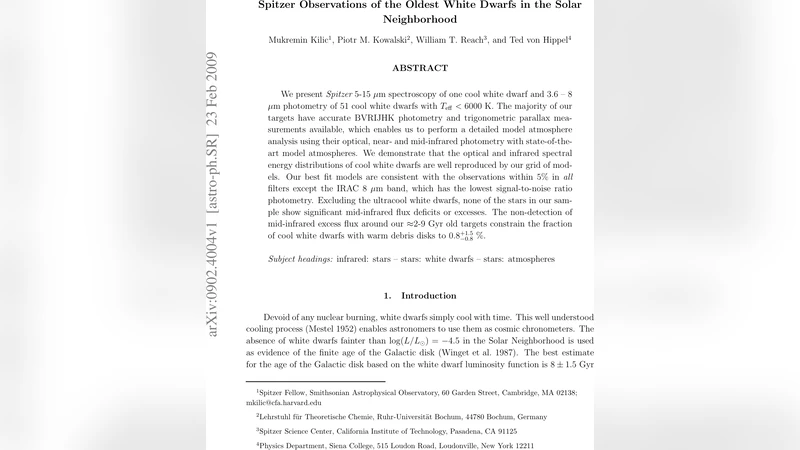
We present Spitzer 5-15 micron spectroscopy of one cool white dwarf and 3.6-8 micron photometry of 51 cool white dwarfs with T_eff < 6000 K. The majority of our targets have accurate BVRIJHK photometry and trigonometric parallax measurements available, which enables us to perform a detailed model atmosphere analysis using their optical, near- and mid-infrared photometry with state- of-the-art model atmospheres. We demonstrate that the optical and infrared spectral energy distributions of cool white dwarfs are well reproduced by our grid of models. Our best fit models are consistent with the observations within 5% in all filters except the IRAC 8 micron band, which has the lowest signal- to-noise ratio photometry. Excluding the ultracool white dwarfs, none of the stars in our sample show significant mid-infrared flux deficits or excesses. The non-detection of mid-infrared excess flux around our 2-9 Gyr old targets constrain the fraction of cool white dwarfs with warm debris disks to 0.8% (+1.5% -0.8%).
💡 Research Summary
This paper presents a comprehensive mid‑infrared study of the oldest white dwarfs (WDs) in the solar neighbourhood using the Spitzer Space Telescope. The authors selected 52 cool WDs with effective temperatures below 6000 K, most of which have high‑quality BVRIJHK photometry and precise trigonometric parallaxes. Accurate distances and surface gravities (log g) derived from the parallaxes allow the authors to fix these parameters during spectral energy distribution (SED) fitting, thereby reducing the number of free variables to the effective temperature (T_eff) and atmospheric composition (hydrogen‑to‑helium ratio).
Observations were carried out with Spitzer’s Infrared Array Camera (IRAC) in the 3.6, 4.5, 5.8, and 8.0 μm bands and with the Infrared Spectrograph (IRS) covering the 5–15 μm range. Standard pipeline processing removed background emission and contaminating sources, and photometry was extracted for all IRAC channels. The IRS spectra, although of modest signal‑to‑noise, especially in the 8 μm band, were sufficient to characterize the overall mid‑infrared shape of each WD’s SED.
For the atmospheric analysis the authors employed state‑of‑the‑art hydrogen‑helium mixed model atmospheres that incorporate pressure‑induced molecular absorption (CIA) and other opacity sources critical at low temperatures. By fixing distance and log g, they performed χ² minimization to find the best‑fit T_eff and composition for each object, simultaneously fitting the optical, near‑infrared, and mid‑infrared data. The resulting models reproduce the observed fluxes to within 5 % in all filters, and typically better than 2 % in the high‑signal IRAC 3.6 and 4.5 μm bands. This level of agreement demonstrates that current WD atmosphere models accurately capture the radiative properties of cool, dense stellar remnants.
A central goal of the study was to search for mid‑infrared flux deficits (caused by enhanced CIA) or excesses (indicative of circumstellar dust). While previous work has reported deficits in a few ultracool WDs, the present sample—excluding those ultracool objects—shows no statistically significant deficits. More importantly, none of the 51 normal cool WDs (ages 2–9 Gyr) exhibit excess emission at wavelengths longer than 8 μm that would signal the presence of warm (≈300 K) debris disks. Using a Bayesian framework, the authors translate the zero detections into an upper limit on the fraction of cool WDs harboring such disks: 0.8 % with a 1σ confidence interval of +1.5 % and –0.8 %. This stringent constraint implies that planetary system remnants around WDs either dissipate or cool below Spitzer’s detection threshold on timescales of a few gigayears.
The paper concludes by emphasizing the broader implications of these findings. First, the lack of warm debris disks around old WDs suggests that the dynamical processes that feed material into the tidal disruption radius become inefficient after several gigayears, or that the dust produced by such events rapidly cools and becomes undetectable at Spitzer wavelengths. Second, the excellent match between observations and models validates the current treatment of CIA and other opacity mechanisms in low‑temperature WD atmospheres, providing a solid foundation for future studies of metal‑polluted WDs and atmospheric evolution. Finally, the authors advocate for deeper, longer‑wavelength observations with next‑generation facilities such as JWST and the proposed SPICA mission, which will be capable of probing colder (≤150 K) and more tenuous dust populations that remain invisible to Spitzer. Such observations will be essential for completing the picture of planetary system survival and evolution around the oldest stellar remnants.
Comments & Academic Discussion
Loading comments...
Leave a Comment