Quiescent Isolation: The Extremely Extended HI Halo of the Optically Compact Dwarf Galaxy ADBS 113845+2008
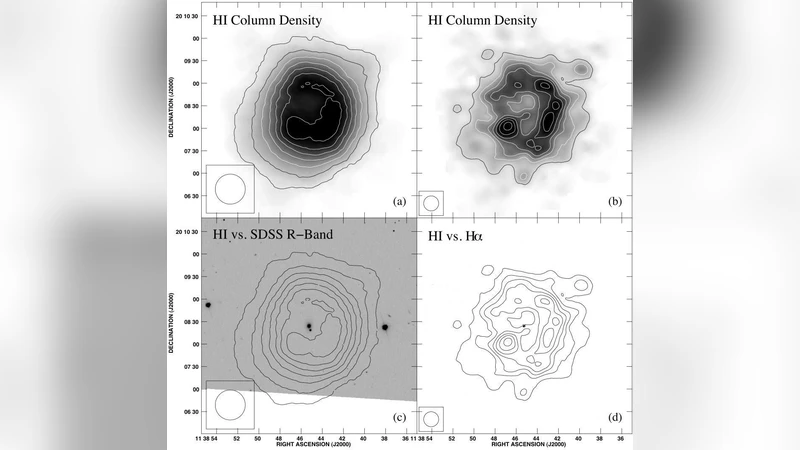
We present new optical imaging and spectroscopy and HI spectral line imaging of the dwarf galaxy ADBS 113845+2008 (hereafter ADBS 1138). This metal-poor (Z~30% Z_Sun), “post-starburst” system has one of the most compact stellar distributions known in any galaxy to date (B-band exponential scale length =0.57 kpc). In stark contrast to the compact stellar component, the neutral gas is extremely extended; HI is detected to a radial distance of ~25 kpc at the 10^19 cm^-2 level (>44 B-band scale lengths). Comparing to measurements of similar “giant disk” dwarf galaxies in the literature, ADBS 1138 has the largest known HI-to-optical size ratio. The stellar component is located near the center of a broken ring of HI that is ~15 kpc in diameter; column densities peak in this structure at the ~3.5x10^20 cm^-2 level. At the center of this ring, in a region of comparatively low HI column density, we find ongoing star formation traced by H alpha emission. We sample the rotation curve to the point of turn over; this constrains the size of the dark matter halo of the galaxy, which outweighs the luminous component (stars + gas) by at least a factor of 15. To explain these enigmatic properties, we examine “inside-out” and “outside-in” evolutionary scenarios. Calculations of star formation energetics indicate that “feedback” from concentrated star formation is not capable of producing the ring structure; we posit that this is a system where the large HI disk is evolving in quiescent isolation. In a global sense, this system is exceedingly inefficient at converting neutral gas into stars.
💡 Research Summary
The authors present a multi‑wavelength study of the dwarf galaxy ADBS 113845+2008 (hereafter ADBS 1138), combining new optical imaging, spectroscopy, and high‑resolution HI 21‑cm line observations. Optical data reveal a metal‑poor (Z≈0.3 Z⊙) post‑starburst system with an extraordinarily compact stellar component: the B‑band exponential scale length is only 0.57 kpc, placing it among the most concentrated stellar distributions known for any galaxy. In stark contrast, the neutral hydrogen (HI) disk is vastly extended. HI emission is detected out to a radius of ~25 kpc at the 10¹⁹ cm⁻² column density level, corresponding to more than 44 times the B‑band scale length. This yields the highest known HI‑to‑optical size ratio among dwarf galaxies, surpassing previously identified “giant‑disk” dwarfs such as DDO 154 or NGC 2915.
The HI morphology is not a simple exponential disk but a broken ring encircling the stellar body. The ring has a diameter of ~15 kpc, with peak column densities of ≈3.5 × 10²⁰ cm⁻². Inside the ring, the HI column drops to relatively low values, yet Hα imaging shows ongoing star formation precisely in this central low‑density region. This juxtaposition of a high‑density outer ring and a low‑density central star‑forming zone is unusual for dwarf systems.
A rotation curve derived from the HI velocity field rises steeply in the inner few kiloparsecs, reaches a turnover near 5 kpc, and then flattens. Dynamical modeling indicates that the total mass within the observed radius is dominated by dark matter; the combined stellar and gas mass (~10⁸ M⊙) is outmatched by the dark halo by at least a factor of 15. This confirms that ADBS 1138 is a dark‑matter‑dominated dwarf, consistent with expectations for low‑mass galaxies.
To explain the peculiar structure, the authors evaluate two evolutionary scenarios. The “inside‑out” hypothesis posits that concentrated star‑formation feedback (supernovae, stellar winds) expelled gas from the central region, creating the observed HI ring. Energy budget calculations, however, show that the cumulative mechanical energy released during the post‑starburst phase is insufficient to move the ≈10⁸ M⊙ of HI required to form a 15 kpc ring. Consequently, feedback alone cannot account for the morphology.
The alternative “outside‑in” scenario envisions a galaxy that has evolved in relative isolation, retaining a massive, quiescent HI disk while only modestly converting gas into stars. In this picture, the central low‑density cavity and surrounding ring arise from internal dynamical processes—such as bar‑driven torques, shear‑induced instabilities, or mild past interactions that did not disrupt the overall disk. The presence of Hα emission in the low‑density core suggests that star formation can proceed in regions below the canonical Kennicutt–Schmidt threshold, perhaps triggered by local turbulence or external pressure fluctuations.
Overall, ADBS 1138 exemplifies an extremely inefficient star‑forming system: despite harboring a neutral gas reservoir an order of magnitude larger than its stellar mass, it forms stars at a very low rate, as indicated by the modest Hα luminosity. The authors argue that the galaxy’s evolution is dominated by quiescent isolation rather than strong environmental effects or vigorous internal feedback. This case provides a valuable benchmark for theoretical models of dwarf galaxy formation, highlighting the importance of dark‑matter halo structure, gas stability, and the conditions under which low‑mass systems can retain large gaseous disks without converting them into stars.
Comments & Academic Discussion
Loading comments...
Leave a Comment